Recycling Rate Fails to Reach 25%
Environmental Groups "Alternative Measures Needed"
The government estimates that the amount of discarded election banners generated from the 22nd general election will exceed 1,740 tons (approximately 2.9 million sheets) from the 21st general election four years ago, and is currently devising measures to increase the recycling rate, which is only 24.6%. Considering that the average South Korean produces 1 kg of waste per day, this amount is equivalent to the daily waste produced by 1.7 million people.
The increase in discarded banners is due to the continuous expansion of the number and size of legally permitted banners by the political circles. Some civic groups have urged, "Since the smartphone penetration rate among adults is 97%, alternative promotional methods to replace banners should be devised."
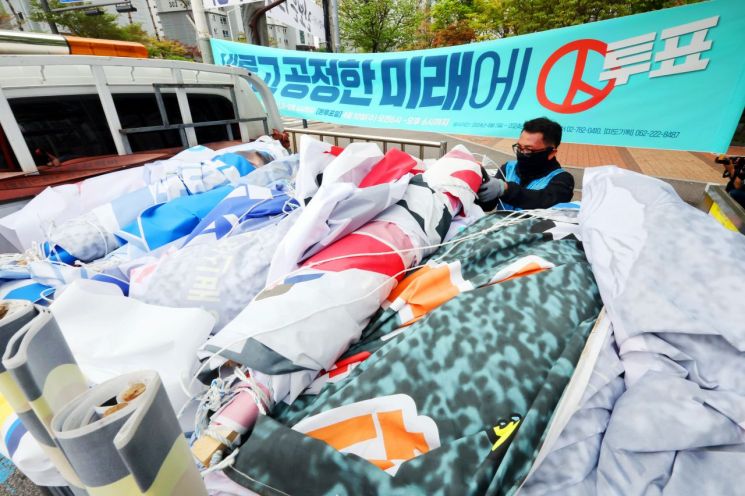 On the afternoon of the 11th, Buk-gu Office employees in Unam-dong, Buk-gu, Gwangju, were transporting election posters for the 22nd National Assembly election that had been removed from a road.
 [Photo by Yonhap News]
The political circles have continuously increased the number and size of banners. In 2005, the Public Official Election Act was amended to remove regulations on the size and material of banners that could be hung at election offices, which led to the appearance of ultra-large banners measuring 100 meters in length and 10 meters in height in this election. In 2018, the Public Official Election Act was also revised to increase the number of banners that could be posted per town, township, or neighborhood within an electoral district from one to two.
Additionally, with the enforcement of the Outdoor Advertising Act at the end of 2022, which allows unlimited installation of party banners separately from election banners, the number of banners surged. The total amount of discarded banners collected last year was 6,129.7 tons, increasing from 1,314.7 tons in the first quarter (January to March) to 1,786.2 tons in the fourth quarter (October to December) as the election approached. Complaints about party banners increased 2.2 times from 6,415 cases in the three months before the amendment to 14,197 cases in the three months after enforcement.
As complaints such as "It's difficult to walk because of the banners" arose, the ruling and opposition parties amended the law again to limit party banners to two per town, township, or neighborhood starting this January. However, due to overlapping election periods, more new banners were put up on the streets than were taken down due to regulations. The problem is that the recycling rate of election banners is less than 25%. The recycling rate of discarded banners generated from the 21st general election in 2020, the 20th presidential election in 2022, and the 8th local elections averaged only 24.6%.
This is because they are mainly made of plastic synthetic fibers, making recycling difficult. In the case of election banners, it is also difficult to repurpose them into clothing or bags because they are printed with candidates' faces or party names. They do not decompose even when landfilled, so incineration is inevitable. Burning one election banner emits 6.28 kg of carbon dioxide, which is roughly equivalent to the amount of carbon dioxide absorbed by a 20-year-old pine tree in one year. Regarding this vicious cycle, Hong Su-yeol, director of the Resource Circulation Social Economy Research Institute, said, "Election and party banners are difficult to recycle and incur processing costs even when recycled. The political circles need to agree to change promotional methods to text messages, etc."
Encouraging banner recycling projects, but effects are minimal
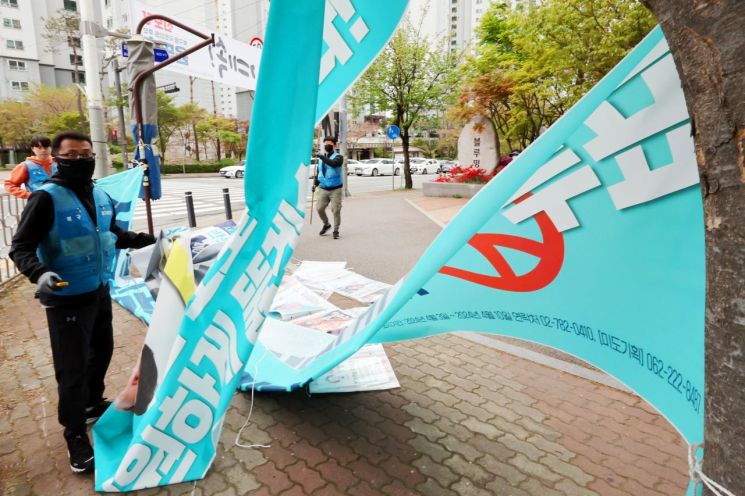 On the afternoon of the 11th, Buk-gu Office employees are removing election posters and banners for the 22nd National Assembly election on a road in Unam-dong, Buk-gu, Gwangju.
 [Photo by Yonhap News]
Although the government is encouraging local governments to carry out election banner recycling projects, the effects are minimal. On the 8th, the Ministry of the Interior and Safety and the Ministry of Environment announced that they would support the 'Discarded Banner Recycling Project' with a budget of 1.5 billion won. A Seoul city official said, "We received the official document for the project and are confirming participation intentions with 25 autonomous districts in Seoul, but no applications have been submitted yet," adding, "There seems to be little demand for products made by recycling banners, and there is also a problem with networking with recycling companies."
There are also criticisms that only habitual measures are repeated whenever problems arise. Hong Su-yeol, director of the Resource Circulation Social Economy Research Institute, said, "Unless the Ministry of Environment or the Ministry of the Interior and Safety concretely establishes recycling plans through prior consultation with recycling companies from the beginning, it may be difficult for local governments to voluntarily and individually carry out the projects," adding, "Ultimately, it is a failure of policy planning and promotion." Hong also said, "Reducing banners from the start is best, but if recycling is to be done, a collection system must be established first," and "In the case of election banners, it is necessary to assign collection and recycling responsibilities to each political party as the poster."
An official from the Ministry of Environment said, "To expand the recycling of discarded banners, we will hold a meeting with local governments and recycling companies next month," and added, "We plan to listen to the difficulties in the entire recycling process on-site and seek ways to increase the circulation use of banners."
© The Asia Business Daily(www.asiae.co.kr). All rights reserved.


















