Seungjin Hwang, Professor Emeritus at Stanford Graduate School of Business, is famous as the first Korean to become a tenured professor at Stanford University. At the late age of 29 in 1981, he went to study abroad at the University of Rochester in New York and was appointed as an assistant professor at Stanford in 1987. He obtained tenure in 1995. Professor Hwang retired in 2022 and currently serves as the Jagdeep and Roshini Singh Chair Professor Emeritus at Stanford Graduate School of Business, teaching in the Executive Education program. Last month, he published his first book, "The World of Management," sharing his 35 years of experience at Stanford. On the 15th, we met Professor Seungjin Hwang at a cafe on Sejong-daero, Jongno-gu, Seoul.
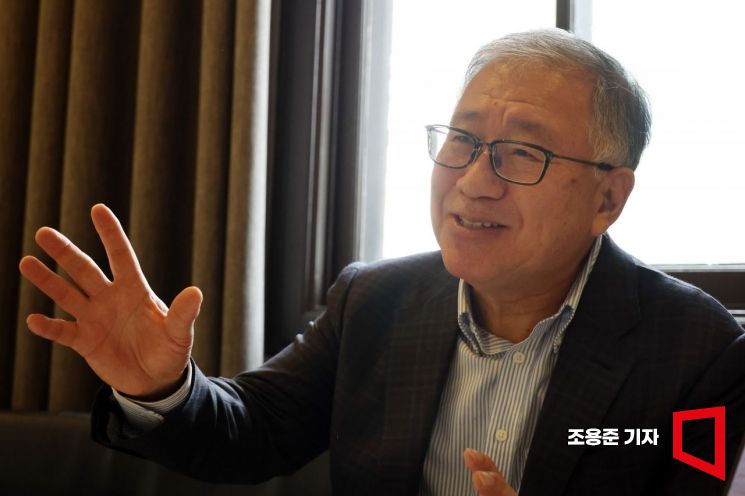 Professor Hwang Seung-jin of Stanford University is being interviewed by Asia Economy. Photo by Jo Yong-jun jun21@
- You decided to study abroad at a late age. Was there a special reason?
▲It was the private tutoring ban imposed by the new military government in 1980. When I was a freshman in college in the 1970s, my father's business failed. He had a live fish business using our house as collateral, but cholera broke out. The export route to Japan was blocked, and all the live fish died. Our house was foreclosed, and one day while I was sleeping, the auctioneers came and took all our belongings outside. My mother had never held a steady job, and I was the eldest son with four younger siblings. As a college freshman, I was the only one who could earn money. I spent more time earning money as a private tutor than studying. Even after graduating in 1974, I continued tutoring and working as an academy instructor. But when the new military government came in 1980, they banned private tutoring. After tutoring was banned, I started working in the IT department of a trust bank. Some friends had already become assistant managers or managers, and others had returned from studying abroad with PhDs. I had just started working and felt I was late. To make up for lost time, I decided to study abroad.
- Your major at Seoul National University College of Engineering was Textile Engineering, but in 1981 you chose Statistics at the University of Rochester. Why?
▲I had no attachment to Textile Engineering. Among the courses I liked in the textile department was quality control, which involved a lot of statistics. So I chose statistics. I wasn’t interested in my major at Seoul National University and was busy tutoring, so my grades were not good?about a C+. It was difficult to study abroad with such grades, but luckily a student whom Rochester University wanted to admit chose another school, so there was a vacancy. Although my grades were poor, my SAT and GRE scores were good, so I was admitted instead. At Rochester, I received A’s in all subjects. People wondered what kind of school Seoul National University was when a student who barely got C+ there got all A’s at Rochester. When writing my doctoral dissertation, my advisor was, in my view, a genius. The dissertation I wrote under him attracted much attention and helped me get an assistant professor position at Stanford. I originally thought that after finishing my studies abroad, returning to Korea to become a university professor wouldn’t be too late compared to others, but since I got a job at Stanford, I couldn’t quit. So I stayed.
- Were there any memorable students while you were teaching at Stanford?
▲I remember a student named Omid from Iran. He lost his father in middle school and immigrated to the U.S. with his family. He always sat in the front row and listened attentively in class. About 10 years later, I met him by chance at a shopping mall. When I asked how he was doing, he said he had started a startup, sold it, and was acting as interim CEO at a new company. He told me the company’s name, which I thought was unusual, and we parted ways. About five years later, while talking with other students, Omid’s name came up, and I realized the unusual company was Google. When Google went public, four billionaires emerged: co-founders Larry Page and Sergey Brin, CEO Eric Schmidt, and the fourth was Omid. Omid Kodestani. Steve Jobs’ wife, Laurene Jobs, also took my class. She took my class in her freshman year and met Steve Jobs in her sophomore year, then married him. Her grades were average, but she had a lively personality.
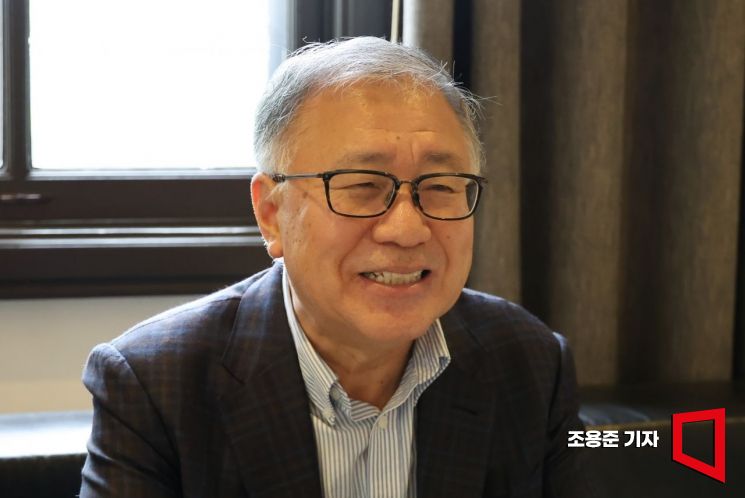 Professor Hwang Seung-jin of Stanford University is being interviewed by Asia Economy. Photo by Jo Yong-jun jun21@
- Stanford is known for actively encouraging students to start businesses. Your book mentions that you advised three Korean-American students to start a venture capital firm.
▲Venture investing doesn’t require extraordinary ability. Anyone with common sense and a bit of skill can do it. I persuaded Hyun Jae-hyun, chairman of Dongyang Group, to consider venture investing. He is a Stanford alumnus. He said he would invest funds and asked me to find people to manage the venture capital. I thought of two students, Han Kim and Brandon Kim, whom I trusted and cared for; they were always together. I contacted Han Kim, but he said he wanted to do consulting and hadn’t thought about venture investing. I told him venture investing isn’t difficult and that I would help, so he should try it. That’s how Han Kim and Brandon Kim, along with a friend named Ho Nam who had venture investing experience, started Altos Ventures.
- I understand you advised Altos Ventures when they invested in Coupang and Baedal Minjok.
▲I don’t think I gave much advice on Coupang. For Baedal Minjok, I met CEO Kim Bong-jin of Woowa Brothers and interviewed him. I felt he was dynamic and creative, possessing all the qualities needed to run a business. I thought it would be okay to invest, and Altos made the decision.
- You must have met many famous people in the IT industry while working at Stanford, but in your book, you said there were only a few?three or four?whom you would call geniuses among all the people you met in business and academia.
▲Geniuses are people with brilliant minds, but among them, some can see far and wide. When John Doerr, the legendary Silicon Valley venture capitalist (not a Stanford alumnus but a key figure who grew Kleiner Perkins into the top venture capital firm through investments in Silicon Valley companies and who made headlines in 2022 by donating a record $1.1 billion to Stanford), visited Stanford, a student asked him who he thought was the greatest leader. He named Google’s Larry Page and Amazon’s Jeff Bezos. In my view, Larry Page and Jeff Bezos are people who can see far and wide. Both Google and Amazon started from A and expanded their businesses to B, C, and D, not because Page and Bezos were geniuses, but because they hired good people around them and accepted their ideas and opinions well. In that sense, the word genius may not be appropriate for business leaders. I think a different definition is needed.
- You also wrote that Steve Jobs was neither a genius engineer, an exemplary leader, nor a strategist worthy of record.
▲I heard a story that one day Jobs spent the whole day just looking at his hands. So maybe Jobs was only concerned with how to create an exciting product that perfectly fit those hands and bring it to market. Jobs is ultimately a person explained by passion alone.
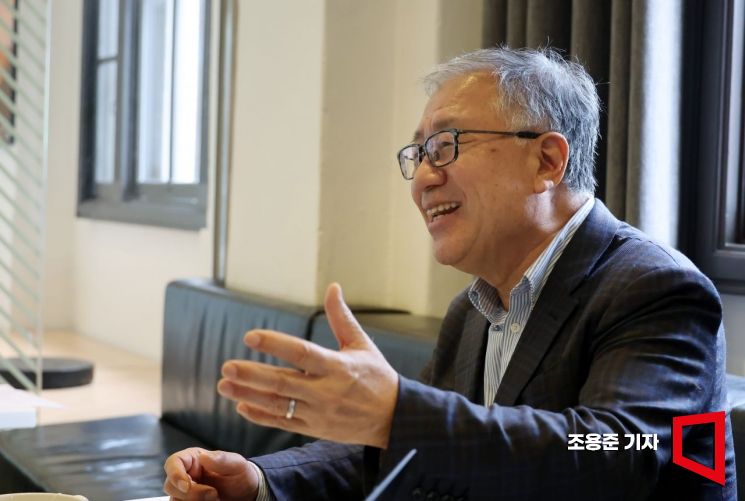 Professor Hwang Seung-jin of Stanford University is being interviewed by Asia Economy. Photo by Jo Yong-jun jun21@
- So, does this mean that a corporate leader does not necessarily have to have outstanding abilities? In your book, you emphasized that leaders should not only act as drivers but sometimes as advisors, critics, or bystanders depending on the situation.
▲Some leaders think they have to oversee everything and micromanage by telling people to try this or that. Good innovation never comes from that. Innovation doesn’t happen at the core but at the edge. People working around and on the ground can see many more opportunities for innovation. What leaders should do at the core is give many opportunities to the edge and manage the results. In conclusion, innovation development happens at the edge, and innovation management should be done at the core.
- The part about leaders sometimes needing to be bystanders stands out. It seems to emphasize the need to watch carefully amid rapid social changes and increasing uncertainty. The part in your book saying "economists are poor at predicting the future" was also impressive.
▲Whether economics or business administration, future prediction is not the domain of scholars. Scholars not only fail to predict but others don’t realize that scholars cannot predict. People tend to overestimate scholars. Actual economic forecasting is done by stock investors like Fidelity or Vanguard, but even they cannot beat the average return of the S&P 500 index. Expectations that the government can revive the economy are also unrealistic. Since prediction and control are impossible, the market should be left alone. However, the government should play a supplementary role to prevent market distortions.
- If uncertainty increases, should we expect the "bullwhip effect" you presented to also increase?
▲If uncertainty increases, the bullwhip effect should also increase. The bullwhip effect means that when demand is forecasted based on sales results, the error margin grows. Naturally, if uncertainty increases, the entire supply chain’s forecasts will fluctuate.
* The bullwhip effect is a concept mentioned in a 1997 paper by Professor Seungjin Hwang and two colleagues titled "Bullwhip Effect: Information Distortion in Supply Chains." It describes how consumer demand shows small changes, but as it moves up the chain from retailers to wholesalers to producers, the demand variability amplifies, causing problems such as increased inventory and decreased service levels due to distorted demand information.
- It seems you read a variety of books. It was impressive how you used novels by famous authors like Charles Dickens, George Orwell, and Somerset Maugham to help understand various management situations. How can literature influence management?
▲I have liked English literature since I was young and read many novels. After entering university, I read many novels in the original English. I cited all the works I read in the book. Literature doesn’t seem to have a direct impact on management.
- If you were to recommend a book you read impressively, which would it be?
▲"Guns, Germs, and Steel" by UCLA Professor Jared Diamond is truly a masterpiece. There are criticisms from historians and economists and some forced parts, but regardless, the power of knowledge it provides is tremendous. Among literary works, I like Charles Dickens and Colombian novelist Gabriel Garcia Marquez. Among Dickens’ works, I like "David Copperfield" the most. Marquez’s writing has considerable power.
© The Asia Business Daily(www.asiae.co.kr). All rights reserved.

![Clutching a Stolen Dior Bag, Saying "I Hate Being Poor but Real"... The Grotesque Con of a "Human Knockoff" [Slate]](https://cwcontent.asiae.co.kr/asiaresize/183/2026021902243444107_1771435474.jpg)

















