Joint Declaration of the Korea-US-Japan Finance Ministers Meeting on the 17th (Local Time)
The finance ministers of Korea, the United States, and Japan shared concerns regarding the sharp fluctuations in the foreign exchange markets of Korea and Japan.
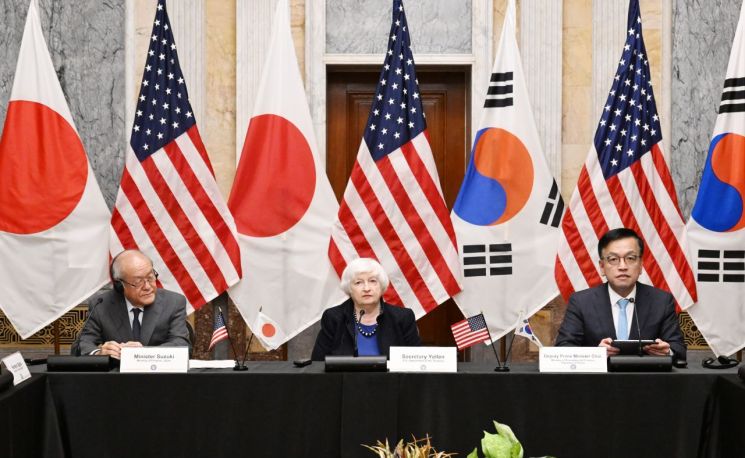 Choi Sang-mok, Deputy Prime Minister and Minister of Economy and Finance, who is visiting Washington, USA to attend the G20 Finance Ministers Meeting and the IMF·WB Spring Meetings, attended the Korea-US-Japan Finance Ministers Meeting held at the US Department of the Treasury on the 17th (local time) together with Janet Yellen, US Secretary of the Treasury, and Shunji Suzuki, Japanese Minister of Finance.
On the 17th (local time), at the Korea-U.S.-Japan Finance Ministers Meeting held in Washington D.C., the finance ministers issued a joint declaration stating that they “plan to closely consult on the development of foreign exchange markets” and “share a recognition of concerns from Japan and Korea regarding the recent sharp depreciation of the yen and the won.” Recently, the won-dollar exchange rate surpassed the 1,400 won mark for the first time in 1 year and 5 months, and the Japanese yen also recorded its lowest level in about 34 years, indicating a rapidly changing foreign exchange market between Korea and Japan. The U.S. expressed sympathy for the verbal intervention remarks made by the two countries the previous day.
The day before, the finance ministers of Korea and Japan shared concerns about the depreciation of their currencies and mentioned that appropriate measures could be taken in response to the sharp volatility in the foreign exchange markets. It is unusual for the U.S. to share concerns about exchange rate instability, such as the depreciation of a specific country’s currency.
The finance ministers of the three countries also emphasized the importance of trilateral cooperation on China’s oversupply issues. The joint declaration highlighted the importance of cooperation to overcome damages that could be caused to their economies by other countries’ non-market economic practices, such as supply chain vulnerabilities, economic coercion in key sectors, and overproduction. Although China was not explicitly named as the source of overproduction, the finance ministers shared the recognition of the importance of cooperation to overcome this issue, following Secretary Yellen’s visit to China on the 5th, during which she pointed out China’s oversupply problems.
Additionally, the joint declaration reaffirmed the leaders’ agreement on funding to respond to supply chain fragmentation, which was discussed at the trilateral summit held at Camp David in August last year. Regarding sanctions on North Korea and Russia, the countries shared their respective sanction statuses and agreed to continue cooperating by utilizing their own sanction measures in the future.
They also emphasized the importance of trilateral cooperation to respond to supply chain disruptions and economic coercion, as well as other non-market measures. The three countries stated that they will continue ongoing discussions on reforms of multilateral development banks and support for ASEAN and Pacific island countries to address global challenges.
© The Asia Business Daily(www.asiae.co.kr). All rights reserved.
![Clutching a Stolen Dior Bag, Saying "I Hate Being Poor but Real"... The Grotesque Con of a "Human Knockoff" [Slate]](https://cwcontent.asiae.co.kr/asiaresize/183/2026021902243444107_1771435474.jpg)
















