Ministry of Culture, Sports and Tourism Announces 'National Reading Status' Survey Results
Reading Volume Decreased by 0.6 Books Compared to 2021
Significant Reading Rate Gap Between Elderly and Youth... Income Also Influences
The annual reading rate among adults in our country (the proportion of people who have read at least one general book in a year) has reached an all-time low.
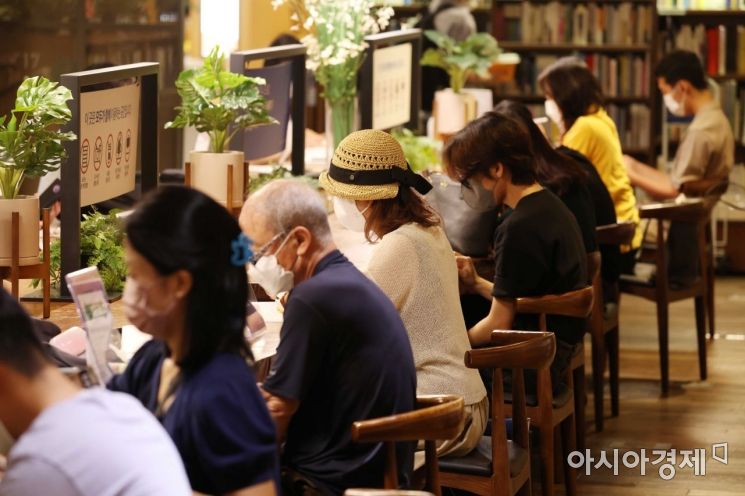 On the 6th, as the heatwave rages, citizens are cooling off at Kyobo Bookstore Gwanghwamun Branch in Jongno-gu, Seoul. Photo by Mun Ho-nam munonam@
The Ministry of Culture, Sports and Tourism announced the results of the "National Reading Status" survey conducted in October and November last year on 5,000 people aged 19 and over and 2,400 elementary, middle, and high school students on the 18th.
According to the results, the overall reading rate, including paper books, e-books, and audiobooks, is 43.0% for adults and 95.8% for students. The former decreased by 4.5 percentage points compared to 2021. The decline over the past 10 years is 29.2%. In particular, the rate for paper books dropped from 71.4% to 32.3%. The latter increased by 4.4 percentage points compared to 2021 and has maintained a rate in the 90% range since 2013 (96.8%).
The contrasting trend is also confirmed in the amount of reading (the number of general books read or listened to in a year). Adults read 3.9 books, while students read 36.0 books. The former decreased by 0.6 books compared to 2021, whereas the latter increased by 1.6 books. The average daily reading time also showed a significant difference, with adults reading for 18.5 minutes and students for 82.6 minutes.
The majority of adults cited "no time due to work (24.4%)" and "using smartphones, television, movies, games, etc. (23.4%)" as reasons for difficulty in reading books. The main reading-related activities experienced in the past year were "reading information from internet searches (77.0%)", "reading text messages (76.5%)", and "reading posts on social networking services (42.0%)". The Ministry of Culture, Sports and Tourism interpreted this as "an indication of a tendency to read short-form texts."
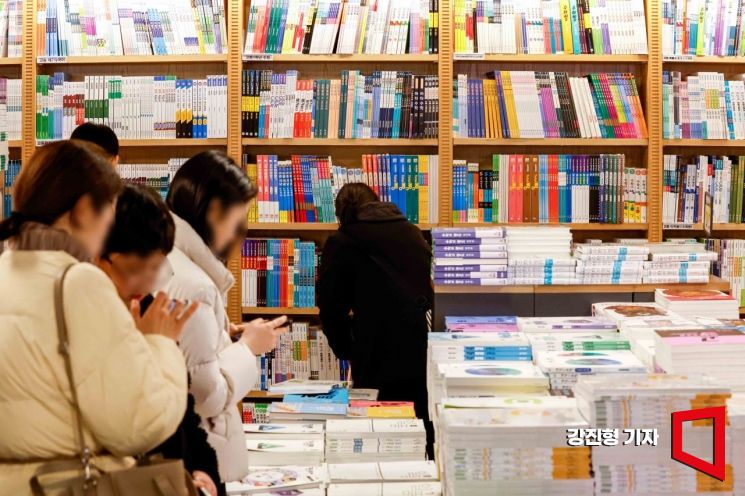 On the 27th, ahead of the new semester, students and parents visiting Kyobo Bookstore in Jongno-gu, Seoul, are looking at teacher's guides and self-study books. Photo by Jinhyung Kang aymsdream@
The Ministry is as concerned about the low adult reading rate as it is about the large reading rate gap between the elderly and youth, and between low-income and high-income groups. The reading rate for those aged 60 and over is 15.7%, sharply contrasting with 74.5% for people in their 20s. Those with a monthly average income of 2 million won or less have a reading rate of 9.8%, far below the 54.7% of those earning 5 million won or more. An official stated, "Based on the implications of the survey, we will earnestly promote policy tasks in the 4th Basic Plan for the Promotion of Reading Culture (2024?2028) to foster a culture of reading."
© The Asia Business Daily(www.asiae.co.kr). All rights reserved.


















