270 Chief Judges and Senior Judges
Leading Election Procedures on Voting Day
In the recent April 10 general election, the nationwide voter turnout reached 67% (29,654,450 voters), marking the highest rate in 32 years. Building on the experience from the 2022 presidential election, which was marred by controversies over poor management of early voting, the National Election Commission (Chairman Justice No Tae-ak) extensively revamped related procedures to completely prevent disputes over election fraud.
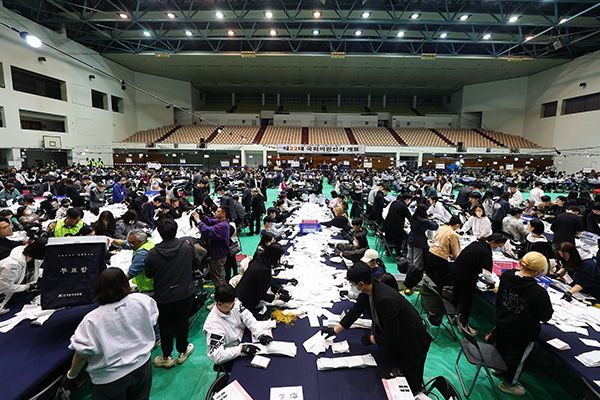
According to coverage by the Legal Times, ahead of this general election, 270 frontline court chiefs and senior judges across the country served as chairpersons of election commissions in cities, provinces, districts, and counties, working overnight on early voting days and the main voting day to lead election procedures. Generally, the chairperson of a city or provincial election commission is the chief judge of the district court, while the chairperson of a district or county election commission is the chief judge or senior judge of the branch court.
The election commission chairperson represents the commission and oversees all commission affairs, deciding on the commission’s basic policies and mid- to long-term plans. They manage the election process during the campaign period and are responsible for overall roles such as staff training and guidance.
At the vote counting sites, they also organized the “opening team” responsible for opening ballot boxes and performed final checks to ensure no issues with the voting. With early voting turnout reaching 31.28%, setting a record high for general elections, they led operations throughout the three days of early voting and the main voting day. One branch court chief who participated as an election commission chairperson said, “Because I had to oversee all operations, I stayed overnight at the site to ensure thoroughness.”
Prior to the election, the National Election Commission significantly upgraded the vote counting management system. To quell controversies over machines and communication equipment used in the voting and counting process, such as ballot sorting machines, they added manual ballot verification procedures. Additionally, serial numbers on early voting ballots were printed as one-dimensional barcodes instead of QR codes. The locations where early and postal ballot boxes were stored were continuously monitored via closed-circuit television (CCTV). In previous elections, ballots from COVID-19 quarantined voters were stored in paper boxes or plastic bags rather than ballot boxes and later transferred, and some voters were given ballots marked for specific candidates, leading to disputes over election fraud.
Despite thorough preparations, before the counting was completed in this election, Hwang Kyo-ahn, former Minister of Justice and former leader of the People Power Party’s predecessor, the United Future Party, claimed on Facebook that “strange ballot boxes were found at various counting centers nationwide, including Incheon Gyeyang, Seodaemun, and Jongno.”
Park Su-yeon, Han Su-hyun, Legal Times reporters
※This article is based on content supplied by Law Times.
© The Asia Business Daily(www.asiae.co.kr). All rights reserved.

















