Policy Success Depends on Resident Acceptance
"Regretful That It Is Later Than Overseas" Criticism
The government's decision to expedite the environmental impact assessment and shorten the land compensation period in order to halve the construction deadline for the Yongin semiconductor cluster factory site reflects a sense of urgency that construction must not be delayed beyond 2026. This indicates a determination to complete the national industrial complex development process as quickly as possible amid the accelerating semiconductor factory construction efforts by the United States, Japan, and others.
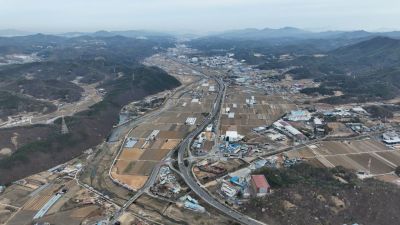
Previously, the government had already begun efforts to reduce related procedures, including exempting the semiconductor cluster from preliminary feasibility studies. However, there are voices pointing out that administrative procedures for facility construction and completion lag behind major competitors such as the U.S., Japan, Europe, and even India, and that further easing of administrative procedures alone may be insufficient.
Policy Speed Accelerated
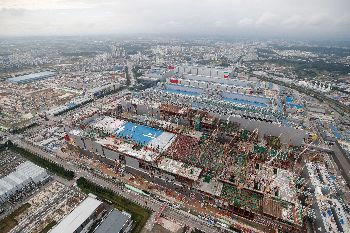 Samsung Electronics Pyeongtaek Campus viewed from the air on September 27 last year. [Aerial shooting cooperation=Seoul Metropolitan Police Agency Aviation Unit, Pilots: Lieutenant Shin Seung-ho - Lieutenant Park Ji-hwan, Crew: Lieutenant Park Sang-jin] Photo by Kang Jin-hyung aymsdream@
Industry experts and professionals have positively evaluated the policy to reduce administrative procedures for national industrial complex construction from 7 years to 3 years and 6 months.
Although power supply measures were not included, lifting the Pyeongtaek Songsan water source protection zone to increase water supply was seen as a significant help for Samsung Semiconductor operations. Since there are now additional water sources nearby besides Paldang Dam, even if securing water from Paldang Dam becomes problematic, alternatives are available.
Kim Yangpaeng, a senior researcher at the Korea Institute for Industrial Economics and Trade, said, "There are many regulations regarding procurement volume, storage volume, and water quality protection when drawing water from protected water source areas, so the government's and local governments' efforts to ease these restrictions are positive."
The Key Is Local Governments' Persuasion of Residents
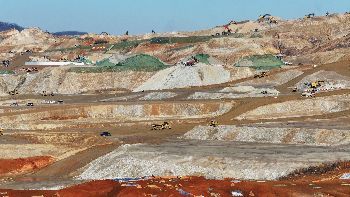 The site of the Yongin Semiconductor Cluster in Wonsam-myeon, Cheoin-gu, Yongin-si, Gyeonggi-do.
 [Photo by Yonhap News]
The industry emphasized that properly resolving resident acceptance issues is crucial to enhancing policy effectiveness. Samsung Electronics has already faced resident opposition during the installation of power transmission towers for the Pyeongtaek factory. In the case of SK Hynix's Yongin factory, construction was delayed multiple times due to land compensation issues and delays in local government permits.
The government, aware of this, stated it would actively engage in resident consultations specifically for the Yongin cluster. Notably, the Ministry of Land, Infrastructure and Transport is conducting land pre-surveys and resident consultations from the compensation plan establishment stage.
An industry insider evaluated, "It is meaningful that the agreement includes Gyeonggi Province, Yongin City, and Pyeongtaek City, and that the government and local governments have expressed a strong commitment to actively participate in resident compensation efforts."
Regret Over Being Behind Overseas
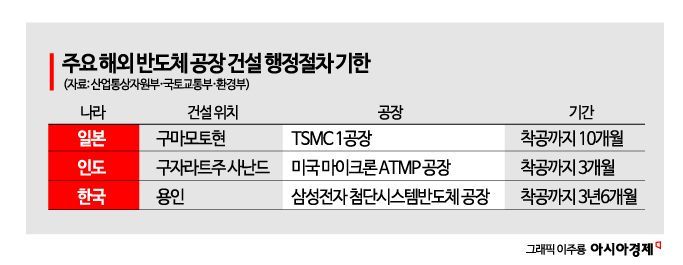
Industry and experts still regret that policy support is slower compared to major countries. A representative example is Japan's Kumamoto Prefecture TSMC Plant 1, which completed construction in 22 months (1 year and 10 months), down from the previous 5 years. India approved the construction of the U.S. Micron semiconductor assembly, test, and marketing (ATMP) plant in Sanand, Gujarat, in June last year and began construction in September of the same year, completing administrative procedures in just 3 months.
However, some argue that directly comparing the Yongin cluster to Japan's TSMC Plant 1 or India's Micron plant is unreasonable due to the larger scale of the Yongin cluster.
An industry official said, "Even if the central government takes the lead, each local government has different calculations, so it is difficult and cumbersome to proceed with industrial complexes and factories as originally planned. Seeing the rapid progress in the U.S. and Japan makes us both envious and regretful." He added, "While it may be burdensome for the central government to dictate terms to local governments, if they make more active efforts to secure local government cooperation like in other countries, progress could be faster."
Senior researcher Kim Yangpaeng said, "Even India, known for slow permit processes, manages to start foreign company factory construction within 3 months, so Samsung's factory only becoming operational in 2030 cannot be considered fast. Although the timing is already late, the government and local governments must actively engage in resident consultations from now on."
© The Asia Business Daily(www.asiae.co.kr). All rights reserved.



















