Seoul Metropolitan Council 'Low Birthrate Countermeasure Housing Policy Forum'
Need to Improve Eligibility for Newlywed and Newborn Rental Housing
"Increase Supply of New Rental Housing to Address Low Birthrate"
There have been calls to relax income criteria for supplying rental housing to newlywed couples and households with newborns in order to address the low birthrate issue.
At the ‘Housing Policy Forum for Low Birthrate Measures’ held by the Seoul Metropolitan Council on the 17th, Nam Won-seok, Senior Research Fellow at the Seoul Institute, said, "Considering income equity among income groups, relaxing the income criteria should be prioritized over abolishing them, and it is necessary to ease the income standards for 2- and 3-person households to cover 50-75% of the target groups."
The income criterion for general supply of Seoul’s long-term jeonse rental housing (exclusive area 60-85㎡) is 110% of the average monthly income of urban workers for 2-person households. To cover 50-75% of newlywed couples or households with newborns, the income standard needs to be relaxed to 120-170% of the average monthly income of urban workers.
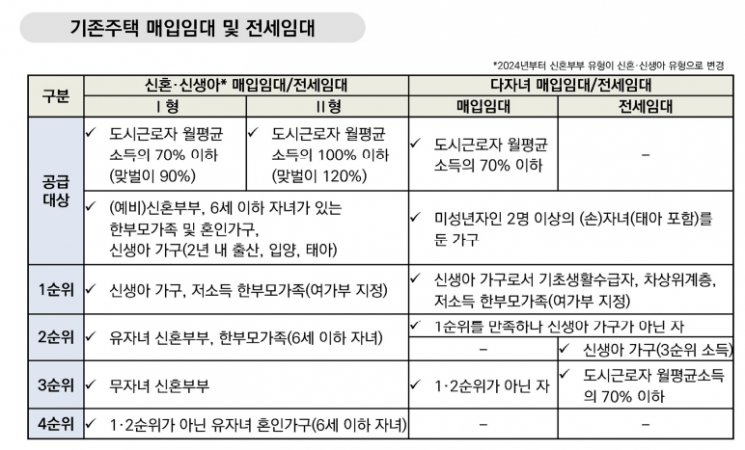
Researcher Nam also pointed out that the rental housing supply policy should move away from focusing solely on expanding total supply and instead increase new rental housing supply aimed at responding to the low birthrate. His argument is that rather than allocating part of the existing rental housing supply to newlywed couples and others amid high competition rates, the total volume of new supply should be increased.
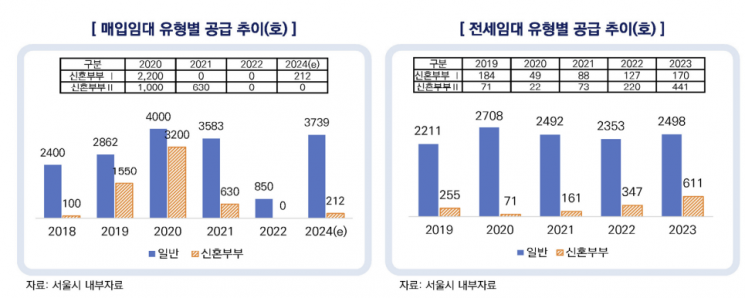
Supply of purchase rental and jeonse rental housing specialized for newlywed couples or multi-child households is sluggish. Seoul supplied zero purchase rental housing units to newlywed couples in 2022, while jeonse rental housing units were 347 in 2022 and 611 last year.
Researcher Nam said, "It is necessary to actively increase the new supply volume of rental housing aimed at responding to the low birthrate, improve eligibility and supply types, and also consider combining this with the discretionary power of project operators. The annual average resupply volume of public rental housing is 12,400 units, and legal amendments are needed to allow this volume to be converted into integrated public rental housing, etc., for supply."
In the case of long-term jeonse rental housing, within 50% of the priority supply volume, the market and project operators can select priority recipients through separate standards and procedures. For purchase rental housing, project operators can also select tenants separately within 30% of the supply volume in consultation with the Minister of Land, Infrastructure and Transport, considering regional characteristics and tenant demand.
Meanwhile, at the forum, opinions were also presented that support for jeonse deposits or housing purchase loans preferred by newlywed couples or child-rearing households should be strengthened to expand housing options. Professor Kwon Oh-jung of Konkuk University suggested, "Research and review are needed to provide birth encouragement housing support policies not only for rental households but also for young households seeking to acquire homeownership."
© The Asia Business Daily(www.asiae.co.kr). All rights reserved.



















