Ministry of Industry, Environment, and Land Collaborate for Win-Win Agreement
Measures Including Lifting Songtan Water Source Protection Zone
Pre-Construction Phase Reduced from 7 Years to 3 Years 6 Months
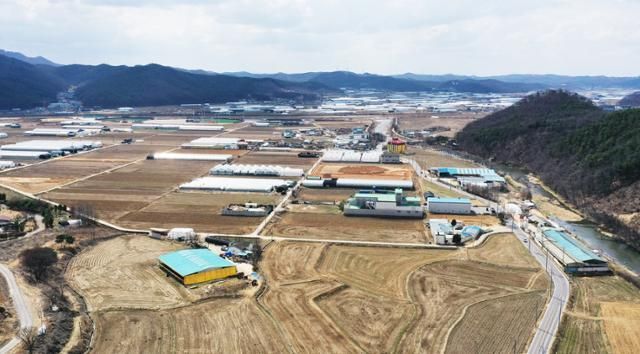 The area around Namsa-eup, Yongin, Gyeonggi, where a system semiconductor complex will be established. Photo by Yonhap News
The government has decided to significantly shorten the development period of the Yongin Semiconductor Industrial Complex site, aiming to operate the factory by the end of 2030, from 7 years to 3 years and 6 months. They plan to fast-track the environmental impact assessment and advance the land compensation period.
The Ministry of Trade, Industry and Energy, Ministry of Land, Infrastructure and Transport, Ministry of Environment, Gyeonggi Province, Yongin City, Pyeongtaek City, Korea Land and Housing Corporation (LH), and Samsung Electronics signed a win-win cooperation agreement on the 17th at the FKI Tower in Seoul to successfully promote the establishment of the Yongin Advanced System Semiconductor National Industrial Complex (Yongin National Industrial Complex).
This agreement includes cooperation plans among related ministries and local governments to swiftly advance the Yongin National Industrial Complex, which was announced for development last year. To ensure smooth semiconductor factory settlement, the plan includes lifting the Songtan water source protection zone in Pyeongtaek on the condition of securing an alternative water source and supplying water timely to the industrial complex and nearby areas.
Previously, the government integrated and commissioned feasibility studies, industrial complex planning, and detailed design services in July last year, and exempted the feasibility study in November of the same year. Through this agreement, the government plans to expedite the start of construction by fast-tracking the environmental impact assessment with prior consulting and fast-track operation, and to shorten the land compensation period by conducting preliminary surveys and resident consultations from the planning stage.
Generally, it takes more than 7 years from announcing a candidate site to starting site development for an industrial complex, but the government has prepared additional measures aiming to start construction in 2026.
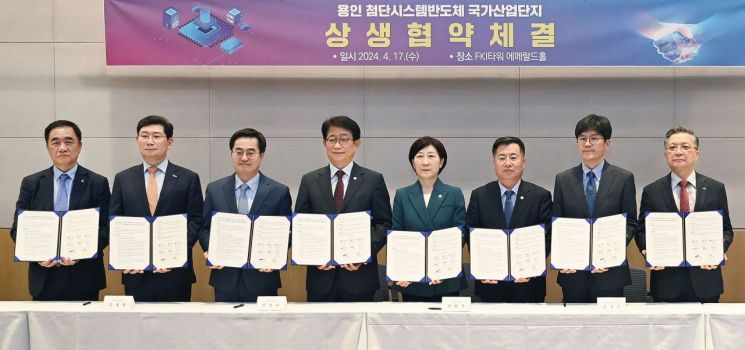 On the morning of the 17th, at the Emerald Hall of FKI Tower in Yeongdeungpo-gu, Seoul, Park Sang-woo, Minister of Land, Infrastructure and Transport, Han Hwa-jin, Minister of Environment, Kang Kyung-sung, 1st Vice Minister of Trade, Industry and Energy, Kim Dong-yeon, Governor of Gyeonggi Province, Lee Sang-il, Mayor of Yongin, Jeong Jang-seon, Mayor of Pyeongtaek, and Lee Han-jun, President of Korea Land and Housing Corporation, attended the "Win-Win Agreement Signing Ceremony for the Successful Promotion of the Yongin Advanced System Semiconductor National Industrial Complex" and took a commemorative photo. Photo by Ministry of Trade, Industry and Energy
The win-win cooperation agreement is also related to the global competition among major countries to attract semiconductor companies. The United States is providing 52.7 billion won (about 73 trillion won) over 5 years to domestic and foreign semiconductor companies under the CHIPS and Science Act (CSA). The U.S. Department of Commerce recently announced it will provide Samsung Electronics with a total of 6.4 billion dollars (about 9 trillion won) in subsidies. Samsung Electronics is currently investing 17 billion dollars (about 24 trillion won) to build a semiconductor manufacturing plant in Taylor, Texas. China, Japan, and Europe are also competing for semiconductor supremacy.
After signing the win-win cooperation agreement, LH, the project implementer, plans to immediately apply to the Ministry of Land, Infrastructure and Transport for industrial complex plan approval. The government plans to reduce the period from site development to construction start by more than half, from the existing 7 years to 3 years and 6 months, aiming for the first factory operation in 2030.
Kang Kyung-sung, First Vice Minister of the Ministry of Trade, Industry and Energy, said, "We will do our best to establish the ‘Semiconductor Mega Cluster,’ which will see an investment of 622 trillion won centered on Yongin National Industrial Complex, Yongin General Industrial Complex, and Pyeongtaek Godeok Industrial Complex, as a global hub for the semiconductor industry beyond Korea."
Park Sang-woo, Minister of Land, Infrastructure and Transport, stated, "We will make it a successful new national industrial complex model that contributes to the development of the semiconductor industry and strengthening national competitiveness by securing sufficient infrastructure and residential conditions," and Han Hwa-jin, Minister of Environment, said, "We will establish a detailed water supply plan and execute it with a sense of urgency."
© The Asia Business Daily(www.asiae.co.kr). All rights reserved.


















