"Recent Data Fails to Confirm Inflation Progress"
Seems to Shift Stance to Three Rate Cuts Within the Year
Jerome Powell, Chairman of the U.S. Federal Reserve (Fed), indicated that the timing of interest rate cuts would be delayed due to inflation being stronger than expected. Recently, the Consumer Price Index (CPI) exceeded expectations for three consecutive months, prompting a shift toward a more hawkish (monetary tightening preference) stance. The market is now considering the possibility that there may be no rate cuts within the year, and the next step could even be a rate hike. Immediately following Powell's remarks, the yield on the 2-year U.S. Treasury note, which is sensitive to monetary policy, briefly surpassed 5% during the trading session.
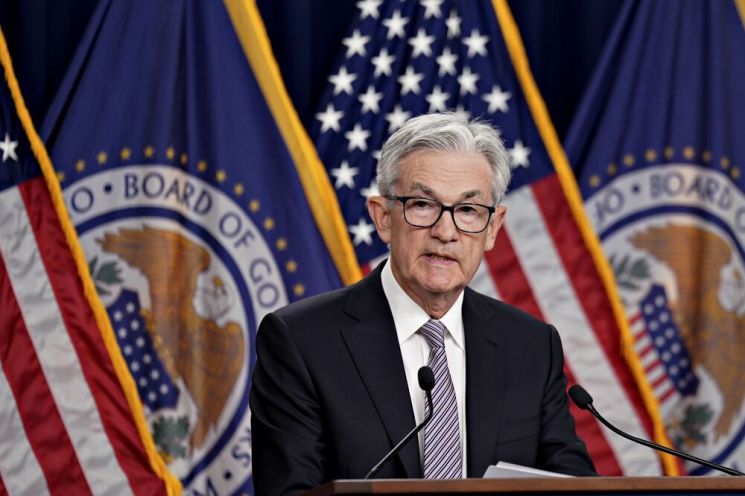
On the 16th (local time), Powell stated at the Washington Forum on the Canadian economy held in Washington D.C., "Recent data has not clearly provided greater confidence that inflation is making progress toward the Fed's goal."
He explained, "Instead, it suggests that achieving such confidence may take longer than expected," adding, "Given the current strength of the labor market and the inflation progress so far, it is appropriate to allow restrictive policies time to take effect."
Powell said that if price pressures persist, the Fed can keep rates "as long as necessary," and that "we believe we are in a good policy position to respond to the risks we face." However, he added that if the economy slows sharply, the Fed is prepared to lower rates.
These remarks were Powell's first public comments following the March CPI release. The core CPI increase for March, released on the 10th, rose 3.8% year-over-year, exceeding market expectations (3.7%) for the third consecutive month. Additionally, March retail sales, announced the previous day, increased by 0.7% month-over-month, surpassing the market forecast (0.4%). With a robust labor market supporting consumption and the risk of inflation becoming entrenched growing, the Fed signaled a shift from a previously dovish (monetary easing preference) to a more hawkish stance.
Earlier, on the 7th of last month, Powell testified before the U.S. Senate Banking Committee, stating, "It would be appropriate to reverse the current restrictive level of rates to avoid a recession when we have more confidence that inflation is sustainably declining to 2%," and added, "We are not far from that point." The minutes of the March Federal Open Market Committee (FOMC) meeting, released recently, also mentioned the possibility that inflation temporarily rose in January and February due to seasonal factors. The Fed had maintained a forecast of three rate cuts within the year at last month's FOMC. However, Powell's remarks on this day are interpreted as a withdrawal of the previous stance of three rate cuts within the year.
In particular, the Fed is most concerned about the scenario where rates are lowered prematurely, causing inflation to rise again and forcing rates to be raised once more. Previously, in the 1970s, the Fed raised and lowered rates repeatedly, fueling inflation, and in the 1980s, it raised rates up to 20%.
Cash Boshchansky, Chief Economist at Nationwide Mutual Insurance, said, "The Fed's confidence has wavered," and evaluated, "Powell confirmed and emphasized that the market is already pricing in economic indicators."
Following Powell's remarks, U.S. Treasury yields rose. The 2-year Treasury yield, sensitive to monetary policy, briefly surpassed the 5% mark immediately after Powell's comments and is currently at 4.98%, up 4 basis points (1bp = 0.01 percentage points) from the previous day. The 10-year Treasury yield, a global bond yield benchmark, is moving around 4.66%, up 4 basis points.
The market's expectations for the timing of rate cuts have also been pushed back. According to The Wall Street Journal (WSJ), Wall Street has mostly withdrawn its expectations for rate cuts in June, and now anticipates only one to two rate cuts this year. According to the Chicago Mercantile Exchange (CME) FedWatch tool, the federal funds futures market on this day reflects about a 44% chance that the Fed will cut rates by 0.25 percentage points or more at the July FOMC meeting. This is a sharp drop from about 49% the day before and 74% a week ago.
The market is even discussing a "no landing" scenario, where the U.S. economy continues to grow without a downturn, and there is growing speculation that the Fed might raise rates again.
UBS Group AG, the day before, viewed that strong growth and persistent inflation increase the likelihood of the Fed raising rates. While the base scenario expects two rate cuts, if inflation does not fall to the central bank's 2% target, the Fed is expected to shift toward rate hikes. Jonathan Pingel, UBS strategist, said, "If the economic expansion remains resilient and inflation stays above 2.5%, there is a real risk that the Fed will resume rate hikes early next year," adding, "Rates could rise to 6.5% (from the current 5.25-5.5%) by mid-next year."
Mohamed El-Erian, advisor to Allianz Group and former CEO of the world's largest bond manager PIMCO, also mentioned the possibility of Fed rate hikes on this day. He warned, "The risk of the Fed raising rates is low, but the possibility is not zero," adding, "If inflation worsens significantly, rates could be raised, which would cause all kinds of shocks to the regional banking crisis and the market."
© The Asia Business Daily(www.asiae.co.kr). All rights reserved.
![Clutching a Stolen Dior Bag, Saying "I Hate Being Poor but Real"... The Grotesque Con of a "Human Knockoff" [Slate]](https://cwcontent.asiae.co.kr/asiaresize/183/2026021902243444107_1771435474.jpg)
















