Ban on Scalping Using Macros Enforced
Loopholes Still Widespread to Evade Law
"Scalping Essential for Highly Competitive Singer Concerts"
Recently, Mr. Lee (30), an office worker in his 30s, purchased a direct link address from a scalper for 5,000 won to get tickets for a male idol group's concert. He was tempted by the claim that clicking the direct link would take him straight to the seat selection screen without pressing the reservation button. Thanks to a program that reduced waiting time, he was able to secure tickets. Mr. Lee said, "Using scalpers has become not a choice but a necessity for concerts of highly competitive singers."
Although an amendment to the Performance Act banning scalping using macros has been in effect since last month, loopholes to evade the law are still rampant. Scalpers active on social networking services (SNS) are making unfair profits ranging from a few thousand won to hundreds of thousands of won by proxy ticketing or transferring tickets to buyers' IDs.
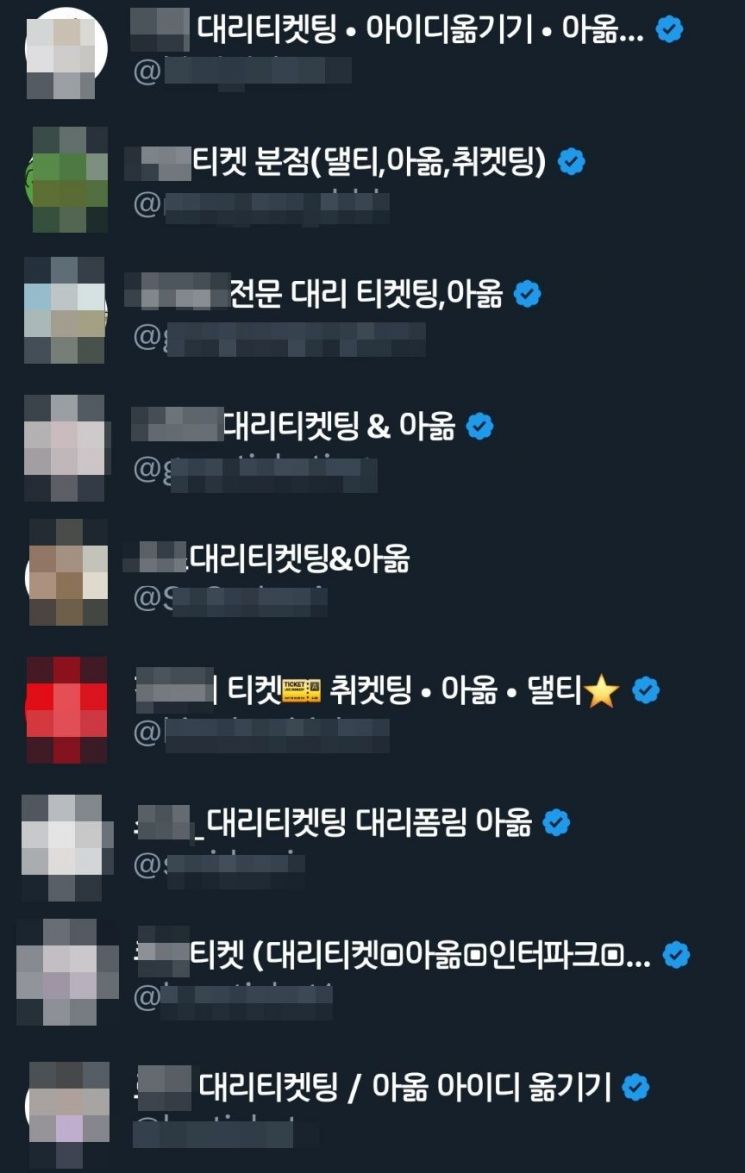 On the 16th, when searching for proxy ticketing and ID transfers on SNS, the accounts of scalpers were exposed. [Photo by X Capture]
Deceiving Agencies through 'Aom (ID Transfer)'... Risk of Losing Advance Payments
On the 16th, searching for ticket reservation tricks on SNS X (formerly Twitter) revealed hundreds of scalper accounts. They posted cases of customers who successfully got tickets using their tricks to promote their expertise.
Since the amendment to the Performance Act, effective from the 22nd of last month, punishing illegal ticket sales via macros, such methods have become even more rampant. Violators face up to one year imprisonment or fines up to 10 million won, so tricks to get tickets without macros have become widespread.
In particular, the so-called 'Aom' or ID transfer method is gaining popularity. 'Aom' involves purchasing tickets with a third party's ID, canceling, and then rebooking with the buyer's ID to evade agencies' verification of personal information matching between ticket holders and buyers. They wait for cancellation tickets to be released on reservation sites and use macro programs to snatch tickets with the buyer's ID.
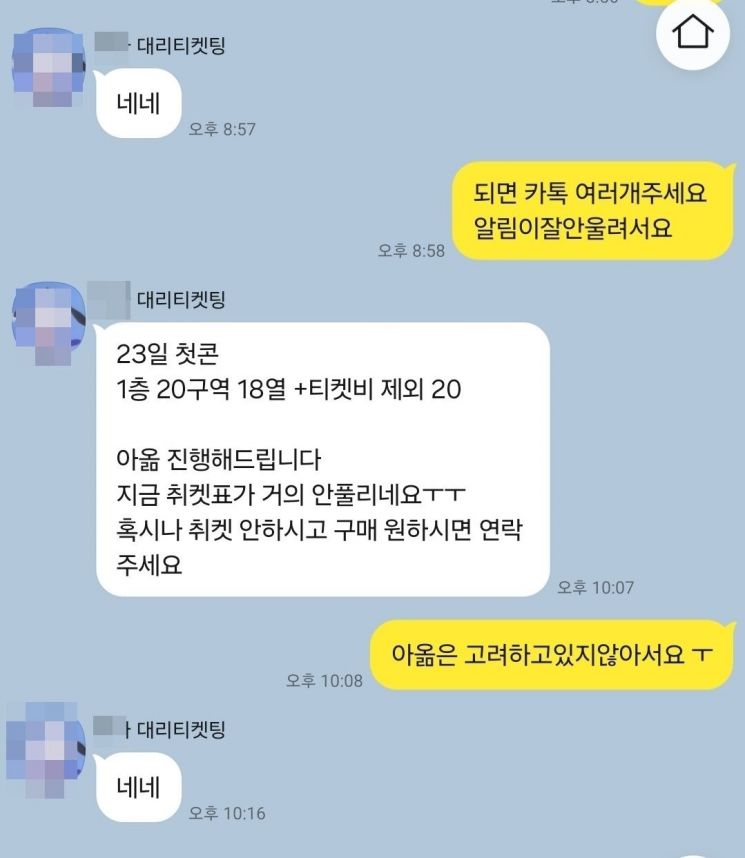 Ticket buyer Mr. A was negotiating the price with a proxy ticketing agent last September to obtain a concert ticket for a singer.
 [Photo by Reader Provided]
Buyers either entrust ID transfer to sellers or hire specialized 'Aom' agencies themselves, paying a service fee. When using specialized agencies, the service fee for transferring tickets ranges from 20,000 won to over 100,000 won. To get tickets for popular singers' concerts, buyers pay the face value plus a premium of hundreds of thousands of won and additional service fees.
The problem is that if the ID transfer fails, advance payments may not be refunded. If sellers set non-refundable conditions, buyers cannot recover the premium price paid in advance even if the ID transfer fails.
Mr. Choi (22), who recently sought an 'Aom' agency to attend a singer's concert, said, "The agency failed the ID transfer and lost the ticket, but I couldn't get back the 200,000 won premium I paid in advance." He added, "Considering the premium price for 'Aom,' spending 500,000 won for one concert is easy, but I've lost money without getting tickets many times, which is very disappointing."
Scalpers Enrich Themselves through 'Daelti' and 'Jikring'... Limitations of the Performance Act Amendment
Besides 'Aom,' scalpers also profit by accepting 'Daelti' (proxy ticketing) requests or selling programs like 'Jikring' (direct link) and 'automatic call' that shorten reservation times.
Proxy ticketing agents charge service fees ranging from 10,000 to 20,000 won up to hundreds of thousands of won depending on the popularity of the performance. They accept requests indiscriminately from trot singers' concerts to e-sports leagues and various festivals.
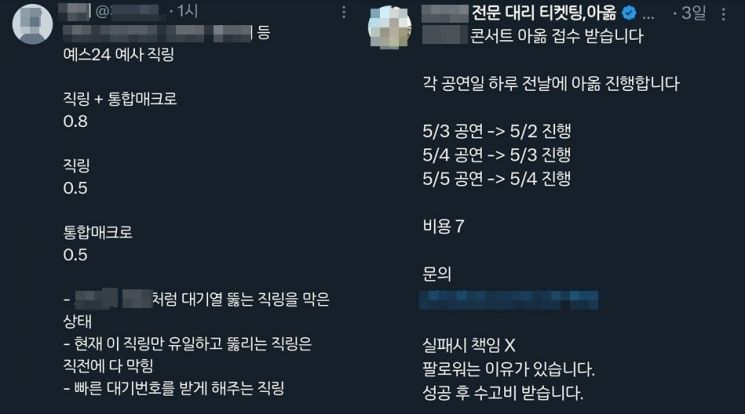 On the 16th, posts from vendors selling direct links and macro programs or accepting requests to transfer IDs were exposed on social media.
 [Photo by X Capture]
Programs like Jikring and automatic call that reduce buyers' waiting times are sold for around 5,000 won. Exploiting the fact that buyers use multiple methods to get tickets, some scalpers operate systematically by simultaneously accepting proxy ticketing, ID transfer, and program purchase requests.
The performance industry points out that the amended Performance Act alone is insufficient to control scalpers' tricks. The current law only specifies punishment for using macro programs to trade scalped tickets online, leaving methods like 'Aom' and 'Jikring' in a regulatory blind spot.
A representative from the Korea Music Label Industry Association said, "The amended Performance Act cannot take any action unless macro use is proven," emphasizing, "There should be alternatives to report and punish online scalping regardless of macro use."
© The Asia Business Daily(www.asiae.co.kr). All rights reserved.



















