16th Press Briefing at BOK Annex
"US Fed Can Do It as a Global Central Bank"
"Regret Can't Raise Rates Further," Jokingly Said
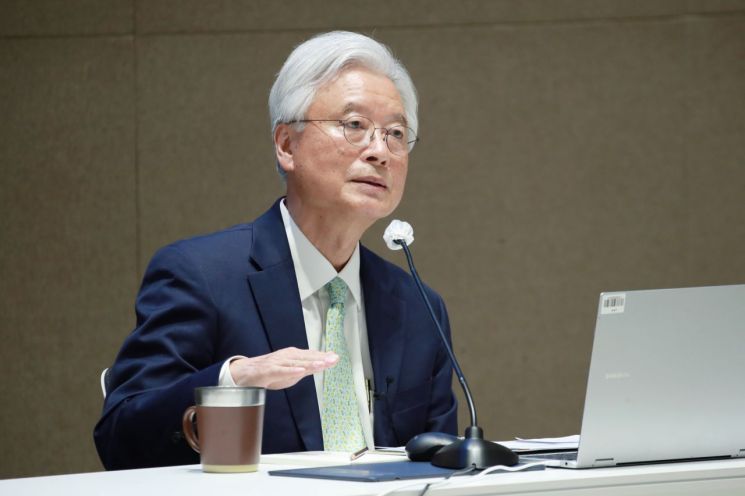
Cho Yoon-je, a member of the Monetary Policy Committee at the Bank of Korea, expressed a negative stance on the extension of forward guidance during a press conference held on the 16th ahead of his retirement.
At the press conference held at the Bank of Korea annex in Jung-gu, Seoul, Cho said in response to a question about extending the forward guidance horizon, "(Unlike the United States) we believe there are limitations to proactively providing forward guidance over a long horizon."
Forward guidance is a monetary policy communication tool through which a central bank signals the future direction of monetary policy based on its assessment of upcoming economic conditions. A representative example is the "dot plot" used by the U.S. Federal Reserve (Fed), where individual Fed members anonymously vote on what they consider appropriate future interest rates, and the results are displayed. Since Lee Chang-yong took office as governor, the Bank of Korea has been experimenting with a "Korean-style dot plot" by presenting the distribution of Monetary Policy Committee members' policy rate forecasts for the next three months starting in October 2022. Recently, discussions have been ongoing about extending this horizon to six months or one year, and the Bank of Korea has also initiated research projects on this matter.
However, opinions among Monetary Policy Committee members are divided regarding the extension of forward guidance. Governor Lee has been providing interest rate forecasts beyond six months since this year, emphasizing that these are his personal views, effectively implementing extended forward guidance. Seo Young-kyung, who is also retiring on the same date as Cho, supported this at a press conference held on the 26th of last month, stating that it "helps manage economic agents' expectations."
Nevertheless, Cho pointed out differences between the U.S., a key currency country, and South Korea, expressing a negative view on extending the horizon. He explained the limitations by saying, "The U.S. can lead monetary policy proactively as it plays the role of the world's central bank, but our monetary policy is influenced by many variables." He added, "When uncertainty is high, providing forward guidance can damage the central bank's credibility in the long term, so it should be done cautiously considering various environmental factors."
When asked about the base interest rate decision, he joked again, "It's a pity that we can't raise (the rate) anymore." Prior to last week's monetary policy meeting, he had said in front of reporters, "Shall we raise (the rate) sharply?" Although said jokingly, this was a pointed joke from Cho, who is usually classified as a hawk (favoring monetary tightening).
Cho added, "Personally, I don't think there is a need to rush rate cuts," explaining, "There are various uncertainties such as potential growth rate, and the financial market has maintained an accommodative trend over the past few months." He emphasized, "It is important to have 'confidence' that inflation will stabilize at the target level," and said, "In broad terms, average consumer inflation could be around 2.3% in the second half of the year or lower by year-end, so I do not rule out the possibility of rate cuts in the second half, but it is not yet the stage to talk about rushing rate cuts."
Regarding the recent sharp rise in the won-dollar exchange rate, which touched the 1,400 won level, he said, "I think the main cause is the strength of the dollar," and evaluated, "South Korea's economy is gradually improving with a current account surplus, and the overall economic fundamentals such as foreign exchange reserves are not bad, so I do not think the exchange rate fluctuations are at a level to be greatly concerned about."
On the impact of the interest rate differential between Korea and the U.S. on the exchange rate, Cho assessed, "The exchange rate changes were influenced more by other factors than by the interest rate differential." The exchange rate reflects a comprehensive risk including the won's valuation, future growth rate, and various financial stability risks. Since the interest rate differential remained unchanged over the past few months while the exchange rate changed, it is interpreted that other factors had a greater influence.
When asked about the potential impact on South Korea's economy if the Trump administration were to return for a second term in the U.S., he said, "There would not be much difference between a second Trump term and the Biden administration's economic policies," and evaluated, "As a former ambassador to the U.S., I don't think a new era has particularly opened." Cho served as ambassador to the U.S. during Trump's presidency.
On this day, Cho reflected on his four years as a Monetary Policy Committee member, expressing regret by saying, "I felt that every staff member at the Bank of Korea is excellent and very diligent," and added, "I felt that if such people move outside, it would greatly benefit our economy."
© The Asia Business Daily(www.asiae.co.kr). All rights reserved.

















