Global Economic Growth Rate Revised Upward by 0.1%P
The International Monetary Fund (IMF) raised its global economic growth forecast for this year by 0.1 percentage points but kept South Korea's economic growth forecast unchanged at 2.3%.
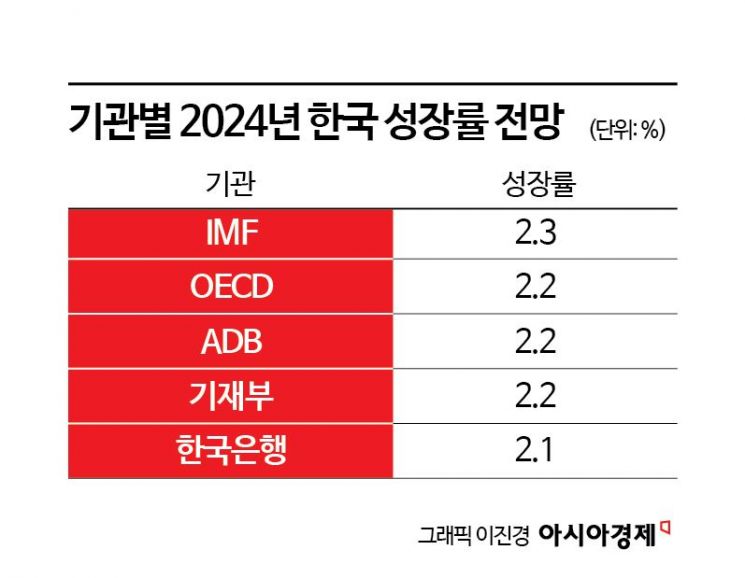
According to the Ministry of Economy and Finance on the 17th, the IMF presented South Korea's economic growth rate for this year as 2.3% in its April World Economic Outlook (WEO). This figure is the same as the forecast announced in January. The IMF releases a global economic outlook for all member countries every April and October, and updates for the top 30 major countries in January and July. The IMF's forecast is slightly higher than the 2.2% suggested by the government and the OECD, and the 2.1% forecast by the Bank of Korea. The IMF predicted that global inflation would decline and consumption would support a gradual recovery phase for the world economy. However, there was no specific mention regarding the maintenance of South Korea's growth rate.
The IMF projected the global economic growth rate for this year at 3.2%, up 0.1 percentage points from its January forecast. It anticipated a solid recovery in the global economy due to falling inflation and robust private consumption. In particular, it raised the U.S. growth rate forecast by 0.6 percentage points from the previous 2.1% to 2.7%. This reflects last year's unexpectedly strong growth, suggesting a higher growth rate than previously forecasted.
There were market expectations that the IMF might also raise South Korea's growth forecast once more. This was because, amid the robust U.S. economy, South Korea's key export item, semiconductors, had continued to increase year-on-year since October last year. The IMF had already raised South Korea's economic growth forecast for this year by 0.1 percentage points from 2.2% to 2.3% in January. A Ministry of Economy and Finance official analyzed, "The IMF's upward revision of the global economic growth forecast seems largely influenced by the expansion of the U.S. domestic service sector. However, unlike goods, services are not easily traded internationally, so the impact of the U.S. on South Korea and the global economy is not very large."
The IMF downgraded the Eurozone (20 countries using the euro) growth forecast from 0.9% to 0.8%, and the UK growth forecast from 0.6% to 0.5%. It judged that the growth rates of European countries such as Germany and France were lowered due to deteriorating consumer sentiment. Japan's forecast was maintained at 0.9%, and China's at 4.6%. For Japan, it diagnosed that growth would slow as temporary factors such as a surge in foreign tourists, which had driven growth, normalize. China’s main factor for economic slowdown was seen as weakness in the real estate market.
In addition to this year's growth rate, the IMF assessed that upward and downward risks are balanced. It cautioned against hasty monetary policy easing and recommended easing monetary policy at an appropriate time according to each country's inflation situation. Furthermore, it advised expanding fiscal capacity and pursuing medium- to long-term productivity improvements to prepare for future risks.
© The Asia Business Daily(www.asiae.co.kr). All rights reserved.
![Clutching a Stolen Dior Bag, Saying "I Hate Being Poor but Real"... The Grotesque Con of a "Human Knockoff" [Slate]](https://cwcontent.asiae.co.kr/asiaresize/183/2026021902243444107_1771435474.jpg)
















