US March Retail Sales Surprise Increase
Bond Yields Surge Amid Inflation Entrenchment Concerns
Rate Cut Outlook Retreats as No-Landing Scenario Spreads
Last month, U.S. retail sales unexpectedly increased, raising the prospect of a 'no landing' scenario in which the U.S. economy continues its growth without a downturn. A robust labor market is supporting consumption, fueling concerns that high inflation and high interest rates may persist for an extended period. As a result, the yield on the 10-year U.S. Treasury note surged to its highest level in five months. Market expectations now include the possibility of no rate cuts this year and even forecasts that the Federal Reserve (Fed) may resume raising rates next year.
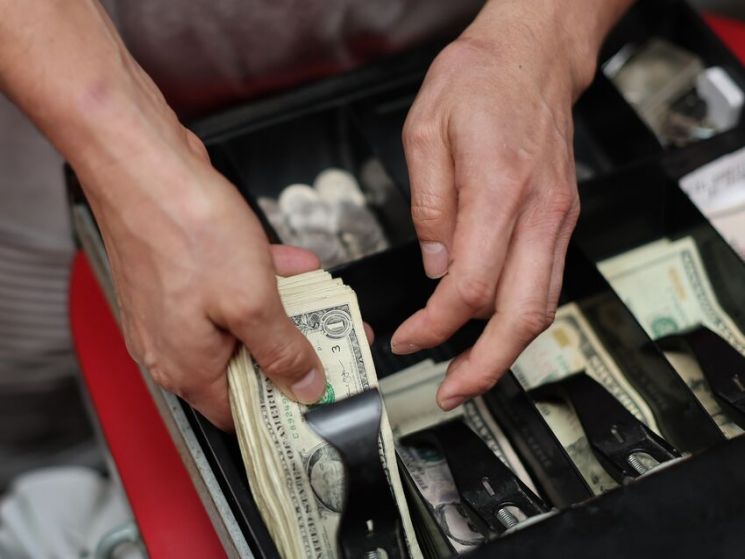
According to the U.S. Department of Commerce on the 15th (local time), retail sales in March rose by 0.7% compared to the previous month. This increase far exceeded market expectations of 0.4%. Retail sales excluding automobiles and gasoline increased by 1%, also surpassing the expert forecast of 0.3%.
Out of 13 retail categories, 8 showed growth. E-commerce consumption rose by 2.7%, gas station sales increased by 2.1%, while automobile sales declined by 0.7%.
The retail sales indicator is considered a key gauge of the overall economic trend, as it accounts for two-thirds of the U.S. real economy. The larger-than-expected increase in consumption last month raises the risk of entrenched high inflation. This has strengthened expectations that the Fed will be more cautious about cutting interest rates, causing bond yields to spike. The 10-year U.S. Treasury yield, a global benchmark for bond rates, rose 11 basis points (1bp = 0.01 percentage points) from the previous trading day to around 4.61%, marking the highest level in five months since mid-November last year. The 2-year Treasury yield, which is sensitive to monetary policy, increased by 4 basis points to 4.92%.
Andrew Hunter, Deputy U.S. Economist at Capital Economics, analyzed, "The recent revival in job growth and the continued resilience of consumption are further reasons to doubt that the Fed will start cutting rates anytime soon."
As the no landing outlook for the U.S. economy spreads, forecasts are emerging that there will be no rate cuts this year.
Thorsten Slok, Economist at Apollo Global Management, predicted, "Given that the economy is continuing to reaccelerate, the Fed will not cut rates in 2024." John Stoltzfus, Chief Investment Strategist at Oppenheimer Asset Management, said, "Our view is that the Fed will maintain a 'pause' rather than keep rates higher for longer until inflation comes down."
Some even observe increasing pressure for rate hikes. UBS Group AG sees a higher probability of Fed rate hikes due to strong U.S. economic growth and persistent inflation. While the base scenario anticipates two rate cuts, if inflation does not fall to the Fed’s 2% target, the Fed may switch to raising rates, potentially triggering a sell-off in bonds and stocks.
Jonathan Pingel, UBS strategist, stated, "If the economic expansion remains resilient and inflation stays above 2.5%, there is a real risk that the Fed will resume rate hikes early next year," adding, "Rates could rise to 6.5% by mid-next year from the current 5.25?5.5%."
Former U.S. Treasury Secretary Larry Summers recently said, "The Fed’s next move is more likely to be a rate hike than a cut," estimating the probability of a rate hike at 15?25%. Jamie Dimon, chairman of JP Morgan and known as the 'Wall Street Emperor,' also warned that rates could surge above 8%.
Following the unexpected rise in U.S. consumption and the sharp increase in Treasury yields, New York stock markets all fell on the day. The Dow Jones Industrial Average dropped 0.65%, while the S&P 500 and Nasdaq indices fell 1.2% and 1.79%, respectively.
© The Asia Business Daily(www.asiae.co.kr). All rights reserved.
![Clutching a Stolen Dior Bag, Saying "I Hate Being Poor but Real"... The Grotesque Con of a "Human Knockoff" [Slate]](https://cwcontent.asiae.co.kr/asiaresize/183/2026021902243444107_1771435474.jpg)
















