In the first quarter of this year, global smartphone shipments increased, while iPhone shipments sharply declined by about 10% compared to a year ago. The poor sales performance in China had a significant impact.
According to market research firm IDC on the 15th (local time), iPhone shipments from January to March this year totaled 50.1 million units. This represents a 9.6% decrease compared to the first quarter of last year. It also fell short of the market's average estimate (51.7 million units) compiled by Bloomberg News. IDC explained that the decline in iPhone shipments in the first quarter was the steepest since the supply chain was paralyzed by COVID-19 in 2022.
Given that global smartphone shipments increased during the same period, this is considered a significant blow to Apple. The total global smartphone shipments in the first quarter of this year reached 289.4 million units, marking a 7.8% growth compared to the first quarter of last year.
The main reason for the decline in iPhone shipments is attributed to poor sales in China due to intensified competition with local manufacturers.
According to market research firm Counterpoint, iPhone sales in China dropped by 24% during the first six weeks of this year compared to the same period last year. During the first quarter, Chinese manufacturers such as Xiaomi (14.1%), Transsion (9.9%), and Oppo (8.7%) ranked third to fifth in global smartphone market share, following Samsung Electronics (20.8%) and Apple (17.3%). During this period, shipments of Xiaomi and Transsion surged by 33.8% and 85%, respectively. Huawei is threatening the iPhone with its popular new smartphone, the Mate 60 Pro, released in August last year.
There is also analysis suggesting that last year’s Chinese government ban on the use of foreign devices in workplaces added pressure on iPhone sales.
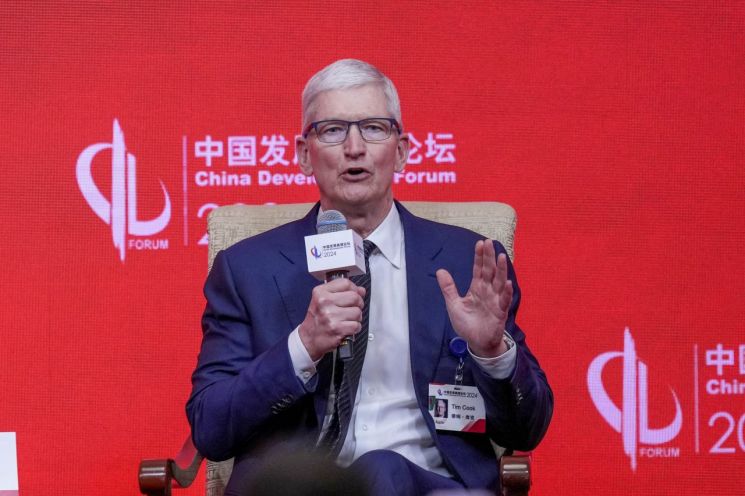
Apple CEO Tim Cook reiterated Apple's commitment to the Chinese market during his visit to China last month. Cook said, "I am very confident about China. I love China, and I love the people and culture," adding, "Every time I come here, I am reminded that anything is possible here."
Meanwhile, amid US-China tensions, Apple is increasing production in Vietnam and India to reduce its dependence on China in the supply chain.
On the 15th, Cook visited Vietnam and announced plans to expand local investment. According to Bloomberg, Apple has spent about 400 trillion Vietnamese dong (22 trillion KRW) on its supply chain in Vietnam since 2019, with annual spending in Vietnam more than doubling during this period. Additionally, Apple opened an online Apple Store in Vietnam last May and launched key services, actively targeting the Vietnamese market.
On the same day, Apple’s stock price closed down 2% compared to the previous trading day on the New York Stock Exchange.
© The Asia Business Daily(www.asiae.co.kr). All rights reserved.
![Clutching a Stolen Dior Bag, Saying "I Hate Being Poor but Real"... The Grotesque Con of a "Human Knockoff" [Slate]](https://cwcontent.asiae.co.kr/asiaresize/183/2026021902243444107_1771435474.jpg)
















