Samsung Increases Investment in Texas Semiconductor Plant to 62 Trillion Won
The U.S. government announced that it has decided to provide Samsung Electronics with a subsidy of $6.4 billion (approximately 8.9 trillion KRW) to build a semiconductor factory in the United States. This semiconductor subsidy from the U.S. government is the third largest, following Intel and TSMC.
According to local foreign media on the 15th (local time), U.S. Secretary of Commerce Gina Raimondo stated in a briefing the day before that $6.4 billion in subsidies will be provided to support Samsung Electronics' investment in an advanced semiconductor factory in Texas.
In response, Samsung Electronics will expand the scale and investment targets of the semiconductor factory currently under construction in Taylor, Texas, with an investment of $17 billion (approximately 23.5 trillion KRW). The company plans to invest a total of about $45 billion (approximately 62.3 trillion KRW) by 2030. This is more than double the previous scale of investment.
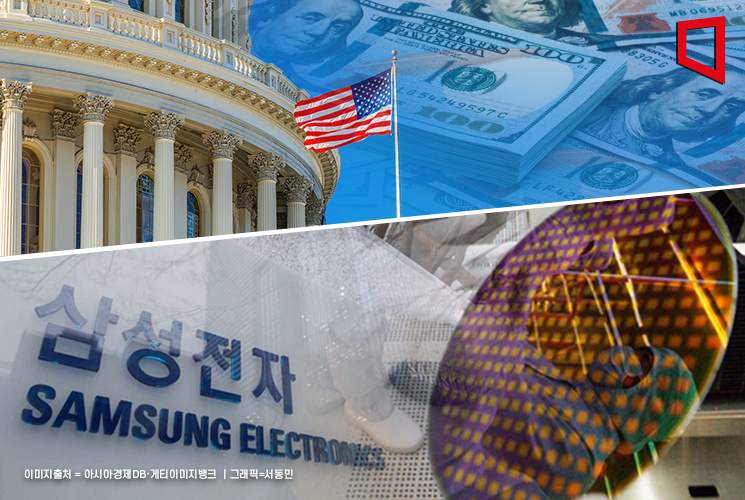
Since 2022, Samsung Electronics has been constructing a semiconductor production factory in Taylor, Texas, and plans to build an additional new semiconductor factory along with packaging facilities and advanced research and development (R&D) facilities to actively target the U.S. market.
Samsung Electronics' first Texas Taylor factory is scheduled to produce 4-nanometer (nm; 1 nm is one billionth of a meter) and 2-nanometer semiconductors starting in 2026. The second factory will begin mass production of advanced semiconductors in 2027, and the R&D fab is also expected to open in 2027.
The semiconductor subsidy provided by the U.S. government to Samsung Electronics is the third largest, following U.S. semiconductor company Intel ($8.5 billion, 11.8 trillion KRW) and Taiwanese company TSMC ($6.6 billion, 9.1 trillion KRW).
This support from the U.S. government to semiconductor companies is part of an economic and security strategy to bring the supply chain of advanced semiconductors domestically. The U.S. aims to produce 20% of the world's most advanced semiconductors domestically by 2030 through bold investments in advanced semiconductors.
The Biden administration has continued large-scale investments to secure supply chain flexibility and counter China. In particular, it legislated the CHIPS Act to attract capital investments from domestic and foreign semiconductor manufacturers.
On the 20th of last month, the U.S. government announced a support package worth $19.5 billion for Intel, including $8.5 billion in subsidies and $11 billion in loans. Then, on the 8th, it revealed a support package totaling $11.6 billion for Taiwan's TSMC, including $6.6 billion in subsidies.
A senior U.S. government official emphasized, "Samsung will conduct core research and development in the U.S. and continue developing future semiconductor technologies in Texas," adding, "This investment will create at least 17,000 construction jobs, and including the supply chain, tens of thousands of jobs will be generated."
© The Asia Business Daily(www.asiae.co.kr). All rights reserved.

















