Stage X to Register 4th Mobile Carrier on May 4
Assemblyman Byeon Jae-il Holds Discussion Forum on Qualifications and Requirements
As the fourth mobile carrier 'StageX' prepares for its full-scale launch, experts have argued that it must secure at least 1 trillion KRW in capital, considering the stagnant market situation, the number of base stations required for 5G service, and marketing costs.
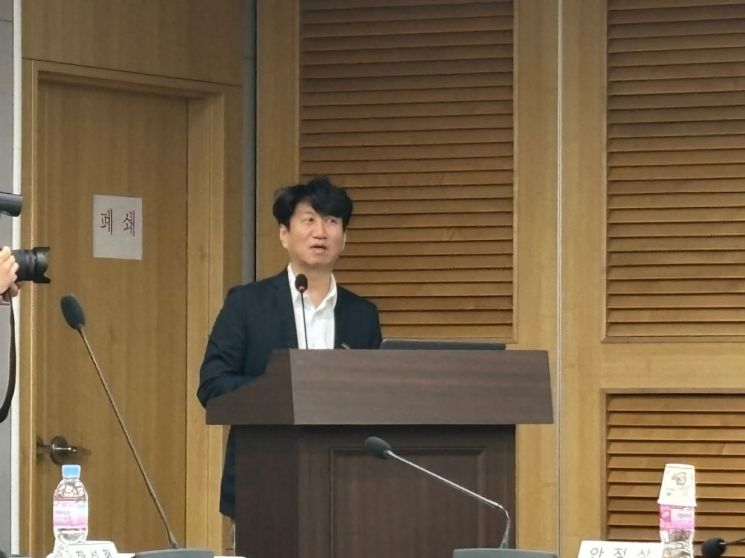 On the morning of the 15th, Professor Jeong Hoon of the Accounting Department at Cheongju University is presenting at the discussion forum on "Qualifications and Requirements for New 28 GHz Business Operators" hosted by Congressman Byun Jae-il of the Democratic Party of Korea. Photo by Hwang Seoyul chestnut@
On the morning of the 15th, Rep. Byeon Jae-il of the Democratic Party of Korea held an expert forum titled ‘Qualifications and Requirements for New 28 GHz Operators’ at the National Assembly Members’ Office Building Seminar Room 2. At the forum, Professor Jung Hoon of the Accounting Department at Cheongju University, who presented the keynote speech, stated, "Since StageX is entering the market as a Mobile Network Operator (MNO) rather than a Mobile Virtual Network Operator (MVNO), it requires at least 1 trillion KRW in capital."
Professor Jung assessed that out of the 400 billion KRW in capital StageX claimed to have secured, excluding paid-in capital increases and Series A investments, the actual confirmed establishment capital is about 100 billion KRW. StageX plans to invest 612.8 billion KRW in infrastructure development.
Professor Jung said, "Compared to LG Telecom’s market entry, more base stations are needed to provide 5G service over the same area," adding, "In a stagnant growth market, a latecomer must spend more on marketing than existing operators to attract users." LG Telecom, which entered the market as the third mobile carrier, invested 2.43 trillion KRW in capital expenditures (CAPEX) and 1.53 trillion KRW in marketing from 1996 to 2001.
In July, the Ministry of Science and ICT announced support measures for new entrants through the ‘Telecommunications Market Competition Promotion Plan,’ including ▲reducing the first-year total frequency allocation fee payment from 25% to 10%, ▲providing up to 400 billion KRW in policy financing, and ▲mandatory network sharing by the three existing carriers in areas without network infrastructure. Subsequently, a call for new entrants for the 5G 28 GHz frequency band was announced for one month starting last November, and on January 31, StageX won the final frequency through an auction. If StageX pays 10% (43 billion KRW) of the allocation fee by February 4, it will officially register as a telecommunications carrier and begin building the 28 GHz communication service.
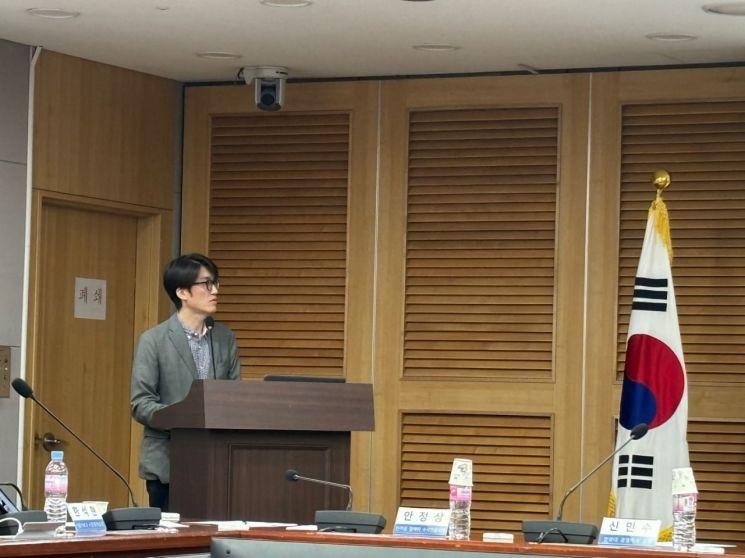 On the morning of the 15th, Han Seok-hyun, Director of the YMCA Citizen Relay Office, is expressing his opinion at the discussion forum on "Qualifications and Requirements for New 28 GHz Business Operators" hosted by Byun Jae-il, a member of the Democratic Party of Korea. Photo by Hwang Seo-yul chestnut@
At the forum, Han Seok-hyun, Director of the YMCA Citizen Monitoring Office, pointed out, "If StageX plans to commercialize next year, it should already be marketing the direction of its rate plans, differences from existing carriers and MVNOs, and ways to save on fees to establish itself in the market." He added, "It is important for market establishment to show consumers differentiated features, such as offering cheaper rate plans or significantly more data for the same price, and whether these can go hand in hand with subscriber acquisition." StageX has announced plans to secure 3 million subscribers within three years after service commercialization next year and achieve 1 trillion KRW in sales by 2028. However, specific business models or details of the rate plans to be launched have not been disclosed.
Han said, "The current mobile telecommunications market has long been a red ocean, and since subscriber poaching is necessary, it is also necessary to verify whether these figures are reasonable."
There were also opinions that conditions should be attached to the benefits the government provides to the fourth carrier, as public funds are involved. Ahn Jeong-sang, Senior Specialist at the Democratic Party Policy Committee, said, "If the annual frequency allocation fee payments are not fulfilled, support for roaming, equipment provision, policy financing, and tax credit benefits should be suspended, and early recovery of allocated frequencies should be possible." He added, "Major shareholders should be prohibited from selling shares for a certain period to dispel concerns about 'quick profit-taking'."
Ahn also argued that roaming should be conditionally allowed. He said, "The roaming system, which supports lowering market entry barriers, allows new operators to use existing operators’ networks temporarily until they build nationwide networks. From the new operator’s perspective, using roaming is cost-effective, so there is an incentive to delay network investment and use roaming for as long as possible."
© The Asia Business Daily(www.asiae.co.kr). All rights reserved.
![Clutching a Stolen Dior Bag, Saying "I Hate Being Poor but Real"... The Grotesque Con of a "Human Knockoff" [Slate]](https://cwcontent.asiae.co.kr/asiaresize/183/2026021902243444107_1771435474.jpg)

















