Concerns Over Loss of Value-Up Momentum Amid 'Yeosoyaedae' Despite Expected Strong Performance in Automobile Stocks
Amid concerns that the value-up program may lose momentum following the election results that led to a female-minority National Assembly, attention is focused on whether the automobile sector, classified under the low price-to-book ratio (PBR) theme, can maintain its upward trend. The securities industry analyzes that the ongoing earnings momentum could turn any correction caused by the value-up program's potential failure into a buying opportunity.
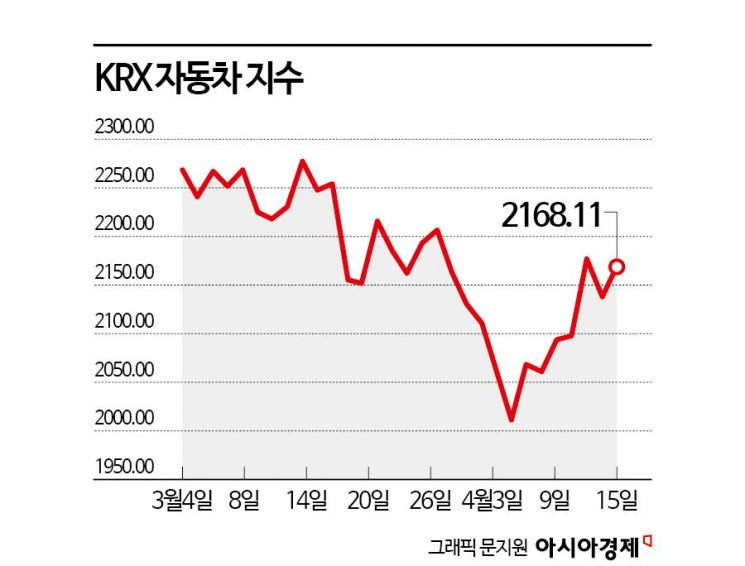
According to the Korea Exchange on the 16th, the KRX automobile index, composed of finished car manufacturers such as Hyundai Motor and Kia as well as parts companies, rose 3.63% last week during the general election, marking the highest increase among KRX indices. During the same period, the KOSPI index fell 1.19%, showing a generally weak market, contrasting with other value-up themes such as KRX Insurance (-6.62%), KRX Banks (-4.09%), and KRX Securities (-3.77%), all of which declined.
Automobile stocks recorded a sharp rise earlier this year due to expectations of benefits from the value-up program, driven by simultaneous net buying from foreigners and institutions. However, influenced by election uncertainties and rotation among low PBR stocks, Hyundai Motor and Kia fell by 15.46% and 20.72%, respectively, from their peaks last month to early this month.
In the securities industry, with the election uncertainty factor related to value-up stocks now concluded, there is an opinion that some stocks that experienced excessive declines should be reanalyzed. Experts believe that although the value-up issue that led the automobile sector's rise has subsided ahead of the upcoming full earnings season, interest should be maintained as solid earnings are expected.
Shin Seung-jin, a researcher at Samsung Securities, highlighted that foreign buying is concentrated in automobiles and semiconductors. He said, "Over the past two weeks this month, foreigners net bought 3.3 trillion KRW in the KOSPI, with net purchases of 3.6 trillion KRW focused solely on the big two automobile companies (Hyundai Motor and Kia) and the big two semiconductor companies (Samsung Electronics and SK Hynix)." He added, "Foreigners are selectively buying large-cap stocks with earnings and valuation appeal. A strategy of compressing the portfolio around stocks with solid earnings momentum will be effective." He also noted, "The recent sluggishness in electric vehicle sales is being offset by the hybrid craze, which is a positive factor."
In the securities industry, target prices for Hyundai Motor, a representative finished car stock, are being raised one after another in anticipation of strong first-quarter earnings. Yoo Min-ki, a researcher at Sangsangin Securities, said, "An increase in sales of mid-sized hybrid models and a mix improvement through the expansion of Genesis's share are expected," adding, "Many positive factors related to profitability, such as raw material cost reductions and exchange rates, will be reflected." He continued, "Compared to global competitors, Hyundai Motor has a profitable electric vehicle (EV) platform and, unlike the North American Big Three (General Motors, Ford, Stellantis), is relatively free from short-term burdens such as compliance with the United Auto Workers (UAW) agreement. Although no additional shareholder return policies have been announced this year, the aforementioned advantages will contribute to maintaining and expanding shareholder return policies in the future," he analyzed.
Kia is also expected to achieve profitability improvements and benefit from exchange rate effects in its first-quarter earnings. Choi Tae-yong, a researcher at DS Investment & Securities, said, "Strong sales of hybrids (HEV) domestically and battery electric vehicles (BEV) in the U.S. are expected," adding, "The first-quarter exchange rate closed at 1,328 KRW, 4.1 percentage points higher than 1,275 KRW in the same period last year, which is positive." He continued, "As BEV market share continues to rise in the U.S., overseas hybrid sales are also expected to show solid profits through strategic concretization. Furthermore, at the recent CEO Investor Day (CID), the policy to repurchase 50 billion KRW worth of treasury shares and cancel 50% over the next five years was reconfirmed, enhancing valuation appeal due to a strong shareholder return policy," he added.
© The Asia Business Daily(www.asiae.co.kr). All rights reserved.

















