Payment of purchase amount by card with card company securitizing accounts receivable
Poor performance and high debt companies, alternative financing options
Companies with heavy debt burdens or difficulties in raising funds, such as Lotte Construction, Hanwha Impact, and Hyosung Chemical, are managing liquidity by utilizing corporate purchase-only cards. A purchase-only card refers to an agreement between a company and a credit card company to pay for raw materials and goods purchases by card. It reduces immediate cash outflows and alleviates working capital burdens, making it a useful alternative financing method.
According to the investment banking (IB) industry on the 16th, Lotte Construction signed a purchase-only card agreement worth 80 billion KRW with its affiliated card company, Lotte Card. Lotte Card pays the purchase amount on behalf of Lotte Construction, and Lotte Construction issued asset-backed securities (a type of securitized bond) using the accounts receivable from Lotte Card as the underlying asset (a form of collateral). Lotte Construction purchases goods on credit and repays the accounts payable on the card payment date, using these funds to repay the principal and interest of the asset-backed securities. Bookook Securities acted as the lead manager for the issuance of the asset-backed securities.
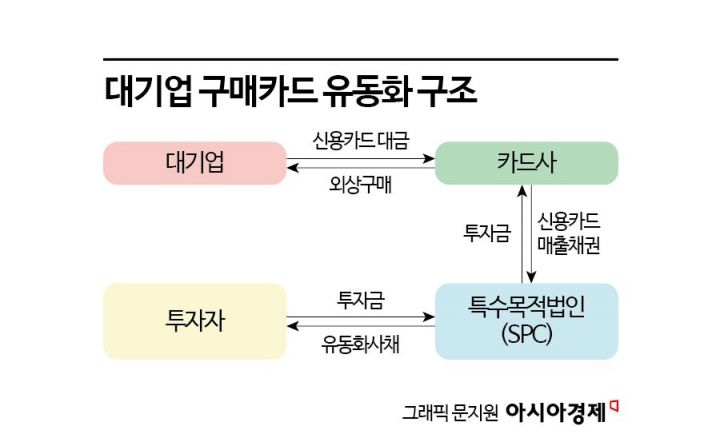
Hanwha Impact recently signed a purchase-only card agreement worth 109.5 billion KRW with Hyundai Card. Hyundai Card simultaneously issued asset-backed securities of the same amount using the card payments receivable from Hanwha Impact as the underlying asset. DB Financial Investment served as the lead manager for the issuance. Hanwha Impact will pay the card amount to a special purpose company (SPC) in July, three months later, and these funds will be used to repay the asset-backed securities.
Hyosung Chemical and LG Chem have also managed funds several times using purchase-only cards. SK Hynix, which has struggled to secure cash liquidity due to prolonged accumulated losses, paid as much as 360 billion KRW in purchase amounts via purchase-only cards last year. SK Energy and SK Incheon Petrochemicals previously paid fuel taxes using purchase-only cards but recently switched to managing liquidity by securitizing checks from Suhyup Bank.
An IB industry official said, "Purchase-only cards allow companies to defer payment dates, reducing cash outflows, so they function as a kind of financing." He added, "Companies with poor cash flow or heavy debt burdens use them as one of the tools for managing working capital." The increase in accounts receivable securitization using corporate purchase-only cards indicates that more companies are facing high debt repayment burdens or difficulties in raising external funds.
Lotte Construction's cash flow has deteriorated due to concerns over project financing (PF) contingent liabilities, rising construction costs, and soaring interest expenses. In this situation, external financing such as bond issuance or new loans is difficult. Although a fund worth 2.3 trillion KRW involving Lotte affiliates and major banks has been formed to somewhat alleviate the PF crisis, market sentiment has not improved, making financing still challenging.
Hanwha Impact is also facing increased financial burdens due to the poor performance of its main affiliate Hanwha Total and rising debt. Its consolidated EBITDA has dropped to one-tenth of last year's level, and short-term borrowings that must be repaid or refinanced within the year amount to 460 billion KRW. Additionally, it must invest several hundred billion KRW annually in equity acquisitions of affiliates and plant facilities.
Hyosung Chemical had net borrowings of about 2.4 trillion KRW at the end of last year, while its equity capital was only 61.9 billion KRW. Its debt ratio is close to 5000%, making it difficult to raise funds through bond issuance or loans. Although it recently attempted to issue corporate bonds with mid-7% interest rates, there is high uncertainty about securing sufficient investor demand in the market.
An IB industry official said, "Initially, card companies' accounts receivable securitization using corporate purchase-only cards was used as an alternative to promissory note payments, but recently, large companies with poor cash flow and heavy debt burdens tend to use it as a liquidity management tool." The official added, "While using purchase cards reduces immediate financial burdens, it increases short-term borrowings that must be repaid in three or six months. If these accumulate continuously, the company's liquidity risk could increase."
© The Asia Business Daily(www.asiae.co.kr). All rights reserved.

















