Drone Airstrike Notified to US 72 Hours in Advance
"To Confirm Middle East Hegemony Status"
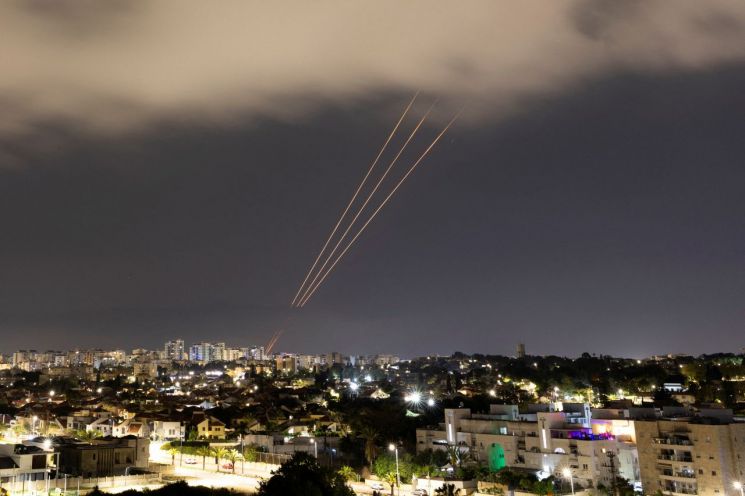 On the 13th (local time), an Israeli air defense missile was launched to shoot down an Iranian drone flying over Ashkelon, Israel. [Ashkelon=Photo by Reuters and Yonhap News]
The damage from Iran's first-ever airstrike on Israeli mainland has turned out to be much lighter than expected, leading to interpretations that the target of this airstrike is not the outbreak of a full-scale war. In fact, the Iranian government claims to have notified the United States and Western countries in advance before the airstrike, and has shown movements to avoid full-scale war by stating that it does not want further escalation of tensions. Some analysts suggest that Iran carried out this airstrike with a very limited objective, aiming only to demonstrate its status as a hegemonic power in the Middle East through low-intensity provocations akin to 'fireworks.'
Over 300 drones and ballistic missiles fired... only 1 injury reported
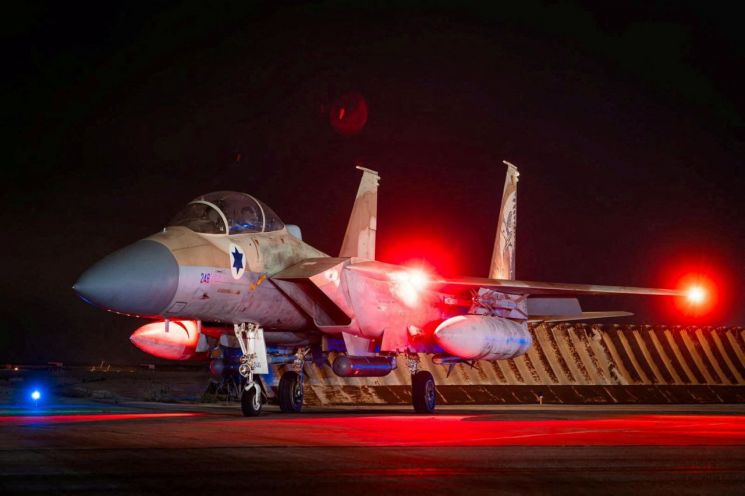 On the 14th (local time), an Israeli Air Force F-15 fighter jet preparing to sortie to intercept Iranian drones and ballistic missiles.
 [Image source=Reuters·Yonhap News]
According to the local media Times of Israel on the 14th (local time), Iran fired over 300 drones and ballistic missiles targeting the entire Israeli mainland, but the damage to Israel was very minor. The Israel Defense Forces (IDF) stated that they intercepted 99% of Iran's drones and ballistic missiles using their own air defense system, the Iron Dome missile system, resulting in only minimal damage. The attack caused minor damage to one Israeli military base, and civilian casualties were limited to a single injured Bedouin girl.
During this airstrike, Iran deployed a large number of drones and missiles into Israeli airspace within a short period. The Institute for the Study of War (ISW) reported, "The Islamic Revolutionary Guard Corps (IRGC) announced the operation would begin at around 3:30 PM on the day of the airstrike, and between 5 PM and 6 PM, they launched over 300 drones and ballistic missiles." Considering that Hamas launched approximately 430 drones and rocket launchers across Israel in one day during their invasion of Israel's southern border region on October 7 last year, this represents a massive volume of airstrikes within just one hour.
However, unlike the Hamas airstrike, which was a surprise attack without any prior warning, the Iranian airstrike allowed Israeli authorities to strengthen their preparedness beforehand, resulting in minimal damage. ISW analyzed, "The Israeli military closed its airspace several hours before the airstrike began, withdrew soldiers from bases expected to be targeted, and reinforced air defense readiness. Residents in border areas were also instructed to stay in shelters, which helped keep the damage low."
"Iran notified the US 72 hours before the airstrike"
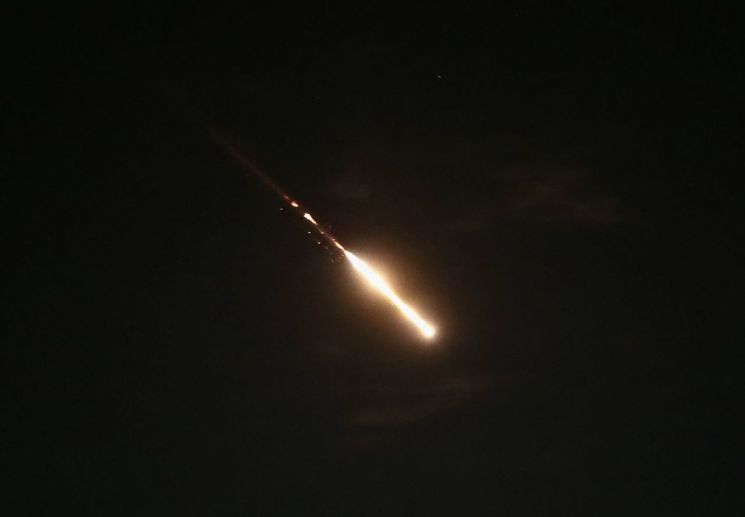 The Israeli Iron Dome air defense missile being launched toward an Iranian unmanned aerial vehicle (drone).
 [Image source: Xinhua · Yonhap News]
The reason the Israeli military was able to prepare in advance for the Iranian airstrike was that they obtained information about the airstrike beforehand from the United States and Western intelligence agencies. On the 12th, one day before the airstrike, the Wall Street Journal (WSJ) cited sources saying, "Israel has entered a state of readiness, anticipating a direct Iranian attack on its southern or northern regions within the next 24 to 48 hours."
The reason they could even know the exact date of the airstrike is presumed to be because Iran notified the United States and Western countries in advance or deliberately leaked information. According to major foreign media, Hossein Amir Abdollahian, Iran's Foreign Minister, said at a meeting with ambassadors from various countries stationed in Tehran on the 13th, "Iran notified neighboring countries and the United States, an ally of Israel, 72 hours before the airstrike," adding, "This was a measure that could significantly deter the attack."
There is also analysis that Iran initially aimed for a limited attack. CNN analyzed, "This operation was like 'fireworks' designed to maximize spectacle while minimizing casualties," adding, "Iran, suffering economic difficulties due to long-term sanctions, likely chose a method to preserve its pride as a hegemonic power in the Middle East while avoiding full-scale war." It also noted, "When General Qasem Soleimani was eliminated by the United States in January 2020, Iran declared retaliation and launched airstrikes on US military bases in Iraq, but even then, they notified the US 10 hours before the attack."
© The Asia Business Daily(www.asiae.co.kr). All rights reserved.
![Clutching a Stolen Dior Bag, Saying "I Hate Being Poor but Real"... The Grotesque Con of a "Human Knockoff" [Slate]](https://cwcontent.asiae.co.kr/asiaresize/183/2026021902243444107_1771435474.jpg)


















