Herzog, President of Israel, "Response Needed"
West Seeks 'Exit'... Struggling to Prevent Escalation
Response Policy Not Yet Decided
As Israel faces retaliatory airstrikes from Iran, there are growing prospects that Israel may launch a counter-retaliation as early as the 15th (local time), intensifying the war atmosphere in the Middle East region.
The Wall Street Journal (WSJ) reported on the 14th that "U.S. and Western officials expect Israel to respond as early as the 15th."
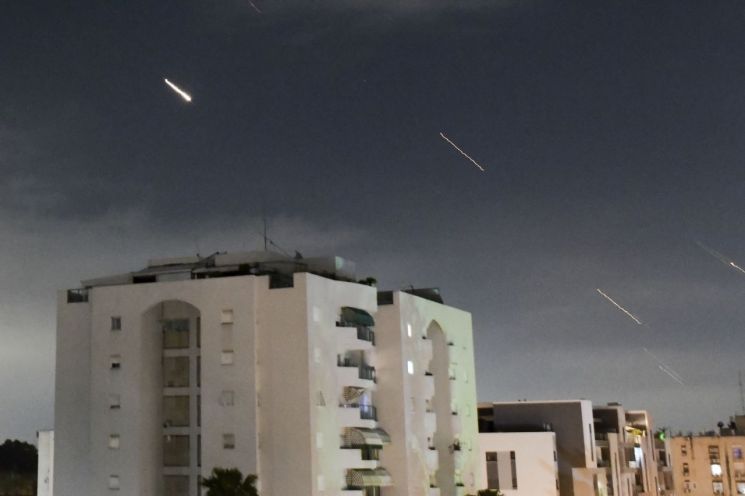 On the 14th (local time), Israel's Iron Dome air defense system was activated to intercept Iranian missiles. Iran launched its first direct attack against Israel starting on the 13th.
 [Image source=AP Yonhap News]
The Israeli government is taking a tough stance. On the 14th, Israeli President Yitzhak Herzog emphasized in an interview with CNN, "We always seek peace," but added, "The whole world must understand that a response to Iran is necessary." He also strongly criticized Iran, labeling it as an "Empire of Evil." He said, "For decades, Iran has waged war against Israel through proxies," and "Israel is confronting an Empire of Evil that seeks to annihilate all the values of the free world."
Most of Israel's wartime cabinet members are reportedly in favor of a counter-retaliation. On the 14th, Prime Minister Benjamin Netanyahu and five other ministers held an emergency meeting to discuss responses to the Iranian airstrikes. However, no specific policy has been finalized yet.
From the night of the 13th to the early hours of the 14th, Iran launched hundreds of ballistic and cruise missiles at Israel and carried out drone attacks. This was retaliation for Israel's strike on the Iranian consulate in Syria, which eliminated a senior commander of the Iranian Revolutionary Guard Corps (IRGC) on the 1st. This marks the first time since the 1979 Islamic Revolution that Iran has directly attacked Israeli mainland. While Iran has waged proxy wars through pro-Iranian armed groups, it had avoided direct clashes until now.
The United States and other Western countries are making strenuous efforts to prevent escalation. The Group of Seven (G7) leaders issued a statement condemning Iran on the 14th. The United Nations (UN) Security Council also held an emergency meeting.
U.S. President Joe Biden spoke with Prime Minister Netanyahu to discuss future responses. A senior U.S. administration official said about the call, "President Biden discussed slowing down the situation and reflecting on what has happened," adding, "No one wants to climb the 'ladder' of escalating tensions."
WSJ stated, "Western officials hope for an exit that limits the crisis escalation by finding a solution where both countries can withdraw with a sense of victory."
Some voices express skepticism about the possibility of a counter-retaliation. Shima Shine, head of the Iran program at the Israeli National Security Institute, said, "Considering the limited damage caused by Iran's attack, I am skeptical about predictions that a retaliatory strike is imminent."
However, since no final decision has been made regarding Israel's response, it remains to be seen. Jonathan Schanzer, a researcher at the U.S. Foundation for Defense of Democracies, said, "Iran has tested missile defense systems, regional countries, and U.S. resolve," adding, "If the two powers enter into direct hostility, no one knows where this conflict will lead."
© The Asia Business Daily(www.asiae.co.kr). All rights reserved.

















