Iran Leads Attack on Israel with 185 Drones
Israel: "No Damage... 99% Intercepted"
"Iran's Ballistic Missile Military Capability Proven," Assessment
On the 13th (local time), Iran carried out retaliatory airstrikes against Israel. Iran launched hundreds of missiles and drones (unmanned aerial vehicles), attacking the Israeli mainland for the first time since the country's founding in 1948. Israel defended against the airstrikes without serious damage using air defense systems such as the Iron Dome. Experts note that Iran's weapons have become more sophisticated and powerful than before.
According to the New York Times (NYT) on the 14th, Iran launched 185 drones, 36 cruise missiles, and 110 surface-to-surface missiles by dawn to attack Israel. Mohammad Hossein Bagheri, Chief of Staff of the Iranian Armed Forces, claimed after the airstrike, "The Zionist regime (Israel) tried to neutralize this operation but failed, and the operation's objectives were achieved."
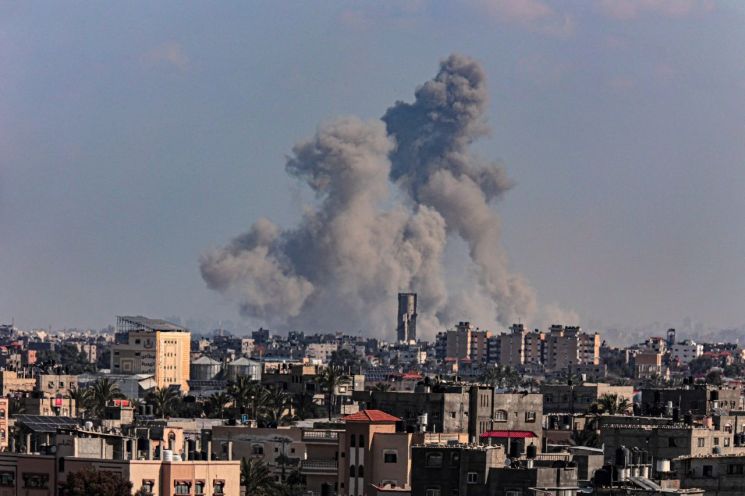
However, the Israeli military denied any significant damage from Iran's airstrikes. Daniel Hagari, the Israeli military's chief spokesperson, stated in a TV briefing that "99% of the approximately 300 projectiles launched by Iran were intercepted," asserting that "Iran's attack was thwarted." He explained that none of Iran's cruise missiles and drones that were launched toward Israel entered Israeli territory, and only a few ballistic missiles reached Israel.
Foreign media analyzed that Iran demonstrated its military capabilities by deploying ballistic missiles that fly with rocket propulsion and explode upon hitting their targets during this airstrike. The missiles and drones Iran deployed have longer ranges and flight distances and higher accuracy than the weapons used by the Palestinian militant group Hamas and pro-Iranian armed factions against Israel over the past six months.
Iran possesses the largest ballistic missile capability in the Middle East, and most of these missiles are believed to be domestically produced. U.S. officials estimate that Iran has over 3,000 ballistic missiles. Iran is producing ballistic missiles with a range of 2,000 km, but experts believe it can quickly develop and deploy missiles with much longer ranges.
A range of 2,000 km is sufficient for missiles to fly from Iran to Israel. Iran is also mass-producing drones. It is reported that Iran possesses a large number of drones with flight ranges between 1,931 and 2,494 km. Iran is assessed to have weapons capable of striking all targets in the Middle East, including Israel. Jeffrey Lewis, an international security advisor at the U.S. State Department, wrote on the social media platform X (formerly Twitter) that most of Iran's ballistic missiles have ranges sufficient to reach Israel.
It is also believed that Iran used ground-attack cruise missiles capable of carrying explosives weighing around 1 ton. Over the past decade, the accuracy of Iran's ballistic missiles has improved, and Iran supplies these missiles to proxy forces in the Middle East known as the "Axis of Resistance," according to the Wall Street Journal (WSJ). Iranian ballistic missiles have also been used in attacks by pro-Iranian armed groups on U.S. military bases stationed in Syria and Iraq.
International sanctions on Iran's ballistic missile and component trade ended last October under the 2015 Iran nuclear deal. While Iran can now trade ballistic missiles and components with Russia and China, the United States, the United Kingdom, and the European Union (EU) continue to maintain sanctions.
© The Asia Business Daily(www.asiae.co.kr). All rights reserved.

















