Japanese Prime Minister Fumio Kishida did not mention historical issues in his speech at the joint session of the US Congress on the 11th (local time), and the government responded by saying, "We understand that this speech focused on US-Japan relations."
A Ministry of Foreign Affairs official briefly stated this position on the 12th in response to questions about the absence of historical issues in Prime Minister Kishida's speech to the US Congress.
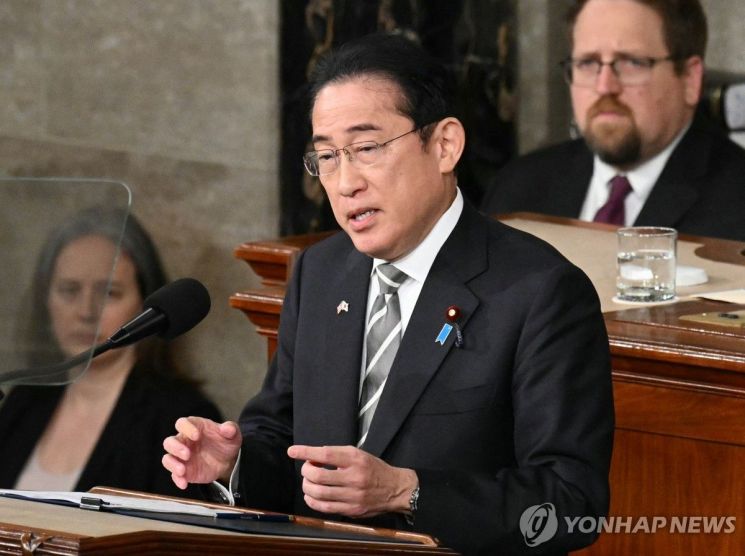 Japanese Prime Minister Fumio Kishida, on a state visit to the United States, is delivering a joint address to the House of Representatives and the Senate at the U.S. Capitol in Washington, D.C., on the 11th (local time).
 Photo by AFP Washington
In this speech, Prime Minister Kishida praised the United States for playing a central role in world peace and stability for decades, emphasizing US-Japan relations by saying, "Japan will stand with the United States as its closest friend." He did not mention reflection on the war or past colonial rule.
On the other hand, former Prime Minister Shinzo Abe, in his joint speech to the US Congress in April 2015, said, "We (Japan) started the postwar period with a deep sense of reflection on the war (World War II)" and "Our actions caused suffering to the people of Asian countries." He added, "We must not turn a blind eye to this. In this regard, we will inherit the perspectives expressed by successive prime ministers."
The South Korean government issued a statement under the name of the Ministry of Foreign Affairs spokesperson expressing regret over that speech, saying there was no "genuine apology." It pointed out that there was no direct mention of Japan's past colonial rule, aggression, or the issue of Japanese military comfort women.
The government's lack of a critical response to Prime Minister Kishida's complete omission of historical issues in this speech is interpreted as viewing the past conflicts between Korea and Japan as having been settled for the time being.
The Yoon Suk-yeol administration effectively concluded the phase of past historical conflicts with Japan through a solution for compensation to forced labor victims in March last year and has been focusing on expanding "future-oriented" cooperation between Korea and Japan.
© The Asia Business Daily(www.asiae.co.kr). All rights reserved.

















