Opposition Lawmakers Oppose Yoon's Policy in Large Numbers
Criticism of the Korea Communications Commission... Emphasis on 'Freedom of the Press'
Possibility of Broadcasting Industry Promotion Act Being Delayed Increases
"I am extremely nervous."
With a large number of opposition figures who opposed the government's broadcasting and telecommunications policies being elected in the 22nd general election, the National Assembly's Science, Technology, Information, Broadcasting and Communications Committee (STIBC) is expected to become a battleground. This is because there is a high possibility that hardline lawmakers will be positioned in the STIBC amid a political landscape where the ruling party holds fewer seats than the opposition. Related industries are closely monitoring the situation without letting their guard down. Some express concerns that since most of the broadcasting and telecommunications policies the government is promoting require legislative amendments, "the government's policies might be disrupted."
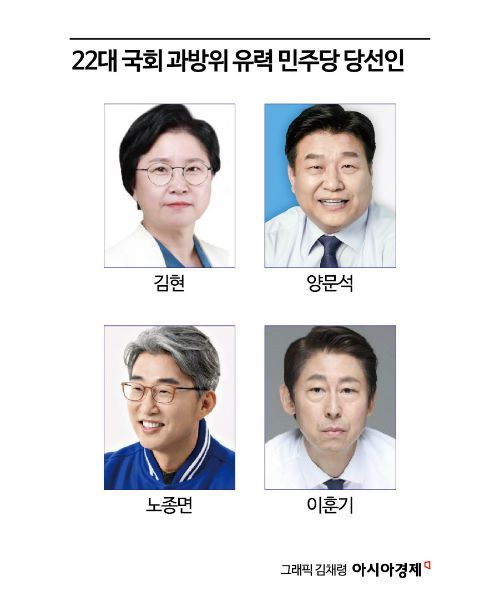
Kim Hyun, a member of the Democratic Party of Korea who was a proportional representative in the 19th National Assembly, was elected as a district lawmaker in this general election. He served as a standing commissioner of the Korea Communications Commission from August 2020 to August last year. During this period, he voiced opposition to the broadcasting and media policy direction of the Yoon Seok-yeol administration. In the 22nd National Assembly, he is expected to strongly raise procedural fairness issues regarding the currently two-person operation of the KCC's decision-making.
Yang Moon-seok, also from the same party, enters the National Assembly shouting for ‘media reform.’ He has declared that his first legislative proposal will be a bill to discipline media outlets that spread false information through punitive damages. Yang also served as a standing commissioner of the KCC from July 2010 to March 2014, recommended by the Democratic Party. He has held positions such as policy committee member of the National Union of Mediaworkers, planning director of the Korean Broadcasting Society, secretary-general of the Media Reform Citizens' Coalition, and director of the Public Media Research Institute.
Among those with a journalism background, No Jong-myeon, former chairman of the YTN labor union and elected representative for Incheon Bupyeong-gap, stands out. He was at the center of opposition protests in 2008 against the appointment of Gu Bon-hong, a former media special advisor under the Lee Myung-bak administration and a distinguished professor at Korea University, as YTN president. Due to this activity, he was disciplined in October of the same year and became the first dismissed journalist during the Lee Myung-bak government. Lee Hoon-gi, elected for Incheon Namdong-eul, who served as labor union chairman six times from the iTV era (the predecessor of OBS) to OBS, was also elected to the 22nd National Assembly. Lee Jae-myung, leader of the Democratic Party, recruited them as party talents, stating, "We have high expectations that they will work together on the task of securing press freedom to prevent the collapse of democracy."
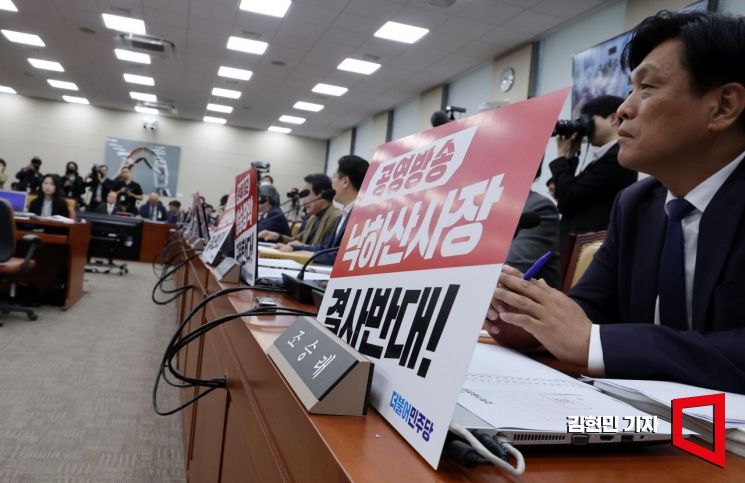 In the National Assembly audit of the Korea Broadcasting System and others by the Science, Technology, Information and Broadcasting Communications Committee last October, a placard reading "Strongly Oppose Parachute Presidents in Public Broadcasting" was attached to the Democratic Party lawmaker seats. Photo by Kim Hyun-min kimhyun81@
There is also a possibility that lawmakers who were active in the previous STIBC will support the committee again. Jo Seung-rae, who served as the Democratic Party's floor leader in the STIBC, succeeded in his third term and may aim for the chairmanship of the committee. Jo has previously led the proposal of bills such as the partial amendment to the Broadcasting Act mandating multicultural family welfare channels for SO and satellite broadcasting operators, and amendments to the Broadcasting Act and the Internet Multimedia Broadcasting Business Act (IPTV Act) to protect the rights of content providers (CPs).
Ko Min-jung, a former KBS announcer and lawmaker for Seoul Gwangjin-eul, took the lead as the main proposer of the impeachment motion during the impeachment phase of former KCC chairman Lee Dong-gwan. The KCC plans to prepare a comprehensive measure this year to eradicate fake news spreading online, including false and manipulated information, but the opposition, which advocates for press freedom, is likely to oppose it.
Furthermore, the media and content industry promotion plan jointly announced by ministries last month is expected to face rough roads. This is because persuading the opposition is essential to revise related laws. Regulatory improvements that require legal amendments include ▲expansion of tax credits for video content production costs ▲abolition of re-licensing and re-approval for pay broadcasting ▲removal of shareholding restrictions on daily newspapers in comprehensive wired broadcasting operators (SO) ▲revision of foreign ownership restrictions ▲abolition of market share limits in pay broadcasting ▲simplification of advertising types and relaxation of total volume regulations.
A cable TV industry official expressed concern, saying, "Legal and institutional improvements to cope with the rapidly changing media environment are urgent," and added, "There is a possibility that discussions on key bills for industry promotion will be sidelined due to intense political confrontation."
© The Asia Business Daily(www.asiae.co.kr). All rights reserved.


















