In the 22nd National Assembly election, which ended with a landslide victory for the opposition, candidates from financial sector labor unions such as Park Hong-bae and Kim Hyun-jung succeeded in entering the National Assembly. However, many financial experts who were active in the 21st National Assembly experienced mixed fortunes, with a considerable number losing their seats or failing to be nominated.
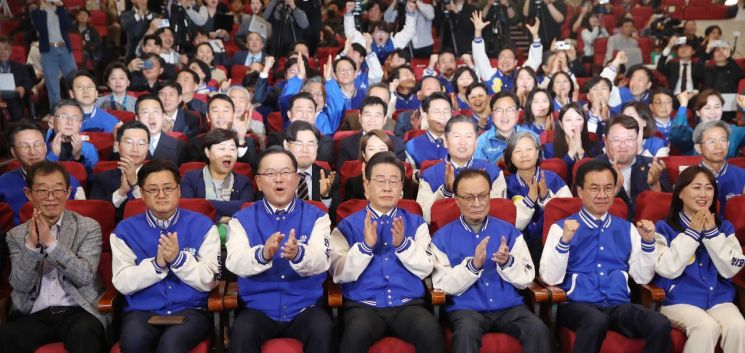
According to the financial sector on the 14th, candidates from financial labor unions secured winning positions in the Democratic Party of Korea and its satellite party, the Democratic United Party. In the Democratic Party, Kim Hyun-jung, a candidate for Pyeongtaek-si Eul, Gyeonggi Province and former chairperson of the National Office and Financial Services Labor Union, was elected, while in the Democratic United Party, Park Hong-bae, a candidate ranked 8th on the proportional representation list and former chairperson of the National Financial Industry Labor Union, was elected.
Park Hong-bae, who joined Korea Housing Bank (now KB Kookmin Bank) in 1999 and entered the financial sector, served as the head of the KB Kookmin Bank branch of the Financial Labor Union, chairperson of the Financial Labor Union, Supreme Council member of the Democratic Party, chairperson of the Financial Labor Union, and member of the Economic and Social Labor Council, before being recommended as a proportional representation candidate representing the Korean Confederation of Trade Unions.
Kim Hyun-jung, who joined BC Card in 1996, also served as chairperson of the BC Card Labor Union and chairperson of the National Office and Financial Services Labor Union. After narrowly losing in the 21st general election, she won the rematch against Koo Eui-dong of the People Power Party held four years later, securing her seat in the National Assembly.
New entries from bureaucrats in the economic and financial sectors stand out in the People Power Party and its satellite party, the People’s Future Party. In Busan Buk-gu Eul, Park Sung-hoon, a former administrative examination pass and senior economist at the World Bank (WB) who began his public service career at the Ministry of Planning and Budget, was elected. In Seoul Gangnam-gu Eul, Park Soo-min, who also worked at the Ministry of Planning and Budget and served as a director at the European Bank for Reconstruction and Development (EBRD), secured his certificate of election.
Additionally, although not a first-term lawmaker, economic and financial expert Choo Kyung-ho of the People Power Party, who served as Deputy Prime Minister and Minister of Economy and Finance, is on track for a third term in Daegu Dalseong-gun. Jo Jung-hoon, a WB alumnus and People Power Party member (proportional representation), also succeeded in winning his first constituency seat in Seoul Mapo-gu Gap.
Meanwhile, financial sector figures active in the 21st National Assembly either lost or announced they would not run. Yoon Chang-hyun, a People Power Party member and former president of the Korea Institute of Finance, ran in Daejeon Dong-gu but came in second with 45.01% of the vote. Yoo Kyung-joon, a former head of Statistics Korea and People Power Party member, also lost running in Hwaseong-si Jeong, Gyeonggi Province.
In the opposition, Kim Byung-wook, a Democratic Party member and former Korea Securities Dealers Association (now Korea Financial Investment Association) official, came in second in Seongnam-si Bundang-gu Eul, Gyeonggi Province. Lee Yong-woo, a Democratic Party member and former CEO of Kakao Bank, tasted defeat after being excluded from the party nomination. Hong Sung-kook, regarded as an economic expert within the Democratic Party and a former financial executive who served as CEO of Mirae Asset Daewoo, announced early on that he would not run.
With the formation of the new National Assembly, the Political Affairs Committee is also expected to be filled with new members. Once the parliamentary groups are formed, the four-year term of National Assembly members is divided into two-year halves, with changes in standing committee members for the first and second halves. Due to this election, half of the Political Affairs Committee members from the second half of the 21st National Assembly either did not run or lost. The seats of Yoon and Hong, who were active in the Political Affairs Committee, became vacant, and Yoo Eui-dong, who had served steadily as a Political Affairs Committee member from the 19th through the 21st National Assembly, also suffered defeat in this general election.
© The Asia Business Daily(www.asiae.co.kr). All rights reserved.

















