7th Promise Among the Democratic Party's Top 10 Pledges
Momentum for Forced Passage Even Before the Election
Possibility of Passage Before the Opening of the 22nd National Assembly
As the April 10 National Assembly general election ended with a landslide victory for the opposition, the legislation to ease distribution regulations promoted by the Yoon Seok-yeol administration is also at risk of being derailed. In particular, the 'Fair Transaction in Franchise Business Act,' which allows franchisees to have collective bargaining rights, is expected to be processed quickly since it was a campaign pledge of the Democratic Party, which secured an outright majority in the 22nd National Assembly.
According to political circles and the distribution industry on the 12th, the Democratic Party promised to amend the Franchise Business Act as the seventh of its top ten pledges in the last general election. This law allows franchisees to form and register a 'franchisee business association,' and if the association reports to the Fair Trade Commission, it can negotiate transaction terms with the franchisor on behalf of the franchisees. It also includes provisions to impose corrective measures or fines if the franchisor refuses to negotiate without justifiable reasons.
So far, the franchise industry has opposed the amendment, arguing that if franchisee associations maliciously abuse the right to request negotiations, franchisors have no way to respond. If this bill passes, it is expected to impact not only franchise food service sectors such as chicken and bakery but also convenience stores and e-commerce platforms, where franchise business is a core.
This bill passed the National Assembly's Political Affairs Committee in December last year and is currently pending in the Legislation and Judiciary Committee. The ruling People Power Party, which controls the committee, opposes the amendment. Therefore, in the February extraordinary session, the Democratic Party attempted to directly submit the bill to the plenary session. This procedure allows a bill that has been pending in the Legislation and Judiciary Committee for more than 60 days to be directly submitted to the plenary session with the approval of three-fifths of the members of the relevant standing committee. At that time, the Korea Franchise Industry Association protested in front of the National Assembly, claiming, "The Democratic Party's unilateral amendment will destroy the foundation of the franchise industry," and the direct submission to the plenary session did not occur. The distribution industry analyzed that the Democratic Party was taking a breather to manage its voter base ahead of the general election.
However, the atmosphere changed as the Democratic Party secured an overwhelming number of seats in the general election. Having confirmed the public's judgment on the administration, they may push for the bill's passage. The distribution industry suggests the possibility of processing it in the next extraordinary session of the National Assembly. Typically, after the general election, the last extraordinary session is held to pass numerous uncontested bills in bulk, a so-called 'bill clearance' to boost legislative achievements. In the 20th National Assembly, 141 bills were passed at once in an extraordinary session held right after the general election.
If the amendment to the Franchise Business Act is not passed in the next extraordinary session, it is highly likely that the related bill will be reintroduced immediately after the opening of the 22nd National Assembly on the 30th of next month.
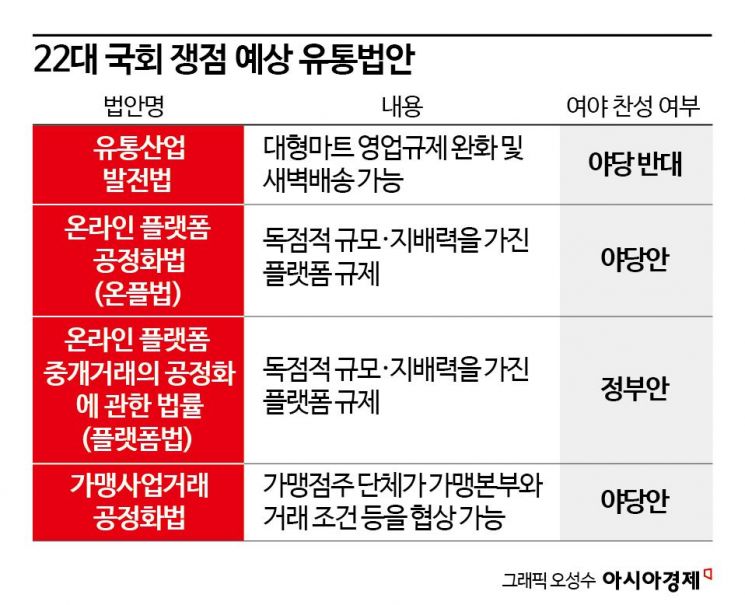
In the distribution industry, it is also expected to be difficult to amend the Distribution Industry Development Act, which includes the abolition of mandatory closure days for large supermarkets and relaxation of business hours, measures strongly driven by the government. The distribution law was only discussed twice last year in the Subcommittee of the National Assembly's Industry, Trade, Energy, Small and Medium Enterprises Committee due to opposition from the opposition parties, with no significant conclusions reached. Although the government plans to amend the law to ease regulations on large supermarket operations in the 22nd National Assembly, legislation is expected to face difficulties given the continued minority government.
The regulatory bill promoted by the government, the 'Act on Fairness in Online Platform Intermediary Transactions (Platform Act),' may develop into even stronger regulations. The opposition's proposed 'Online Platform Fairness Act (On-Platform Act)' shares the main framework of prohibiting monopolistic abuse by platform companies with the government bill but includes regulations on corporate mergers and has stronger regulatory measures. It also prohibits more types of conduct. Therefore, fierce power struggles between the ruling and opposition parties are expected over the government bill in the 22nd National Assembly. A distribution industry official said, "In the 21st National Assembly, discussions on distribution regulations did not gain momentum due to the minority government structure. Although the opposition did not reach the 200 seats needed to nullify veto power, the positions on regulatory reform remain sharply divided, raising concerns that the 22nd National Assembly will also see repeated stalemates."
© The Asia Business Daily(www.asiae.co.kr). All rights reserved.

















