TIUM Bio announced on the 11th that it unveiled a preclinical animal study poster of the immuno-oncology drug TU2218 at the American Association for Cancer Research (AACR) 2024.
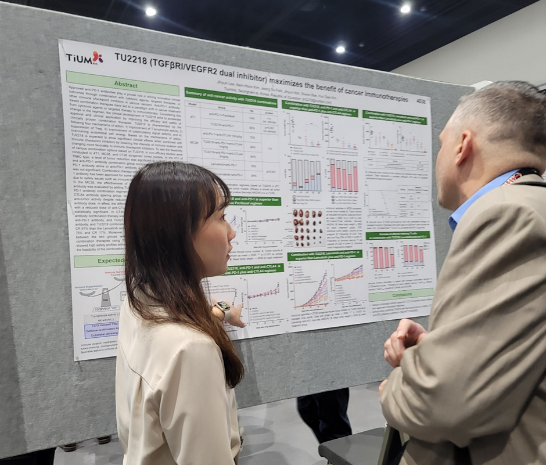 A TiUM Bio researcher explaining a poster presentation to attendees at the AACR event
[Photo by TiUM Bio]
On the 9th (local time), TIUM Bio presented a poster at the AACR conference on the therapeutic outcomes and safety of combining TU2218 with existing approved treatments in breast cancer models (4T1 cell line) and colorectal cancer models (MC38 and CT26 cell lines), using the existing approved therapies as control groups.
TU2218 is a dual inhibitor that simultaneously blocks the pathways of transforming growth factor (TGF)-beta (β) and vascular endothelial growth factor (VEGF), which are known to interfere with the activity of immuno-oncology drugs, thereby maximizing the efficacy of immuno-oncology agents such as Keytruda.
Among the three animal studies presented at AACR, the combination therapy of TU2218 and anti-programmed cell death protein 1 (PD-1) treatment in the breast cancer mouse model (4T1) showed statistically significant improvement in tumor growth inhibition (TGI) compared to the existing approved therapies, including anti-PD-1 treatment and chemotherapy combination therapy. Additionally, in the colorectal cancer model (MC38) cell line, the triple combination therapy of TU2218, anti-PD-1, and anti-CTLA4 showed superior therapeutic effects compared to the control group that combined only the two drugs excluding TU2218. The TGI of the triple combination therapy was 84%, higher than the control group's 70%. Notably, this result was achieved even though the dose of the anti-CTLA4 treatment in the triple therapy was reduced to one-tenth of the usual amount.
The company explained, "Although the combination of anti-PD-1 and anti-CTLA4 treatments shows high therapeutic efficacy, significant side effects make it difficult to prescribe to patients. The ability to administer a lower dose of anti-CTLA4 when combined with TU2218 provides scientific evidence that this treatment option can reduce the likelihood of side effects while maintaining effective anticancer activity."
They also reported favorable results with TU2218 combination therapy in the colorectal cancer model (CT26). When TU2218 was administered together with the targeted anticancer drug Lenvatinib and anti-PD-1 treatment, the TGI reached 99%, showing statistically significant improvement compared to the control group combining only Lenvatinib and anti-PD-1 treatment, which had a TGI of 76%. The complete remission rate also reached 67%.
Kim Hoon-taek, CEO of TIUM Bio, stated, "The research results presented at AACR confirmed the various combination possibilities of TU2218 targeting breast and colorectal cancer models with high unmet medical needs. The combination effects of TU2218 have demonstrated synergistic effects across multiple cancer types through preclinical and clinical trials."
© The Asia Business Daily(www.asiae.co.kr). All rights reserved.

















