Personal Bond Holdings Surpass 50 Trillion This Year
Bond ETFs More Popular Than Equity ETFs
Capital Gains Expectations Rise Amid Anticipated Interest Rate Cuts

Individual funds are pouring into bond investments. As uncertainty surrounding the Federal Reserve's (Fed) monetary policy direction deepens, the timing of interest rate cuts in Korea is likely to be delayed more than expected. However, since rate cuts are certain in the future, investors are focusing on purchasing long-term government bonds, expecting capital gains. Experts advise that temporary interest rate hikes that may occur before the actual base rate cut could actually present buying opportunities at lower prices.
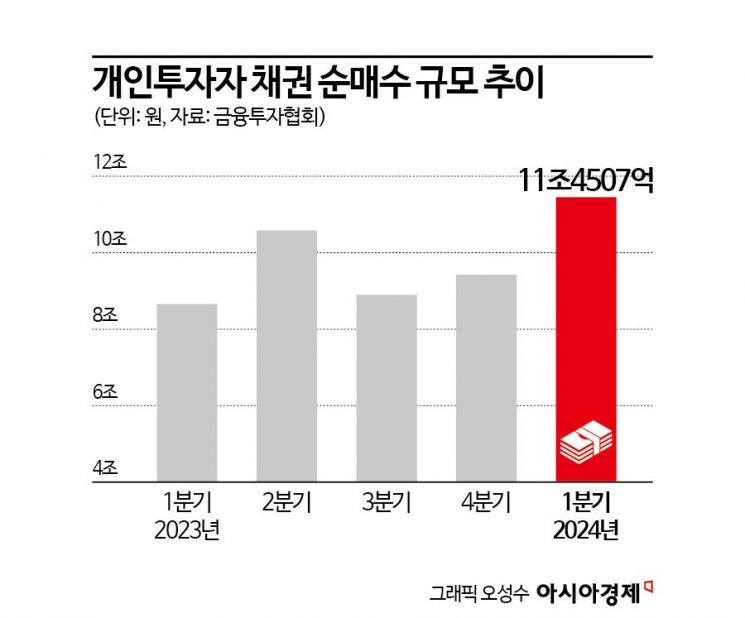
According to the Korea Financial Investment Association on the 12th, the net purchase amount of bonds by individuals reached KRW 13.3061 trillion as of the 11th this year. This is 39% higher compared to KRW 9.5512 trillion during the same period last year. On the same day, the balance of Korean won-denominated bonds held by individual investors was KRW 51.8866 trillion. Before 2022, the balance of Korean won-denominated bonds held by individuals was less than KRW 10 trillion, but in just two years, it has surged nearly fivefold, exceeding KRW 50 trillion.
In particular, individual investors purchased about KRW 3.2 trillion worth of government bonds in the first quarter alone. This is interpreted as individuals continuing to prefer bonds due to their relatively higher yields and stability compared to fixed deposits. Recent trends in individual bond net purchases show that most were government bonds, including five 30-year bonds (20-2, 24-2, 23-7, 23-2, 21-2), two 20-year bonds (20-7, 19-6), a 5-year bond (19-5), and a 3-year bond (21-4). The proportion of long-term bonds with maturities of 20 to 30 years or more was high. Notably, more than half of these were bonds issued between 2019 and 2021 with low coupon rates.
The strong interest of individual investors in bonds is also evident in the exchange-traded fund (ETF) market. Choi Byung-wook, a researcher at Meritz Securities, said, "Recently, newly listed ETFs are focusing more on bond types than stock types," adding, "Among bond ETFs listed this year, the largest, Heroes Money Market Active, has assets under management (AUM) of KRW 380 billion, which is significantly larger than stock ETFs." He further explained, "Considering short-term bond ETFs linked to negotiable certificates of deposit (CDs) and the Korea Overnight Financing Rate (KOFR), which are classified as others, the proportion of bond ETFs is quite substantial."
The securities industry analyzes that the background of the individual bond investment boom includes competitive yields and improved accessibility. Kim Myung-sil, a researcher at Hi Investment & Securities, analyzed, "The overall rise in bond yields due to previous base rate hikes has increased the attractiveness of bond investments, and the growing demand for stable portfolio construction amid aging also had some influence." He also noted, "Unlike before, the activation of digital platforms such as mobile trading systems (MTS) has made it easier for individuals to invest in bonds."
This year, government bond yields have been fluctuating within a narrow range. This contrasts with the strong bond market seen at the end of last year. Although the direction of monetary policy strongly favors rate cuts, uncertainty about the exact timing has led the bond market to move sideways within a box range. Accordingly, Kim Ji-man, a researcher at Samsung Securities, said, "In early Q2, bond yields may continue to fluctuate similarly to Q1, but as the latter half progresses, yields are expected to decline reflecting expectations of base rate cuts." He added, "Although there are some concerns about increasing real estate financial risks, considering sufficient policy response capacity, any rate hikes caused by related noise could be met with buying."
Ahn Jae-kyun, a researcher at Shinhan Investment Corp., said, "KRW 46.2 trillion worth of government bonds were issued in Q1 this year, and about KRW 48.7 trillion is expected to be issued in Q2, so the market needs to absorb the increased supply." However, he noted, "The expectation of a near-certain shift to rate cuts is likely to maintain a reverse carry market where investors pay interest through investments." He added, "For 3-year government bonds, buying opportunities may arise when yields approach or exceed 3.40%."
© The Asia Business Daily(www.asiae.co.kr). All rights reserved.


















