Subsidies Increased 9.5 Times in 2 Years
"Chinese Subsidies 3-4 Times Higher Than EU and OECD"
Chinese electric vehicle manufacturer BYD has received at least 3.4 billion euros (approximately 4.9781 trillion KRW) in direct subsidies from the Chinese government, according to the Kiel Institute for the World Economy in Germany.
On the 10th (local time), Bloomberg reported that according to the Kiel Institute, Chinese government support for BYD surged from 220 million euros (approximately 322.1 billion KRW) in 2020 to 2.1 billion euros (approximately 3.0747 trillion KRW) in 2022.
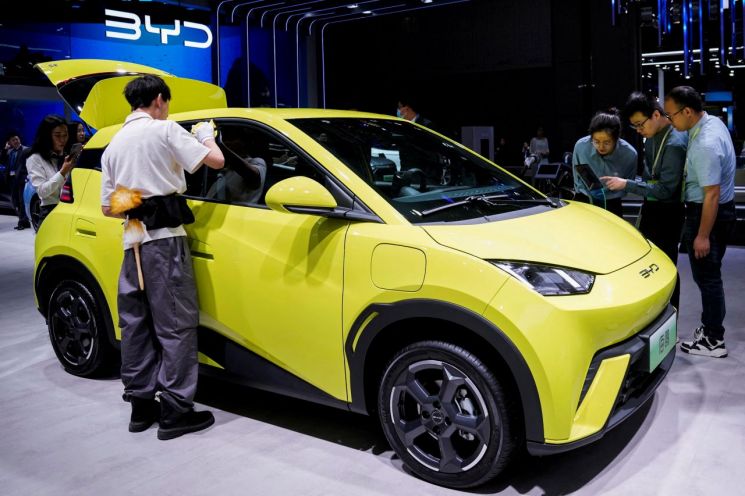
The European Union (EU) Commission has been conducting an anti-subsidy investigation since October last year into Chinese electric vehicle companies such as BYD, Shanghai Automotive Industry Corporation (SAIC), and Geely. The stance is that low-priced Chinese electric vehicles made with government subsidies are distorting the market. The European policy group Transport & Environment (T&E) projected that Chinese manufacturers would hold a 25.3% share of the European electric vehicle market this year.
According to the report, BYD receives support for battery manufacturing and rebate benefits for car buyers. The Kiel Institute stated, "Through subsidies, BYD was able to rapidly scale up, dominate the Chinese market, and promote expansion into the EU market."
BYD started as a battery manufacturer but has invested heavily in research on electric vehicles and plug-in hybrid technologies. Along with the effect of electric vehicle purchase subsidies, the Chinese domestic car market has grown rapidly, leading to explosive growth for BYD. Leveraging its affordable prices, BYD is launching aggressive campaigns in global markets including Europe.
The Kiel Institute said that not only BYD but virtually all publicly listed Chinese companies received direct subsidies in 2022. It noted that subsidies were particularly concentrated in wind power, solar energy, and railway vehicle companies. According to the institute, China’s industrial support is at least three to four times greater than that of the EU or OECD countries.
The EU plans to impose tariffs as early as July based on the anti-subsidy investigation targeting Chinese electric vehicle companies. The day before, it announced the start of a new investigation into Chinese wind turbine suppliers.
However, China regards the EU’s anti-subsidy investigation as protectionism and maintains that its electric vehicle companies lead Western brands with superior product quality. Wang Wentao, China’s Minister of Commerce, emphasized during a recent European tour, "Chinese electric vehicle manufacturers do not rely on government subsidies but depend on continuous technological innovation, optimal production and supply chain systems, and full market competition."
Dirk Toz, Director of the Kiel Institute, said, "Next week’s visit of German Chancellor Olaf Scholz to China is a good opportunity to negotiate with China regarding subsidies."
© The Asia Business Daily(www.asiae.co.kr). All rights reserved.

















