Lee Jun-seok Reform New Party Victory 'Upset'
Casting Vote 'Chungcheong' Blue Wave
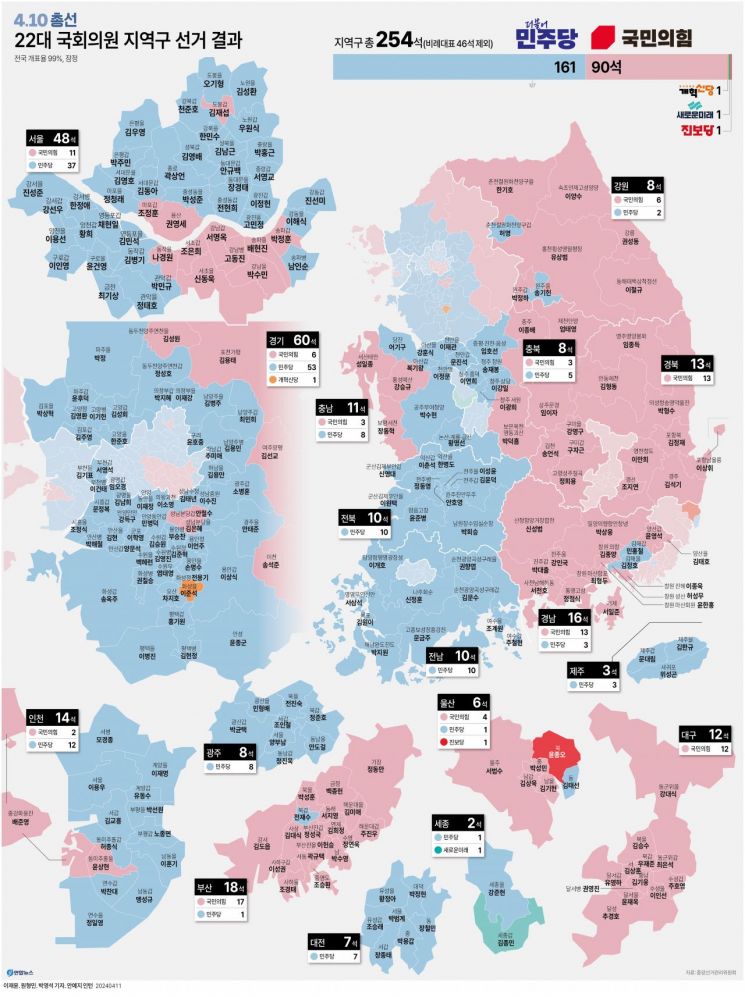
In the 22nd National Assembly election held on the 10th, the Democratic Party of Korea secured 161 seats out of 254 constituency seats nationwide, while the People Power Party won 90 seats. The Democratic Party achieved a landslide victory in the fiercely contested metropolitan areas of Seoul, Incheon, and Gyeonggi, whereas the People Power Party held firm in the Nakdong River region, including Busan and Gyeongnam.
According to the Central Election Management Committee's general election vote count status as of 10:10 a.m. on the 11th, with a nationwide constituency vote count rate of 99.96%, the Democratic Party of Korea secured 161 seats, the People Power Party 90 seats, the Progressive Party 1 seat, the Reform New Party 1 seat, and the New Future Party 1 seat.
Democratic Party's Complete Victory in Seoul and the 'Semiconductor Belt'... Lee Jun-seok's Election 'Upset'
In Seoul, the barometer of voter sentiment, the Democratic Party won 37 out of 48 seats, while the People Power Party took 11 seats. The Democratic Party dominated early in the 'Hangang Belt,' the largest battleground in the metropolitan area, winning decisively in Yeongdeungpo Gap and Eul, Gwangjin Gap and Eul, Jungseongdong Gap and Eul, Gangdong Gap and Eul, Mapo Eul, and Dongjak Gap. The People Power Party narrowly won only in Yongsan, Dongjak Eul, and Mapo Gap, and managed to hold onto traditional conservative strongholds such as Gangnam Gap, Eul, Byeong, Seocho Gap and Eul, and Songpa Gap and Eul. Outside the Hangang Belt, most areas in Seoul saw a landslide victory for the Democratic Party, with Kim Jae-seop of the People Power Party achieving a surprise win in Dobong Gap.
In Gyeonggi Province, out of 60 seats, the Democratic Party won 53, the People Power Party 6, and the Reform New Party 1. In Suwon, known as the 'number one political district in Gyeonggi,' the Democratic Party secured all five seats for the third consecutive term in the 20th, 21st, and now the 22nd National Assembly. Candidates Baek Hye-ryun (Suwon Eul) and Kim Young-jin (Suwon Byeong) were re-elected for a third term, and Kim Seung-won (Suwon Gap) was re-elected for a second term. Kim Jun-hyeok, the Democratic Party candidate for Suwon Jeong, who faced criticism for controversial remarks, narrowly defeated Lee Soo-jung of the People Power Party. The People Power Party's Ahn Cheol-soo and Kim Eun-hye were elected in Seongnam Bundang-gu Gap and Eul, respectively. In Hwaseong, Lee Jun-seok, who left the People Power Party and ran as a Reform New Party candidate, caused an upset by being the only winner among the two major parties.
In Incheon, where 14 seats were contested, the Democratic Party won 12 seats and the People Power Party 2 seats. In the highly watched Gye-yang Eul district, dubbed the 'Myungryong Battle,' Democratic Party leader Lee Jae-myung defeated People Power Party candidate Won Hee-ryong to enter the 22nd National Assembly.
Casting Vote Chungcheong, Blue Wave in the Home Turf Honam
In the Chungcheong region, which played the role of a 'casting vote,' the Democratic Party achieved a landslide victory by winning 21 out of 28 seats. The Democratic Party swept all 7 seats in Daejeon, and in Chungnam, with 11 seats, the Democratic Party won 8 seats while the People Power Party took 3. In the fiercely contested areas of Cheonan Gap, Gongju-Buyeo-Cheongyang in Chungnam, Democratic Party candidates Moon Jin-seok and Park Soo-hyun won respectively. In Chungbuk, the Democratic Party secured 5 out of 8 seats, with the People Power Party winning 3.
Han Dong-hoon, the People Power Party's Emergency Committee Chairman and General Election Campaign Chairman, focused on areas such as Cheonan Gap, Eul, Byeong, Asan Gap and Eul, and Dangjin in Chungnam, but all were lost to the Democratic Party. Only in Boryeong-Seocheon in Chungnam did People Power Party candidate Jang Dong-hyuk win after a close contest. In Sejong, the Democratic Party won 1 seat and the New Future Party won 1 seat.
In Honam, the Democratic Party overwhelmingly won without any upsets. Out of 28 seats, the Democratic Party won all 8 seats in Gwangju, 10 seats in Jeonbuk, and 10 seats in Jeonnam.
People Power Party Holds Conservative Stronghold Nakdong River Belt
In the conservative stronghold of TK (Daegu and Gyeongbuk), the People Power Party swept all 25 seats, 12 in Daegu and 13 in Gyeongbuk. In Gyeongsan, Gyeongbuk, former Deputy Prime Minister and pro-Park Geun-hye faction member Choi Kyung-hwan, who ran as an independent, narrowly lost to People Power Party candidate Jo Ji-yeon. In the PK region (Busan, Ulsan, Gyeongnam), where 40 seats were contested, the People Power Party won 34 seats, the Democratic Party 5 seats, and the Progressive Party 1 seat. In Busan, the People Power Party won 17 seats and the Democratic Party 1 seat; in Ulsan, the People Power Party won 4 seats, the Democratic Party 1 seat, and the Progressive Party 1 seat; in Gyeongnam, the People Power Party won 13 seats and the Democratic Party 3 seats.
Among the 10 seats in the Nakdong River Belt, which emerged as the biggest battleground in the general election, the People Power Party won 7 seats and the Democratic Party 3 seats. Yoon Jong-oh, the candidate from the Progressive Party in Ulsan Buk-gu, was the only winner from his party. In Gangwon, with 8 seats, the People Power Party won 6 seats and the Democratic Party 2 seats, while in Jeju, the Democratic Party won all 3 seats.
© The Asia Business Daily(www.asiae.co.kr). All rights reserved.
![Clutching a Stolen Dior Bag, Saying "I Hate Being Poor but Real"... The Grotesque Con of a "Human Knockoff" [Slate]](https://cwcontent.asiae.co.kr/asiaresize/183/2026021902243444107_1771435474.jpg)
















