Minority Government Within 5-Year Term
Key Policies Requiring Legal Amendments Come to a Complete Halt
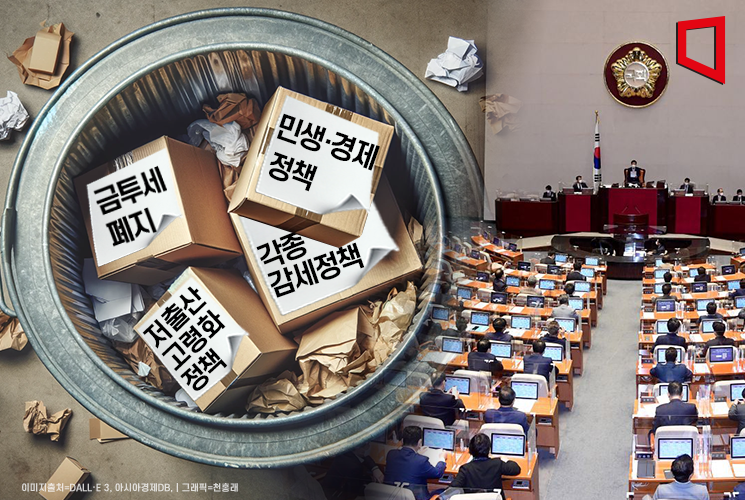
With the confirmation of a minority government in the 22nd National Assembly, many of the core livelihood and economic policies promised by the Yoon Suk-yeol administration face the risk of being derailed. Economic bills aimed at revitalizing the economy and corporate investment, which require parliamentary approval for enactment or amendment, are expected to be stalled or scrapped in the 22nd National Assembly. Although the Yoon Suk-yeol administration plans to continue its dynamic economic stance to overcome national crises such as the decline in the working-age population due to low birth rates and aging, as well as the trend of decreasing potential growth rates during the remaining three years of its term, the driving force behind key economic policies centered on tax cuts is expected to weaken.
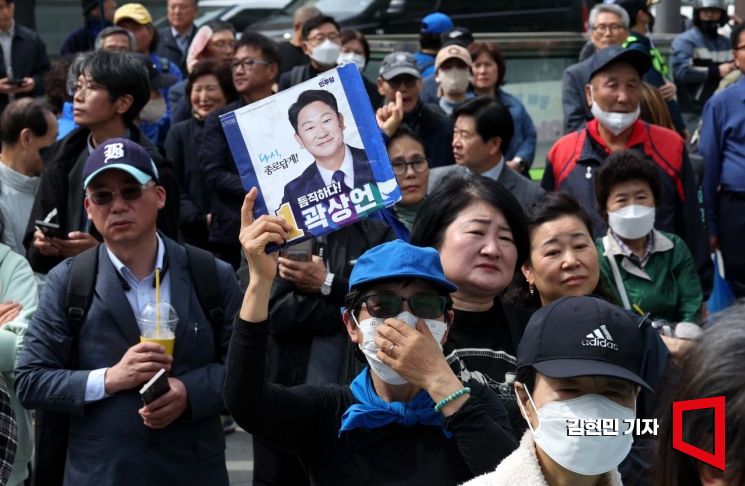 Two days before the 22nd National Assembly election, on the 8th, voters are watching the campaign rally supporting candidate Gwak Sang-eon, led by Lee Jae-myung, the leader of the Democratic Party of Korea, in front of Dongmyo Station in Seoul Subway. Photo by Hyunmin Kim kimhyun81@
Tax Cut Proposals Including Abolition of Financial Investment Income Tax Face Risk of Failure
As the opposition parties are set to control legislative power for the next four years, various tax cut policies, including the abolition of the Financial Investment Income Tax (FIIT), are likely to be blocked. Currently, major legislative tasks such as amendments to the Restriction of Special Taxation Act and the Income Tax Act, including the abolition of FIIT, are pending in the National Assembly’s Planning and Finance Committee, which has jurisdiction over these matters. FIIT is scheduled to be implemented next year, but President Yoon declared its abolition at a livelihood discussion forum held in January.
Subsequently, in February, bills to amend the Income Tax Act and the Restriction of Special Taxation Act to abolish FIIT were proposed, but they failed to pass the National Assembly due to clear differences between the ruling and opposition parties. If these bills do not pass during the May extraordinary session at the end of the 21st National Assembly, they will be automatically discarded.
In that case, the government will have to reintroduce and pass the bills in the 22nd National Assembly. However, since the Democratic Party strongly criticized the abolition of FIIT during the election campaign, framing it as a tax cut favoring the wealthy, it is widely expected that passing the bills in the National Assembly will be practically impossible.Other policies that may be blocked by the minority government include expanding tax benefits for Individual Savings Accounts (ISA), temporarily increasing tax credits for research and development (R&D) investments, extending the sunset clause on temporary investment tax credits, special tax treatment for unsold houses after completion in non-metropolitan areas, expanding card income deductions in the first half of the year, and reducing individual consumption tax when replacing old vehicles. These policies were presented by the government through economic policy directions announced earlier this year and 24 livelihood discussion forums. Given that the government caused a record tax revenue shortfall of 56.4 trillion won last year due to various tax cuts, it seems difficult to push through existing tax cut measures legislatively after the general election.
Not only new legislation but also the so-called three major reforms (labor, pension, education) are expected to face rough roads. Labor reform, in particular, has faced intense opposition from labor groups, and even if the ruling party holds a majority in the National Assembly, there were many obstacles to strong implementation. The major pillar of labor reform, the revision of working hours, has become even more difficult to push through as planned due to opposition from the opposition parties and controversies over regression in the system, especially following the opposition’s victory in the general election. Currently, the Economic, Social, and Labor Council (ESLC), a presidential advisory social dialogue body, has temporarily postponed the social dialogue scheduled for the 4th, but has yet to set a new date.
Previously, labor, management, and government agreed to address three agendas through social dialogue: work-life balance, response to demographic changes, and sustainable job creation. These agendas include sensitive legislative issues such as working hours reform, improvement of the dual labor market structure, and extension of retirement age, making coordination difficult. A Ministry of Employment and Labor official said, "If the opposition does not agree with the government’s legislative agenda, it will become even more difficult to speed up the processing of bills."
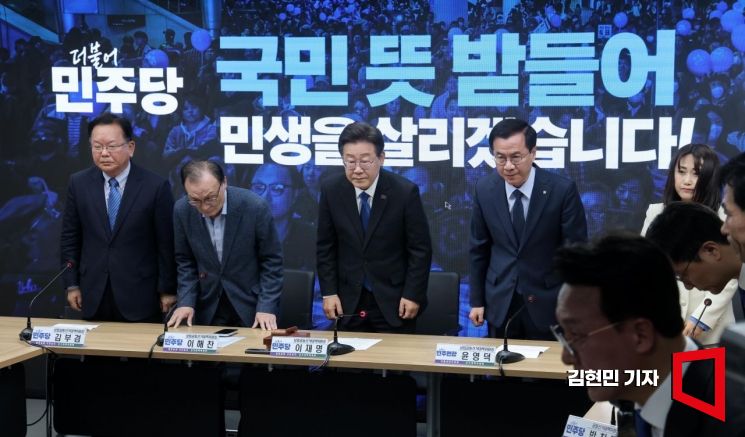 On the 11th, attendees are greeting each other after finishing their speeches at the 12th Joint Central Election Countermeasures Committee Meeting and the disbandment ceremony of the election committee held at the Democratic Party headquarters in Yeouido, Seoul. From the left: Kim Boo-kyum, Lee Hae-chan, Co-Chairmen of the Standing Joint Election Committee, Lee Jae-myung, Representative, Democratic Union, Yoon Young-duk, and Baek Seung-ah, Co-Representatives. Photo by Kim Hyun-min kimhyun81@
Focus Likely to Shift to Price Stability and Economic Defense in the Second Half
With little support expected from the National Assembly, the government is anticipated to focus more on pressing economic issues this year. Major research institutions forecast South Korea’s economic growth rate to be in the low 2% range this year. The Asian Development Bank (ADB) projects South Korea’s GDP growth rate at 2.5%, while the International Monetary Fund (IMF) and the Organisation for Economic Co-operation and Development (OECD) estimate slightly lower rates of 2.3% and 2.2%, respectively. The economic growth rate was 2.6% in 2022, the first year of the Yoon Suk-yeol administration, but halved to 1.3% last year. Analysts expect this year’s growth to be better than last year’s. The core inflation rate, which shows the underlying trend of prices, is also decreasing to 2.4%, indicating a stabilization trend. However, with the domestic economy worsening and concerns growing over the three highs?high interest rates, high inflation, and high exchange rates?policy efforts are needed to prevent the economy from slipping back into a downturn.
Experts emphasize that the focus of policy momentum should shift to follow-up measures aimed at restoring economic dynamism and raising potential growth rates. They point out that in the prolonged minority government situation, the government should concentrate on price stability and economic defense rather than fragmented policy achievements. Professor Seok Byung-hoon of Ewha Womans University’s Department of Economics said, "Although external conditions are uncertain due to the possibility of escalation in the Middle East war, soaring international oil prices, and global supply chain instability, price stability and economic defense will be the key themes in the second half of the year." He added, "It will be inevitable for the current administration to revise its economic policy direction, which has emphasized sound fiscal policy while pursuing economic stimulus through tax cuts."
© The Asia Business Daily(www.asiae.co.kr). All rights reserved.
!["The Woman Who Threw Herself into the Water Clutching a Stolen Dior Bag"...A Grotesque Success Story That Shakes the Korean Psyche [Slate]](https://cwcontent.asiae.co.kr/asiaresize/183/2026021902243444107_1771435474.jpg)


















