General Election with Insufficient Sample Size Has High Margin of Error
High Early Voting Rate is a Variable... Participation Rate Rising in Every Election
During the last presidential election, the exit polls conducted by the three major broadcasters (KBS, MBC, SBS), which were praised for accurately predicting results down to decimal points, failed to maintain their "spot-on" reputation in the April 10 general election. Although the prediction that the Democratic Party of Korea would secure an outright majority and become the largest party in the National Assembly was correct, the exit polls fell short in forecasting the exact number of seats, leading to criticism about the accuracy of the exit polls, which cost a total of 7.2 billion KRW.
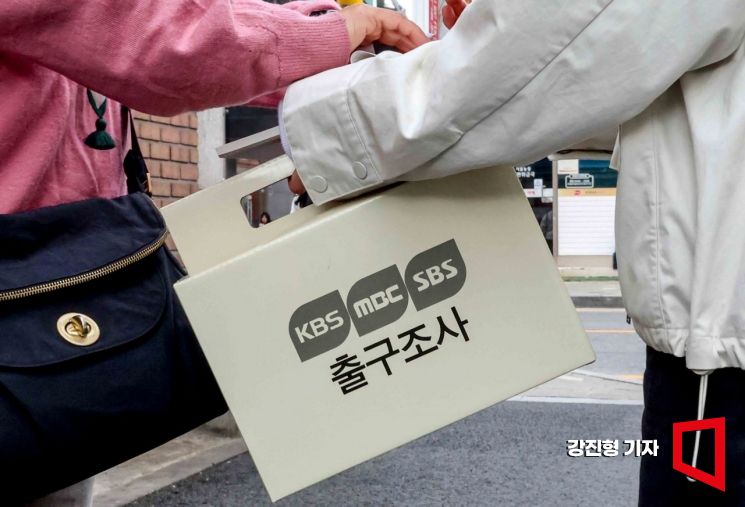 On the 10th, the day of the 22nd National Assembly election, exit poll workers from a broadcasting company are conducting exit polls on voters who have finished voting at a polling station in Seoul. Photo by Kang Jin-hyung aymsdream@
As of 9 a.m. on the 11th, with a counting rate exceeding 99.8%, the Democratic Party and its satellite party, the Democratic United Party, secured 174 seats. Adding the 12 seats won by the Justice Innovation Party brings the total opposition bloc seats to 186, which is 4 seats short of the lowest estimate of 190 seats predicted by the three broadcasters' exit polls. The People Power Party and its satellite party, People Future, secured 108 seats, surpassing the maximum exit poll estimate of 105 seats. Previously, the three broadcasters predicted that the opposition bloc would secure around 200 seats. The exit poll analysis forecasted that the Democratic Party and Democratic United Party would win 178 to 197 seats, the Justice Innovation Party 12 to 14 seats, People Power Party and Future 85 to 105 seats, Reform Party 1 to 4 seats, and New Future 0 to 2 seats.
◆ Presidential Election Exit Polls: 100% Accuracy in Predicting Winners from the 16th to 20th Presidential Elections
Exit polls by broadcasters were introduced in 1995 during the first simultaneous local elections nationwide. Since then, exit polls have been conducted five times for presidential elections from the 16th to the 20th and six times for general elections from the 16th to the 21st. Previously, each broadcaster conducted exit polls independently, but since 2010, the three broadcasters have conducted joint exit polls.
The presidential election exit polls by the three broadcasters have accurately predicted all winners since 2002. While the predicted vote shares for each candidate slightly differed from the actual results, the winner and the ranking of vote shares were perfectly predicted. During the 16th presidential election, the three broadcasters conducted exit polls individually and announced the results, all correctly predicting the victory of Roh Moo-hyun, then the candidate of the Millennium Democratic Party. Among them, KBS was the most accurate, predicting that Roh Moo-hyun and Lee Hoi-chang of the Grand National Party would receive 49.1% and 46.8% of the vote, respectively. The actual results showed Roh Moo-hyun winning with 48.91%, beating Lee Hoi-chang by 2.33 percentage points.
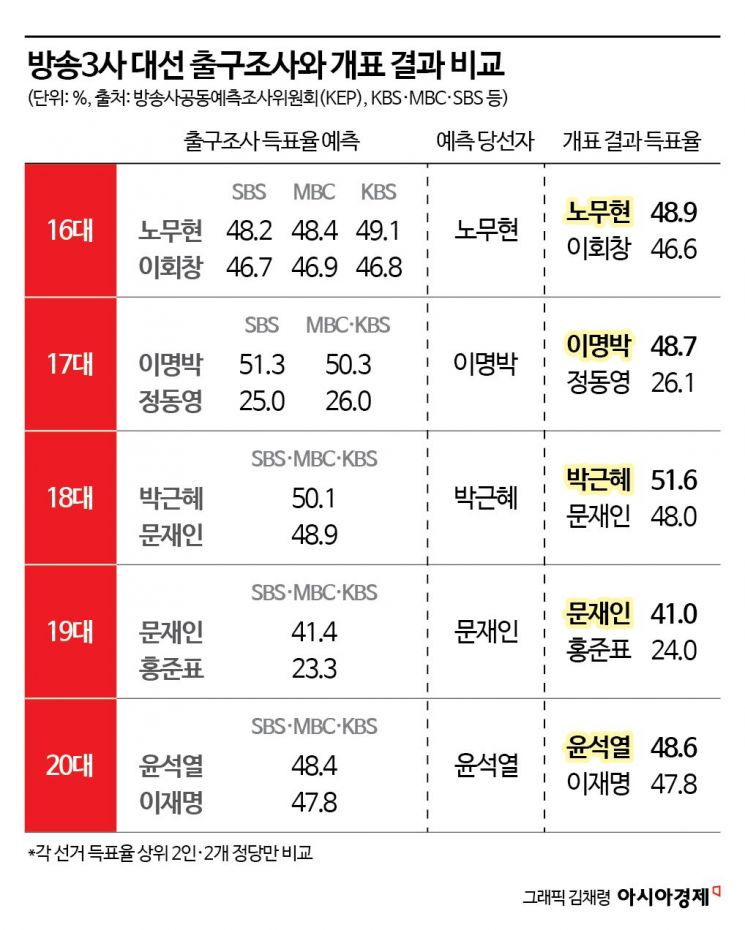
In the 17th and 19th presidential elections, where the gap between the first and second candidates was large, predicting the winner was relatively easier. However, predicting the vote share remained challenging. In the 17th presidential election in 2007, all three broadcasters predicted that Lee Myung-bak of the Grand National Party would secure over half the votes, but the actual vote share was 48.7%. However, the predicted vote share for Chung Dong-young of the United New Democratic Party (26.0% by MBC and KBS) closely matched the actual 26.1%. In the 19th presidential election, Moon Jae-in won with 41.0% of the vote, which was only 0.4 percentage points different from the broadcasters' prediction of 41.4%.
In the 20th presidential election held in 2022, the exit polls showed an extremely high accuracy with only a 0.1 percentage point difference. This led to praise from former Dongyang University professor Jin Joong-kwon, who called it "a realm of science and art." At that time, the three broadcasters predicted that Yoon Seok-youl would receive 48.4% and Lee Jae-myung 47.8% of the vote, while the actual results were 48.6% for Yoon Seok-youl and 47.8% for Lee Jae-myung, almost identical.
◆ General Elections Are Difficult to Predict and Often Miss the Mark
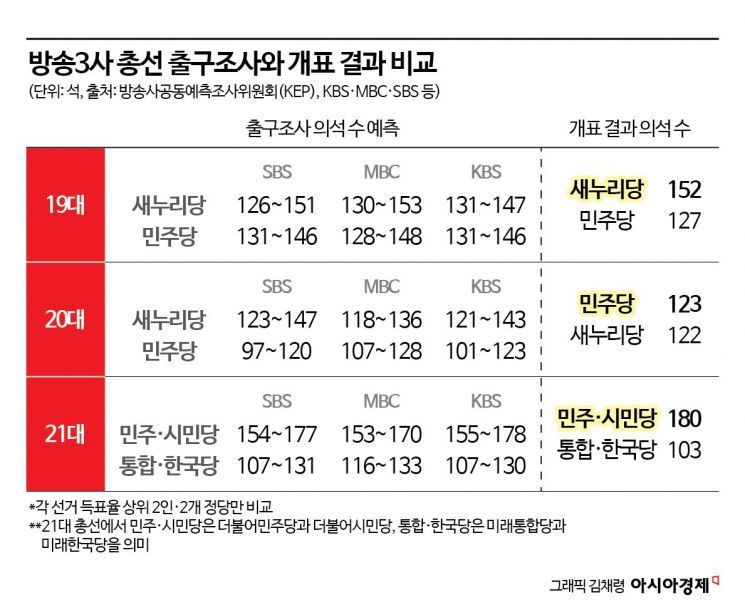
However, the general elections have often been embarrassing for the exit polls. This is because exit polls cover 254 constituencies, and the sample size per individual constituency is smaller than at the national level, making accurate predictions difficult. In the 19th general election in 2012, MBC was the only broadcaster to correctly predict the Saenuri Party's seat count (152 seats), forecasting a range of 130 to 153 seats. All three broadcasters failed to predict the Democratic Party's seat count. In the 20th general election, MBC and KBS expanded their prediction ranges from about 15 seats to up to 24 seats, successfully predicting the seat counts for the two major parties.
In the most recent 21st general election, the semi-proportional representation system was implemented, requiring predictions that included satellite parties. The combined expected seats for the Democratic Party and its satellite party, the Together Citizens' Party, were ▲KBS 155?178 seats ▲MBC 153?170 seats ▲SBS 154?177 seats, but the actual result was 180 seats. For the United Future Party and its satellite party, Future Korea Party, the expected seats were ▲KBS 107?130 seats ▲MBC 116?133 seats ▲SBS 107?131 seats, but the actual seat count was 103. All three broadcasters succeeded in predicting that the Democratic Party would secure more than half the seats but failed to accurately predict the exact number of seats.
Since the 2016 general election, the early voting system has introduced a new variable affecting the accuracy of exit poll strategies. Because exit polls for early voting are prohibited by election law, there is an additional challenge to adjust for differences between early voting and election day votes. Generally, early voting tends to show higher vote shares for Democratic Party candidates compared to election day voting. Regionally, Honam shows high early voting turnout, while Yeongnam has low early voting turnout, a phenomenon known as "high Honam, low Yeongnam" (Hogo-Youngjeo). In the 22nd general election, Jeonnam and Jeonbuk ranked first and second in regional early voting rates at 41.2% and 38.5%, respectively. The lowest early voting rate was in Daegu (25.6%).
Moreover, the early voting rate, which was 12.19% when first introduced in the 20th general election, has been breaking records in each subsequent election: 26.69% in the 21st and 31.28% in the 22nd general elections, increasing the difficulty of predictions. Approximately half of the total expected voter turnout of around 60% occurs through early voting. The three broadcasters and polling agencies apply correction factors based on telephone surveys of early voters.
The three broadcasters conducted joint exit polls again in this general election, investing a total of 7.2 billion KRW. The Korea Broadcasting Association's Joint Broadcasting Prediction Survey Committee (KEP), which includes the three broadcasters, conducted exit polls at about 2,000 polling stations nationwide on election day, the 10th, surveying approximately 500,000 voters before announcing the results. The executing agencies were Korea Research, Korea Research, and Ipsos Corporation.
© The Asia Business Daily(www.asiae.co.kr). All rights reserved.
![Clutching a Stolen Dior Bag, Saying "I Hate Being Poor but Real"... The Grotesque Con of a "Human Knockoff" [Slate]](https://cwcontent.asiae.co.kr/asiaresize/183/2026021902243444107_1771435474.jpg)


















