Climate Shareholder Review System, Strengthening Union Rights, etc.
Business Community "Difficult to Accept" Reluctant
Semiconductor 'Subsidy' Not Specified
Democratic Party Only Mentions Tax Credit Extension
With the 22nd general election ending in a landslide victory for the Democratic Party of Korea, changes in industrial policy are unlikely to be easy. This is because, as in the 21st National Assembly, the 22nd National Assembly is also dominated by the opposition party. Environmental and labor issues are expected to increase the burden on companies due to significant disagreements with the business community, and there is also a possibility that President Yoon Suk-yeol’s vetoed bills, such as the Yellow Envelope Act (amendment to the Labor Union Act), may be reintroduced.
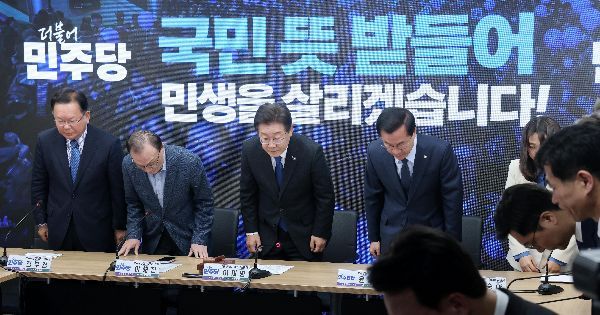 On the 11th, attendees greet each other at the 12th Joint Central Election Countermeasures Committee meeting and the disbandment ceremony of the election committee held at the Democratic Party of Korea headquarters in Yeouido, Seoul. From the left: Kim Boo-kyum of the Democratic Party of Korea, Lee Hae-chan, Co-Chairman of the Standing Joint Election Committee, Lee Jae-myung, Representative, Yoon Young-duk, and Baek Seung-ah, Co-Representatives of the Democratic Union Party. Photo by Hyunmin Kim kimhyun81@
According to the business community and political circles on the 11th, the Democratic Party’s election pledges included institutionalizing equal pay for equal work, shortening working hours, strengthening labor union rights, the phased introduction of the 'Say on Climate' system (a system where shareholders review climate-related issues at general meetings), expanding RE100 (100% renewable energy use), and establishing a Ministry of Climate and Energy. Policies also included the creation of the 'Pangyo K-Fabless (semiconductor design) Valley' and the advancement of industrial structures in steel, petrochemicals, and shipbuilding. Regarding semiconductor support, the plan is to extend the facility investment tax credit (15% for large corporations), which is scheduled to expire at the end of the year.
Among these, the Say on Climate system and strengthening labor union rights are considered difficult for the business community to accept. Experts also believe that climate change disclosure systems like Say on Climate should not be rushed, considering the possibility of the United States withdrawing from the climate change agreement if Donald Trump is elected after the U.S. presidential election in November (local time). Additionally, the introduction of a four-day workweek too rapidly and the implementation of equal pay for equal work without reforming the job- and performance-based wage system could only increase the burden on companies. The proposal to strengthen the so-called 'right to unionize' by changing employment rules to 'workplace agreements' through labor-management consensus is also widely regarded as radical. The introduction of amendments to apply the Labor Standards Act to workplaces with fewer than five regular employees is currently seen as difficult by the business community.
Jo Cheol, a senior researcher at the Korea Institute for Industrial Economics and Trade, said, "If policies that make it difficult to do business, such as strengthening union powers and shortening working hours, are implemented, increased management costs could slow down corporate production and management activities." He added, "If environmental and labor regulations are pushed too quickly, the structural transformation of key industries like steel will be delayed, and management burdens will only increase."
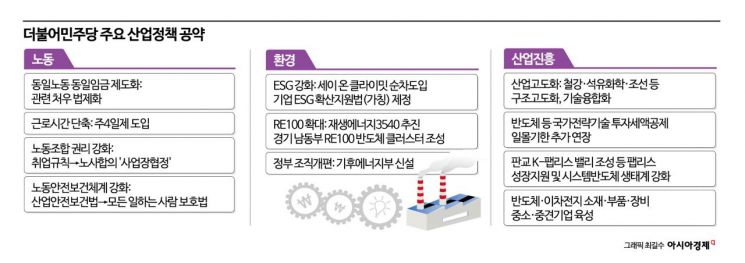
On the other hand, the likelihood of accepting business demands such as expanding facility investment support and easing corporate tax burdens is expected to decrease. The semiconductor industry and the ruling party want subsidies for new facility investments, but the Democratic Party intends only to extend the tax credit. Jang Ji-sang, an emeritus professor at Kyungpook National University who served as the head of the Korea Institute for Industrial Economics and Trade during the Moon Jae-in administration, said, "While the whole world is trying to attract semiconductor factories from overseas, if South Korea falls behind in subsidy support policies, it will be disadvantageous to completing the domestic industrial ecosystem," adding, "To attract foreign investment, subsidy incentives must be provided."
The postponement of the Serious Accident Punishment Act and reforms to inheritance and gift tax systems also seem unlikely. The Korea Employers Federation (KEF) has called for amendments to the Serious Accident Punishment Act, arguing that the level of punishment for individual executives is excessive and proposing fines be imposed on corporations instead of individuals, but the likelihood of this being accepted by the National Assembly has diminished. Furthermore, efforts to lower the top inheritance tax rate to around 25% and switch the taxation method to an estate acquisition tax have lost momentum.
The industrial sector is expressing concerns that various industrial supports may be delayed due to changes in the political landscape. A business community official said, "This is a very important time for strengthening competitiveness in advanced industries and implementing a super-gap strategy, but there are worries that policy support may slow down."
© The Asia Business Daily(www.asiae.co.kr). All rights reserved.
![Clutching a Stolen Dior Bag, Saying "I Hate Being Poor but Real"... The Grotesque Con of a "Human Knockoff" [Slate]](https://cwcontent.asiae.co.kr/asiaresize/183/2026021902243444107_1771435474.jpg)












