122 Seats in the Capital Region... Democratic Party 102 Seats · People Power Party 19 Seats
In the Chungcheong Region, Democratic Party 21 Seats · People Power Party 6 Seats
The outcome of the 22nd National Assembly general election (April 10 election) was decided in the key battlegrounds of the metropolitan area and the Chungcheong region, once again proving these areas as the 'public sentiment barometer' and 'casting voter.' Amid strong calls for judgment on the Yoon Seok-yeol administration, the ruling party responded with a judgment on the Lee-Jo (Lee Jae-myung and Cho Kuk) faction, but it was interpreted as insufficient.
According to the Central Election Commission on the 11th, as of 5 a.m. (counting rate 99%), among the 122 constituencies in the metropolitan area, known as the 'public sentiment barometer' region, the Democratic Party secured 102 seats, and the People Power Party won 19 seats. In the previous general election, the Democratic Party secured 103 seats out of 121 constituencies in the metropolitan area, while the People Power Party secured 17 seats, including Representative Yoon Sang-hyun (Incheon Dong-gu·Michuhol-gu), who ran as an independent at that time.
Out of 48 seats in Seoul, the Democratic Party won 37 seats, and the People Power Party won 11 seats. Compared to the previous general election, the Democratic Party lost 4 seats, and the People Power Party gained 3 seats. Meanwhile, in Gyeonggi Province, the Democratic Party increased by 2 seats to 53 seats compared to the last general election, while the People Power Party decreased by 1 seat to 6 seats. In Incheon, compared to the previous general election where the Democratic Party planted its flag in 11 out of 13 constituencies, there was no surprise in this election except that the Democratic Party additionally took the newly divided constituency (Seo-gu Byeong).
In the Chungcheong region, including Daejeon, Sejong, Chungnam, and Chungbuk, which are casting voter areas, the Democratic Party achieved a landslide victory. Out of 28 seats, the Democratic Party won 21 seats, the People Power Party 6 seats, and the New Future Party 1 seat. The People Power Party lost 2 seats compared to the previous general election, while the Democratic Party gained 1 seat. In particular, the Democratic Party took all 7 seats in Daejeon, and among the 2 seats in Sejong, the New Future candidate Kim Jong-min was elected in Sejong Gap, where the Democratic Party canceled its nomination.
Among the 11 seats in Chungnam, the Democratic Party secured 8 seats, and the People Power Party 3 seats. The Democratic Party increased by 2 seats compared to the previous general election by winning in Asan Gap, Gongju·Buyeo·Cheongyang. In Chungbuk's 8 seats, the Democratic Party won 5 seats, and the People Power Party 3 seats, the same number of seats and constituencies as in the previous general election.
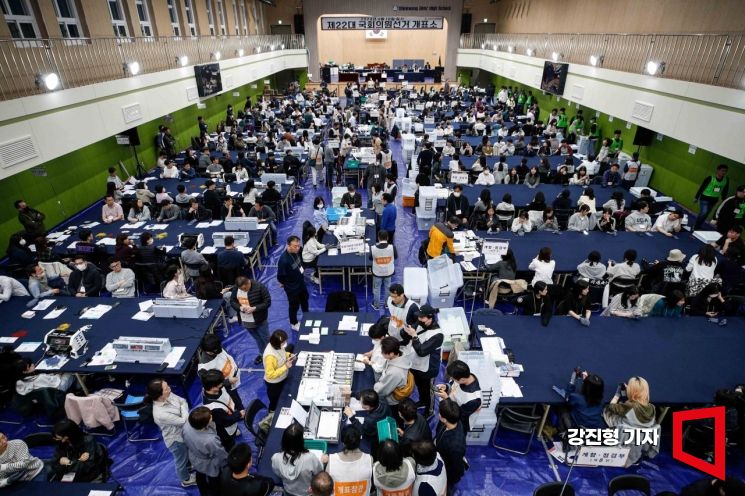 Vote counting is underway at the counting center set up at Shingwang Girls' High School in Yongsan-gu, Seoul, after the voting for the 22nd National Assembly election ended on the 10th. Photo by Jinhyung Kang aymsdream@
In the traditional conservative strongholds of Daegu·Gyeongbuk (TK) and conservative-leaning areas of Busan·Ulsan·Gyeongnam (Bu-Ul-Gyeong) and Gangwon, the People Power Party won, while the Democratic Party secured the majority in the progressive strongholds of Honam and Jeju. Across the Yeongnam region, out of 65 seats, the People Power Party won 59 seats, the Democratic Party 5 seats, and the Progressive Party 1 seat. Compared to the previous general election, the People Power Party gained 3 seats, and the Democratic Party lost 2 seats. In Daegu·Gyeongbuk (TK), the People Power Party swept all 25 seats. In the Bu-Ul-Gyeong region, where 40 seats were contested, the People Power Party won 34 seats, the Democratic Party 5 seats, and the Progressive Party 1 seat. In Gangwon's 8 seats, the People Power Party won 6 seats, and the Democratic Party 2 seats.
There were no surprises in Honam and Jeju either. The Democratic Party dominated all 28 constituencies in Gwangju, Jeonbuk, and Jeonnam, overwhelming their opponents and securing all seats. Notably, Min Hyung-bae, a Democratic Party candidate, won by a margin of 62.3 percentage points over Lee Nak-yeon, co-leader of the New Future Party who left the Democratic Party, in Gwangju Gwangsan. Jeju also saw the Democratic Party retain all 3 seats, as in the previous general election.
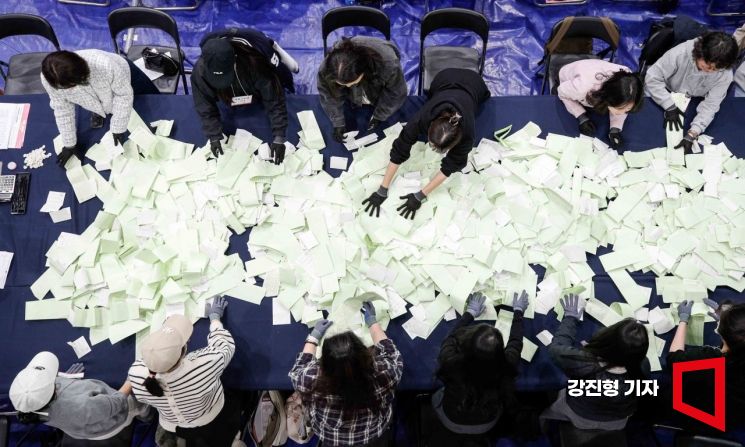 The vote counting is underway at the counting center set up at Shingwang Girls' High School in Yongsan-gu, Seoul, after the voting for the 22nd National Assembly election ended on the 10th. Photo by Jinhyung Kang aymsdream@
© The Asia Business Daily(www.asiae.co.kr). All rights reserved.
![Clutching a Stolen Dior Bag, Saying "I Hate Being Poor but Real"... The Grotesque Con of a "Human Knockoff" [Slate]](https://cwcontent.asiae.co.kr/asiaresize/183/2026021902243444107_1771435474.jpg)

















