Democratic Party Sweeps Victory in Seoul and Capital Area
People Power Party's Na Kyung-won and Kwon Young-se Save Face
People Power Surpasses Democrats in Nakdong River Belt
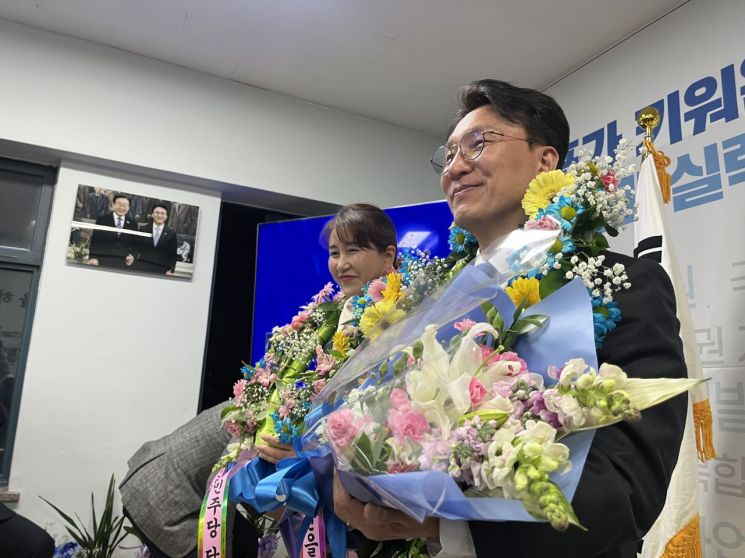 Democratic Party candidate Kim Min-seok, running for Yeongdeungpo-eul in Seoul, is holding a congratulatory bouquet and expressing his victory remarks early morning on the 11th at the election office in Daerim-dong, Yeongdeungpo-gu, Seoul, as his win became certain.
 [Photo by Yonhap News]
In the 22nd National Assembly election, the Democratic Party of Korea achieved a landslide victory. However, in some battleground districts, the fortunes of the ruling and opposition parties diverged. While the Democratic Party maintained its stronghold in the Seoul metropolitan area and the 'Hangang Belt,' the People Power Party performed unexpectedly well in the Nakdong River Belt.
First, in the Seoul, Incheon, and Gyeonggi metropolitan areas?considered a barometer of public sentiment?the Democratic Party secured a decisive victory. In Seoul, the Democratic Party won 37 seats, while the People Power Party took 11 seats. In Gyeonggi, the Democratic Party obtained 53 seats, the People Power Party 6 seats, and the Reform New Party 1 seat.
Both Han Dong-hoon, the emergency committee chairman of the People Power Party, and Lee Jae-myung, the leader of the Democratic Party, made efforts to win over the floating voters in the metropolitan area, including Seoul, but the electorate favored the 'regime judgment theory.'
Especially within the 'Hangang Belt,' the Democratic Party secured early victories in Yeongdeungpo-gap (Chae Hyun-il), Jungseongdong-gap (Jeon Hyun-hee), Gangseo-gap (Kang Seon-woo), and Gangseo-byeong (Han Jeong-ae), and also held onto Yeongdeungpo-eul (Kim Min-seok), Mapo-eul (Jung Cheong-rae), Gwangjin-gap (Lee Jeong-heon), and Gwangjin-eul (Go Min-jeong).
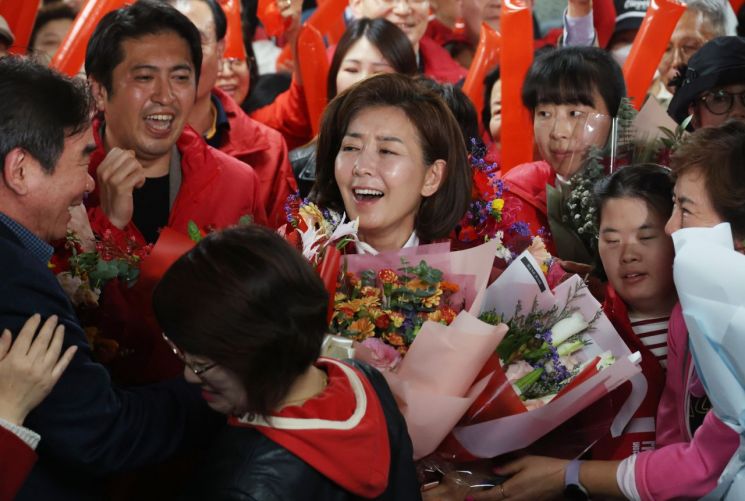 Na Kyung-won, the confirmed winner from Dongjak-gu, Seoul, representing the People Power Party, is receiving a bouquet at the Dongjak-gu campaign office on the 11th. [Image source=Yonhap News]
On the other hand, the People Power Party managed to secure seats only in Yongsan (Kwon Young-se), Dongjak-eul (Na Kyung-won), and Mapo-gap (Jo Jeong-hoon), saving some face. Additionally, they held onto traditional strongholds in the Gangnam 3 districts, including Gangnam-gap (Seo Myeong-ok), Gangnam-eul (Park Soo-min), Gangnam-byeong (Go Dong-jin), Seocho-gap (Jo Eun-hee), Seocho-eul (Shin Dong-wook), Songpa-gap (Park Jeong-hoon), and Songpa-eul (Bae Hyun-jin).
In the largest battleground, Songpa-byeong, Democratic Party candidate Nam In-soon narrowly defeated People Power Party candidate Kim Geun-sik to win the seat.
In the Gyeonggi region, except for Seongnam Bundang and areas adjacent to Gangwon where People Power Party candidates Kim Eun-hye and Ahn Cheol-soo won, the Democratic Party secured numerous victories. This included Seongnam Jungwon (Lee Su-jin), Seongnam Sujeong (Kim Tae-nyeon), and Pyeongtaek, where electoral district adjustments were made.
In the 'Semiconductor Belt,' which includes Gyeonggi's Suwon, Yongin, and Hwaseong?home to domestic semiconductor complexes?the Democratic Party achieved a landslide victory. In Suwon Jeong, Democratic Party candidate Kim Jun-hyeok, who was involved in a controversy over inappropriate remarks, won with 50.86% of the vote against People Power Party candidate Lee Su-jeong. In Hwaseong, Lee Jun-seok, leader of the Reform New Party, ran and was elected.
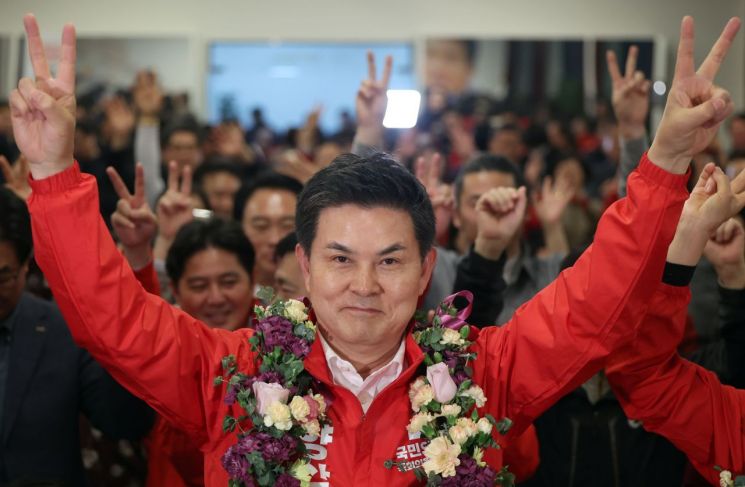 On the morning of the 11th, Kim Tae-ho, the People Power Party candidate for Yangsan-eul, Gyeongnam, greeted supporters at his campaign office in Yangsan City as the "election victory confirmed" notification appeared.
 [Image source=Yonhap News]
Meanwhile, in the Nakdong River front, the People Power Party was evaluated to have performed well.
The Democratic Party won only in Busan Buk-gap (Jeon Jae-su), Gyeongnam Gimhae-gap (Min Hong-cheol), and Gimhae-eul (Kim Jeong-ho), while the People Power Party won most other districts including Busan Saha-gap (Lee Seong-gwon), Saha-eul (Jo Gyeong-tae), Sasang (Kim Dae-sik), Gangseo (Kim Do-eup), Buk-eul (Park Seong-hoon), and Gyeongnam Yangsan-eul (Kim Tae-ho).
The Nakdong River Belt covers 10 electoral districts, with the People Power Party winning 7 seats and the Democratic Party 3 seats. Kim Tae-ho, who defeated incumbent Democratic Party candidate Kim Du-gwan in Yangsan-eul, secured his fourth term, preserving his pride.
It is analyzed that the Democratic Party failed to break through the Busan, Ulsan, and Gyeongnam wall. The Democratic Party aimed to increase its number of seats centered on the Nakdong River Belt in this general election to expand its support base in the Busan, Ulsan, and Gyeongnam regions, but it was deemed insufficient.
© The Asia Business Daily(www.asiae.co.kr). All rights reserved.
![Clutching a Stolen Dior Bag, Saying "I Hate Being Poor but Real"... The Grotesque Con of a "Human Knockoff" [Slate]](https://cwcontent.asiae.co.kr/asiaresize/183/2026021902243444107_1771435474.jpg)


















