The average time individuals spend outside their homes is 10.3 hours, of which 2.5 hours are spent traveling, accounting for 24.3% of daily activity time, according to big data analysis results.
On the 9th, the Korea Research Institute for Human Settlements released a report titled "Characteristics of Activity Space-Time in Our Society Seen Through Mobility Big Data." This analysis was based on data from March to May last year provided by WithDrive, a startup that builds personal mobility data through smartphone apps.
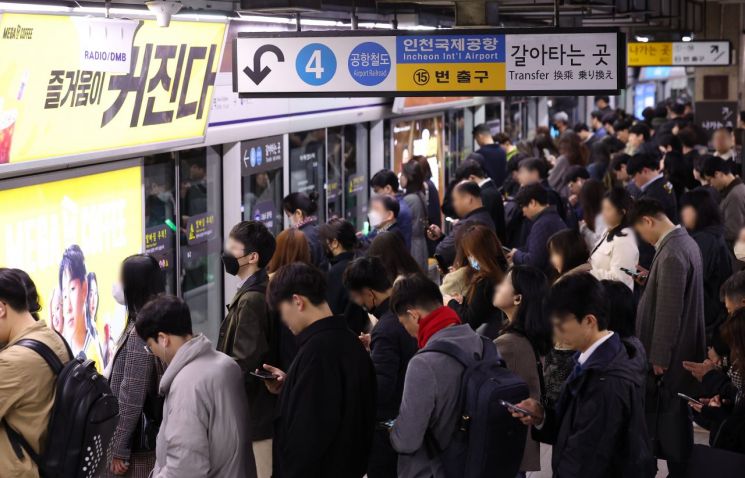 Seoul Station subway platform in Jung-gu, Seoul is crowded with citizens. Photo by Yonhap News Agency
The provinces and cities with relatively low daily activity time of 600 minutes or less were Jeju, Gangwon, Jeonbuk, Chungbuk, and Daejeon. Gyeonggi, Seoul, and Sejong had longer activity times outside the home, exceeding 620 minutes.
Analyzing the travel distance and stay time of residents in 19 new towns in the metropolitan area, nine new towns including Pyeongchon, Ilsan, Gwanggyo, and Unjeong were classified as "regional extroverted" types, where individuals have shorter travel distances than the Gyeonggi average but longer activity times outside the home.
Second-phase new towns far from Seoul, such as Wirye, Pangyo, and Dongtan 2, were classified as "metropolitan extroverted" types, characterized by long travel distances and long activity times outside the home. New towns with long travel distances but short activity times outside the home, classified as "metropolitan introverted," included Bundang, Jungdong, and Gimpo Hangang.
When analyzing travel time by gender, significant differences were observed. Women’s activity time outside the home was 86% of men’s, and their travel distance was 50% of men’s.
By age group, the average daily travel distance for those in their 40s and 50s was 44.5 km, while those in their 20s and 30s traveled 31.4 km, shorter than the middle-aged group.
Senior Researcher Kim Jong-hak stated, "The travel distance is longest among the 40s and 50s age group, which has a high population ratio. As the concepts of shared population and living population become more active in the future, it is necessary to consider regional economic revitalization policies tailored to this age group."
© The Asia Business Daily(www.asiae.co.kr). All rights reserved.
![Clutching a Stolen Dior Bag, Saying "I Hate Being Poor but Real"... The Grotesque Con of a "Human Knockoff" [Slate]](https://cwcontent.asiae.co.kr/asiaresize/183/2026021902243444107_1771435474.jpg)
















