Depending on the results the ruling and opposition parties receive in the April 10 general election, the direction of economic policy management in the latter half of the Yoon Suk-yeol administration is expected to diverge. If the opposition parties, including the Democratic Party of Korea, secure a majority of seats in the general election, various economic policies and reform tasks proposed in the 24 public discussion forums on livelihood and economic policy directions held this year will face difficulties. Most of the government’s strongly promoted policies, such as the abolition of the financial investment income tax, easing of inheritance tax burdens, and full tax exemption for corporate childbirth support funds, require legislative amendments that must be discussed in the National Assembly. Regardless of which side wins, recovering from the domestic demand slump amid the so-called three highs?high inflation, high interest rates, and high exchange rates?will be the greatest challenge pressuring the government.
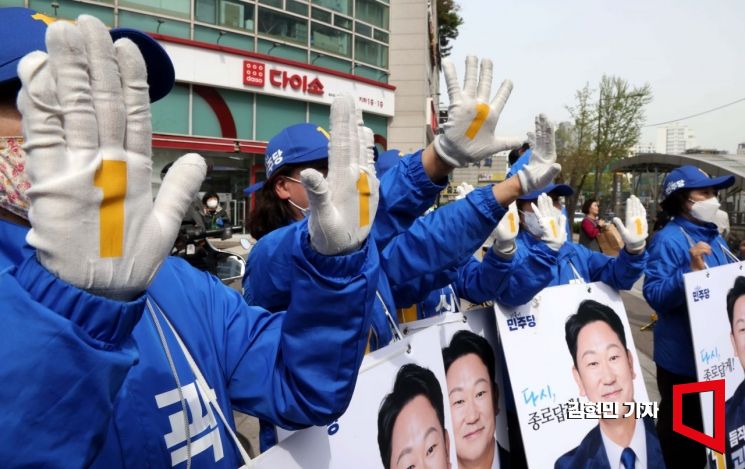 Two days before the 22nd National Assembly election, on the 8th, election campaigners from the Democratic Party of Korea are appealing for support for the general election in front of Dongmyo Station in Seoul Subway. Photo by Hyunmin Kim kimhyun81@
Challenging Economic Situation Even After the General Election
The government spent the first quarter fighting against inflation. Inflation, which had dropped to 2.8% in January, recorded 3.1% consecutively in February and March. Apple prices soared nearly 90% compared to a year ago, marking the highest increase in 40 years since the government began compiling statistics.
As inflation, a barometer of public sentiment, continued its high run, government authorities ahead of the general election implemented various discount policies and blocked corporate price hikes. By suppressing high inflation caused by supply-side issues through short-term market interventions, concerns have been raised that these measures could become factors driving prices up after the election. Approximately 150 billion won was invested to stabilize agricultural and livestock product prices, while on the other hand, fiscal spending was loosened through early execution of social overhead capital (SOC) investment projects, resulting in contradictory inflation policies.
As inflation, a barometer of public sentiment, continued its high run, government authorities ahead of the general election implemented various discount policies to block corporate price hikes. About 150 billion won was invested to stabilize agricultural and livestock product prices, and early execution of social overhead capital (SOC) investment projects was carried out, loosening fiscal spending and producing contradictory inflation policies. By suppressing high inflation caused by supply-side issues through short-term market interventions, concerns have also been raised that these measures could become factors driving prices up after the election.
Recently surging international oil prices have further increased the burden of high inflation. Amid geopolitical instability stemming from Ukraine and the Middle East, and with Mexico reducing crude oil exports, global supply concerns have surged, pushing Brent crude oil prices above $90 per barrel and now approaching the $100 mark. On the 8th (local time), June Brent crude oil on the London ICE Futures Exchange recorded $90.53 per barrel, slightly down 0.70% from the previous session. The price has risen 18% since the beginning of the year.
If rising international oil prices intensify inflationary pressures, it will pose a significant burden on the U.S. Federal Reserve’s expected pivot (direction change) within the year. As domestic inflation in the U.S. remains unchecked, expectations are growing that the timing of interest rate cuts will be further delayed. Additionally, the rise in import prices caused by the high exchange rate of around 1,300 won per dollar is also considered a factor that will increase inflationary pressure.
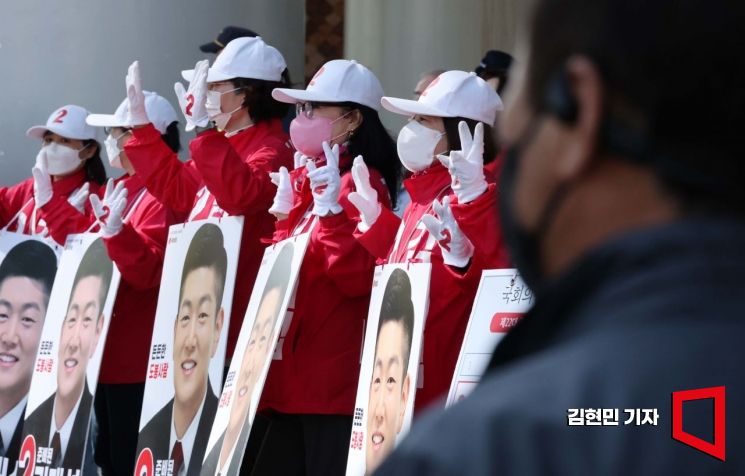 On the 9th, one day before the 22nd National Assembly election, People Power Party campaigners are appealing for support for the general election in front of Changdong Station in Dobong-gu, Seoul. Photo by Hyunmin Kim kimhyun81@
‘Tax Cut’ Policies in Limbo if the Opposition Wins
If the ruling party wins the upcoming general election, the government’s tax reform efforts are expected to gain momentum. The tax reform plan for next year, to be announced at the end of July, focuses on tax cuts. These include the abolition of the financial investment income tax, expansion of tax benefits for Individual Savings Accounts (ISA), corporate tax relief and dividend income tax reduction for companies increasing dividends, and expansion of the business succession deduction. All these tax cut proposals require amendments to laws such as the tax law and capital market law, but they have yet to pass the National Assembly due to contentious disagreements between the ruling and opposition parties. Proposed amendments to the Restriction of Special Taxation Act, which include expanding tax credits for research and development (R&D) investment and extending the sunset clause for temporary investment tax credits (temporary investment), have also been submitted but not yet passed.
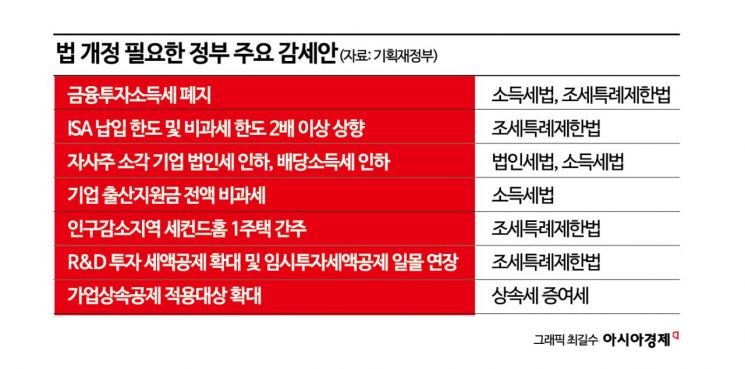
Attention is also focused on whether momentum for a comprehensive overhaul of inheritance and gift taxes will reignite. The government, which has been pushing for the introduction of an inheritance acquisition tax that levies taxes based on the inherited property, has been promoting reforms including switching the inheritance tax system from the current estate tax to the inheritance acquisition tax. Political circles expect that if the ruling party wins and the National Assembly’s power dynamics change, a tax law revision bill will be prepared immediately after the election, leveraging public opinion from the general election, and legislative procedures will begin in the National Assembly.
On the other hand, if the opposition wins and a minority ruling party-majority opposition National Assembly continues, the driving force behind the government’s strongly pushed economic policies will be significantly weakened. In particular, various tax cut policies, which are a core economic pillar of the Yoon Suk-yeol administration, will fall into limbo. As the administration enters its third year, the latter half of its term, major policies are likely to be blocked by the National Assembly and unable to exert their full effect. With the 21st National Assembly recording the lowest rate of government spending bills being reflected in legislation, it is uncertain whether the government’s policy implementation will proceed smoothly. A Ministry of Economy and Finance official pointed out, "If the current minority ruling party-majority opposition situation continues after the general election, the government’s ability to push forward state affairs will weaken, and passing bills through the National Assembly will become even more difficult than now."
© The Asia Business Daily(www.asiae.co.kr). All rights reserved.



















