AI-Semiconductor 9 Key Technology R&D Greatly Expanded
Semiconductor Companies Consider Domestic Investment Incentives
Extension of National Strategic Technology Investment Tax Credit
Financial Support to Local Governments Cooperating on Infrastructure
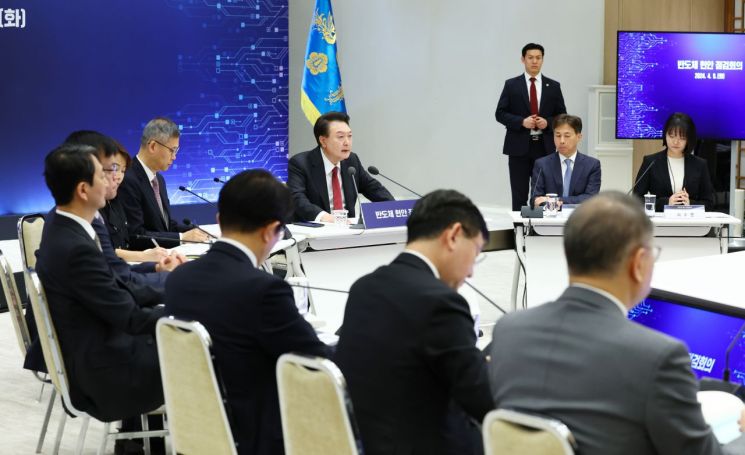 President Yoon Suk-yeol is speaking at the semiconductor issue review meeting held on the 9th at the Yongsan Presidential Office building in Seoul. [Image source=Yonhap News]
The government has decided to promote the 'AI-Semiconductor Initiative' and significantly expand research and development (R&D) to leap to the world's third position in artificial intelligence (AI). While extending the application period of the national strategic technology investment tax credit, which is set to expire at the end of this year, it also plans to promptly devise measures to provide incentives to semiconductor companies investing domestically.
On the 9th, the government held a 'Semiconductor Issue Review Meeting' at the Presidential Office in Yongsan, Seoul, attended by President Yoon Seok-yeol and jointly organized by related ministries including the Ministry of Science and ICT and the Ministry of Trade, Industry and Energy, to discuss these matters.
On this day, the government decided to promote the 'AI-Semiconductor Initiative' to enhance AI competitiveness amid fierce global leadership competition. The AI-Semiconductor Initiative started with the aim of organically linking and cooperating AI semiconductors, AI models, hardware (HW), and software (SW) to leap to the global AI third place. It plans to concentrate national R&D capabilities on a total of nine technological innovations and expand the scale of support.
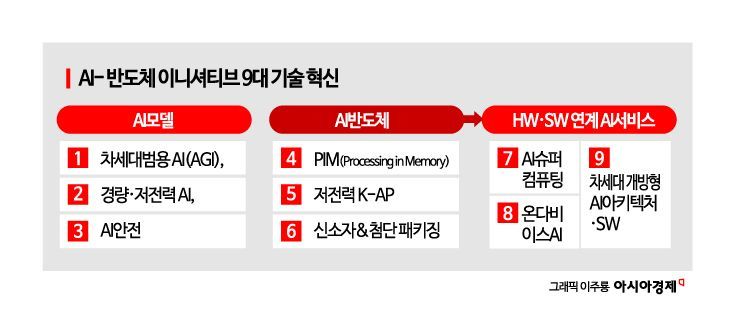
In the AI model field, the government will pursue securing core technologies for next-generation general-purpose AI (AGI), lightweight and low-power AI small large language models (sLLM), and developing AI safety technologies. In the AI semiconductor field, it will promote innovations in processing-in-memory (PIM) applying computing functions to high-bandwidth memory (HBM) and low-power memory (LPDDR), Korean-style application processors (K-AP) implemented based on neural processing units (NPU) and neuromorphic AI semiconductors, and new device & advanced packaging technologies.
Alongside this, the government will promote K-Cloud 2.0 aimed at AI supercomputing, secure core technologies for on-device AI, and develop next-generation open AI architecture and software technologies.
The government explained, "We plan to concentrate national R&D capabilities on nine AI-semiconductor technological innovations, expand investment support scale, and support the entire AI-semiconductor value chain including talent cultivation, innovation infrastructure, global cooperation and advancement, and leading AI ethical standards." Additionally, it plans to successfully host the 'AI Seoul Summit' in May to strengthen Korea's global leadership in AI ethical standards. On the 4th, the 'AI Strategy High-Level Council' for public-private cooperation in AI semiconductors was also launched.
On this day, the government also discussed follow-up measures for the semiconductor mega cluster, which involves a total investment of 622 trillion won. Samsung Electronics' Yongin system semiconductor cluster, which plans to invest 360 trillion won until 2047, intends to significantly shorten the originally planned development period through the use of the environmental impact assessment pre-consultation system and expedited land compensation.
SK Hynix's Yongin semiconductor cluster, which plans to invest 122 trillion won until 2045, requires additional water supply at a level similar to the 270,000 tons of water already secured. The government plans to promptly finalize water supply measures as soon as the companies and local governments establish water supply facility installation plans.
Furthermore, the government plans to amend the Advanced Industry Act to establish a legal basis for providing financial support to local governments cooperating in the installation of infrastructure such as power and water. It will also promptly devise measures to provide incentives to advanced companies investing domestically in response to semiconductor subsidy competition from countries like the United States and Japan. Currently, a maximum deduction rate of 25% is applied, but the government will also pursue extending the application period of the national strategic technology investment tax credit, which expires at the end of this year.
To cultivate field-customized professionals, the government will additionally select 10 semiconductor-specialized universities and 3 graduate schools, and expand semiconductor academy education personnel from 520 last year to 800 this year. It will establish mobile public housing districts around semiconductor clusters and promptly promote the construction of the semiconductor highway (Hwaseong~Yongin~Anseong, 45km). Plans will also be made to provide package support for immigration, residence, and settlement to attract excellent overseas professionals to Korea.
Meanwhile, this meeting was convened to confirm global semiconductor supply chain risks caused by events such as the Taiwan earthquake and to have President Yoon Seok-yeol directly inspect measures for the rapid establishment of the semiconductor mega cluster. Related ministries including the Ministry of Trade, Industry and Energy, Ministry of Economy and Finance, Ministry of Science and ICT, Ministry of Land, Infrastructure and Transport, and Ministry of Environment, as well as related companies such as Samsung Electronics, SK Hynix, Naver, and Sapeon Korea participated.
© The Asia Business Daily(www.asiae.co.kr). All rights reserved.


















