Opposition Party Opposes, Ruling Party Omits from Top 10 Pledges
Discussion in the 22nd National Assembly Expected to Take Over a Year
As Chinese direct purchase applications (apps) such as AliExpress and Temu strengthen their attack on the domestic distribution market, the bill to ease distribution regulations, including early morning delivery by large supermarkets and the conversion of mandatory closing days to weekdays, is at a crossroads. Although the Yoon Seok-yeol administration has promoted large supermarket business regulations as a core policy since the beginning of the year and pushed for it, opposition parties have opposed it, and it is expected to be automatically discarded when the 21st National Assembly ends.

According to the top 10 party pledges submitted by each party to the National Election Commission ahead of the general election on the 9th, the ruling People Power Party did not include any content related to early morning delivery by large supermarkets or changes to mandatory closing days in their top 10 pledges. In January this year, the Office for Government Policy Coordination held a 'Public Discussion on Livelihood with the People' and announced plans to abolish the regulation requiring large supermarkets to close twice a month on designated public holidays and to improve the system to allow early morning delivery.
The abolition and relaxation of mandatory closing days for large supermarkets was considered the 'No. 1 regulatory reform' agenda by the Yoon Seok-yeol administration. However, the ruling party, which should supplement this through legislation, excluded this agenda from their top 10 pledges.
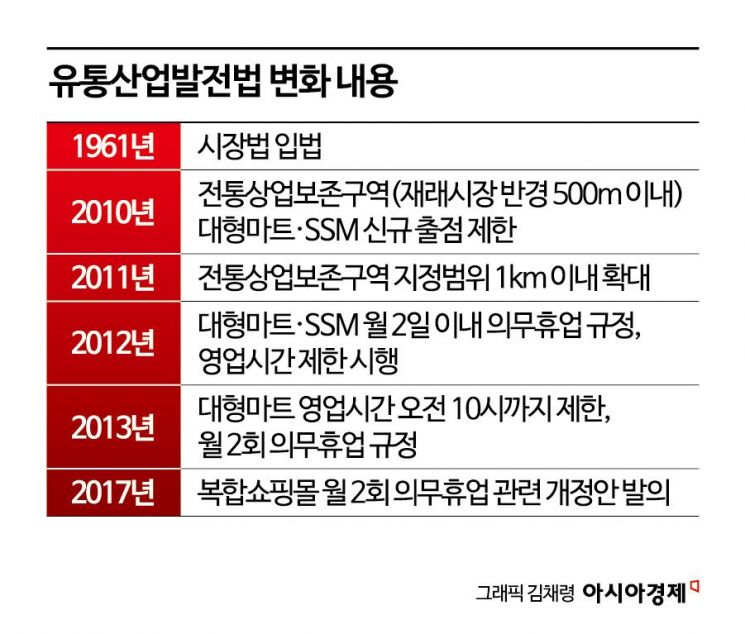
The amendment to the Distribution Industry Development Act, which has been in effect since 2013, has been stagnant for over 10 years. After being reviewed by the Subcommittee of the National Assembly's Industry, Trade, Energy, Small and Medium Enterprises Committee in August and December last year, no discussions have taken place this year. Currently, large supermarkets centered on offline stores cannot provide early morning delivery. According to the Distribution Industry Development Act, large supermarkets are subject to mandatory closing twice a month and business hour restrictions (from midnight to 10 a.m.), which prohibit early morning work for supermarket employees.
As the weight of the distribution market has recently shifted online, voices calling for the removal of shackles binding large supermarkets are growing louder. The National Assembly Legislative Research Office expressed in a report earlier this year that allowing telecommunication sales (online sales) during restricted business hours and mandatory closing days for large supermarkets should be positively considered, citing the rapid changes in the distribution market. In particular, as the influence of the online market grows, the influence of Chinese e-commerce is increasing even more. According to Statistics Korea, last year, the scale of online overseas direct purchases reached 6.76 trillion won, surpassing 6 trillion won for the first time since related statistics began in 2014. Of this, the amount of Chinese overseas direct purchases reached 3.2873 trillion won.
An official from the distribution industry said, "The domestic distribution market has shifted leadership to online, and with the fierce offensive of Chinese companies, it is unreasonable to view the Distribution Industry Development Act only from the perspective of traditional markets and large supermarkets," adding, "The regulatory easing bill should be legislated from the perspective of consumer benefits."
However, it is expected that the Distribution Industry Development Act is unlikely to be amended in the 21st National Assembly. The government plans to amend the law to allow early morning delivery by large supermarkets after this general election, but the speed of amendment may vary depending on the results of the April 10 general election.
© The Asia Business Daily(www.asiae.co.kr). All rights reserved.


















