KCC to Submit Bill to National Assembly in Second Half of Year
Same Service-Same Regulation Principle, Increased OTT Regulation
OTT Continues to Oppose: "Different Characteristics from Pay TV"
The government plans to regulate the media industry through the Integrated Media Act (tentative name) under the principle of 'same service - same regulation.' Regulations on Over-The-Top (OTT) services will be strengthened compared to the current level, while regulations on existing broadcasting such as terrestrial broadcasting, which have been relatively strict, are likely to be eased. However, since the 22nd National Assembly is about to convene, the direction may change depending on the political landscape between the ruling and opposition parties.

According to the Korea Communications Commission (KCC) on the 15th, the government plans to prepare the 'Integrated Media Act' in the second half of this year and submit it to the National Assembly. The Integrated Media Act is a law that encompasses existing media such as TV and radio as well as OTT. It is also an attempt to revise the Broadcasting Act, which has remained unchanged for over 20 years, and to bring OTT, which has been in a legal blind spot, into the regulatory framework. A KCC official stated, "The sponsor and schedule for the bill have not been decided yet, but it will be proposed as soon as the bill is prepared."
However, it is uncertain whether the preparation of the bill will accelerate following the opposition's landslide victory in the general election. Although the Democratic Party has been pushing for changes in the media regulatory system for some time, since it was their number one pledge in the broadcasting media sector, discussions on improving the governance structure of public broadcasting? which was vetoed by President Yoon Seok-yeol?are likely to ignite first.
The Integrated Media Act was first proposed during the 20th National Assembly under the name 'Complete Revision of the Broadcasting Act' during the Moon Jae-in administration but failed to pass the plenary session. The 5th KCC, led by former Chairman Han Sang-hyuk appointed during the Moon administration, announced in January 2021 plans to draft and revise the bill by 2022, but this deadline was missed. The Yoon Seok-yeol administration also mentioned 'establishing future legislation for old and new media' as a national agenda, with the 6th KCC under former Chairman Lee Dong-gwan emphasizing the need for integrated legislation. Last month, the KCC announced in its work plan that it would reorganize the fragmented old and new media laws scattered across the Broadcasting Act, IPTV Act, and Telecommunications Business Act to re-pursue the enactment of the Integrated Media Act. A KCC official said, "We are continuously reviewing and adjusting based on the drafts previously prepared."
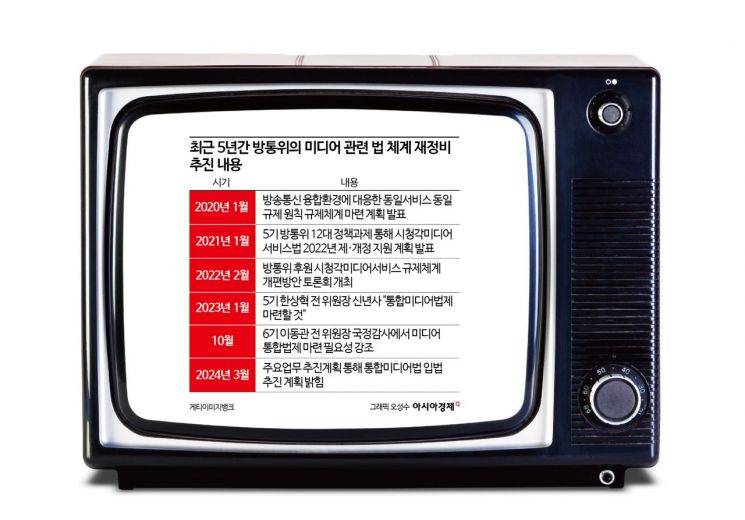
The Integrated Media Act applies the principle of same service - same regulation to media grouped in the same category. Therefore, OTT, which currently faces relatively less regulation compared to other media, is expected to face increased regulation, while terrestrial and cable broadcasting, which have been more heavily regulated, are likely to see eased regulations. A KCC official explained, "There is a significant regulatory gap between traditional broadcasting and new media, so some alignment is necessary," adding, "In broad terms, unnecessary regulations on existing broadcasting will be eased to reflect reality, and new regulations necessary from the user's perspective will be introduced for OTT."
OTT is expected to be regulated together with IPTV and cable TV, which act as platform operators. Currently, pay-TV operators undergo government reauthorization or reapproval every seven years. An industry insider from the OTT sector said, "Pay-TV requires government permission or registration to enter the market, but in return, it can hold a kind of monopoly right," adding, "If OTT, which anyone can enter, is to be regulated like other media, benefits equivalent to monopoly rights are necessary." They further noted, "For the bill to be effective, it must reflect the constraints and advantages unique to each industry." An industry representative from cable TV, which is likely to be grouped in the same category as OTT, also said, "We hope for deregulation of pay-TV rather than strengthening regulations on OTT."
There are also significant concerns that strengthened regulations will impact domestic OTT providers more than global OTT companies. According to the 2023 audit report disclosed on the 12th by Netflix Services Korea, the Korean branch of Netflix, the company recorded sales of 823.3 billion KRW domestically last year. However, its corporate tax expenditure was only 3.6 billion KRW, which is 0.4% of sales.
An OTT industry insider said, "If regulations on OTT are introduced while Netflix pays almost no corporate tax domestically, it is highly likely that only domestic companies will be regulated, resulting in reverse discrimination," adding, "This will inevitably weaken the competitiveness of domestic OTT providers." A KCC official stated, "We are preparing the bill with consideration to prevent discrimination between domestic and foreign operators."
© The Asia Business Daily(www.asiae.co.kr). All rights reserved.