Fair Trade Commission Investigates Temu for False and Exaggerated Advertising
Carcinogens Detected in Sold Products
Customer Complaints Increase Over Slow Delivery and Returns
Government Forms Task Force to Address C-Commerce
AliExpress, Temu, and other C-commerce (Chinese e-commerce) companies, which are rapidly expanding in the domestic market, have encountered consecutive obstacles. Following criticism over inadequate consumer protection policies, there are now indications of exaggerated product advertisements. Safety concerns are also growing as inspection results revealed carcinogenic substances exceeding standard levels in some products.
According to the distribution industry on the 8th, the Fair Trade Commission is investigating Temu for potential violations of the Electronic Commerce Act and the Act on Labeling and Advertising. The commission is reportedly examining allegations of false and exaggerated advertising by Temu. Additionally, it is investigating whether Temu has violated consumer protection obligations stipulated under the Electronic Commerce Act. According to the Act, communication sales intermediary businesses must provide consumers with information about the identity of the vendors and have personnel and facilities to resolve consumer complaints and disputes. The Fair Trade Commission is reportedly verifying whether Temu complies with these consumer protection regulations.
Since entering Korea in July last year, Temu has rapidly expanded its share of the domestic e-commerce market through aggressive marketing. During this process, it provided cash-equivalent coupons to domestic customers, and there is growing interest in whether the multi-level marketing method used in the 'Invite a Friend' event is also under investigation.
Detection of Carcinogens such as Cadmium and Lead... Hazardous Substances Exceeding Standards Found in Baby Products
Safety issues have also been raised regarding products sold on C-commerce platforms. The Incheon Regional Customs Office announced yesterday that, after analyzing the components of 404 accessories sold on AliExpress and Temu, carcinogenic substances exceeding the standard levels were detected in 96 products, accounting for 24%. According to the component analysis by Incheon Customs, these products contained cadmium and lead at levels ranging from at least 10 times to as much as 700 times the domestic safety standards.
Cadmium is a heavy metal known to cause "Itai-itai disease" in Japan and can induce respiratory, renal, and digestive system diseases upon poisoning. Lead poisoning can cause diseases affecting the renal, central nervous, digestive, and reproductive systems. Incheon Customs plans to strengthen customs clearance, management, and supervision of these products while requesting AliExpress and Temu to suspend their sales.
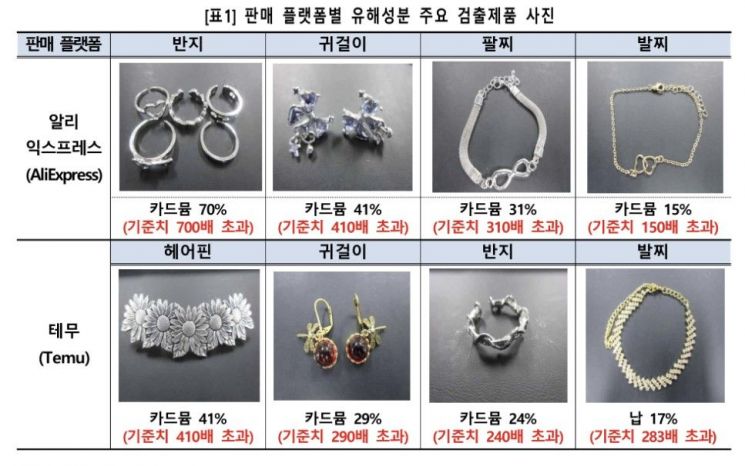 Major jewelry products sold on AliExpress and Temu found to contain harmful substances. [Image provided by Incheon Customs]
Hazardous substances were also detected in baby products sold on C-commerce platforms. Last month, Seoul City conducted a safety investigation on 31 frequently sold daily-use products on AliExpress and found that 8 children's products significantly exceeded the allowable limits for hazardous substances. Additionally, some products were found to lack physical safety standards such as durability.
The products that failed the inspection include eight items: children's water play tubes, walkers, wooden magnetic fishing toys, teething toys (candy-shaped and banana-shaped), character pencils, eraser pencils, and children's leather bags. Among these, four types of phthalate plasticizers used in processing plastics were detected in the children's leather bags, at levels 55.6 times higher than the standard. Phthalate plasticizers are known to cause reproductive toxicity such as infertility, and di(2-ethylhexyl) phthalate (DEHP) is classified as a possible human carcinogen (Group 2B) by the International Agency for Research on Cancer.
Increase in Customer Complaints... Companies Pledge to Take Down Problematic Listings
As the number of domestic customers using C-commerce increases, consumer complaints are also rising. According to the Korea Consumer Agency, the number of international transaction consumer consultations received last year was 19,418, a 16.9% increase from 16,608 in the previous year. Among these, consultations related to direct product transactions surged by 136.1%, marking the largest increase. The Consumer Agency attributes this rise to increased consultations related to AliExpress and other C-commerce platforms. In fact, the number of consultations related to AliExpress increased nearly threefold, from 228 in 2022 to 673 last year.
The main consumer inconveniences experienced on C-commerce platforms were related to refunds and delivery issues. Among complaints received by the Consumer Agency, delays or refusals of cancellations and refunds accounted for the largest share with 7,521 cases (38.7%). This was followed by delivery-related complaints such as non-delivery, delayed delivery, and wrong delivery with 2,647 cases (13.6%), and unfair charges for penalties and fees as well as price complaints with 2,271 cases (11.7%).
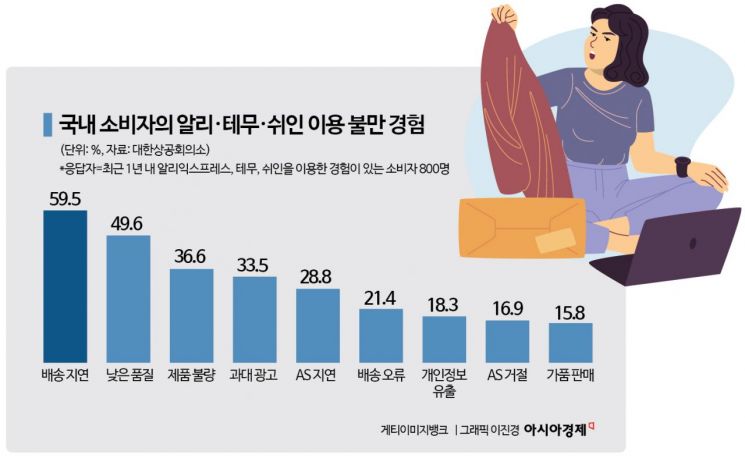
A survey also revealed declining shopping satisfaction among customers using C-commerce. The Korea Chamber of Commerce and Industry recently surveyed 800 consumers who had used AliExpress, Temu, or Shein within the past year about their "Usage Status and Perceptions of Chinese Online Shopping Platforms." The results showed that 80.9% of users experienced dissatisfaction or harm while using C-commerce. In this survey, the most frequently cited problem was delivery delays (59.5%), followed by low quality (49.6%), defective products (36.6%), exaggerated advertising (33.5%), and delayed after-sales service (28.8%).
As consumer and industry criticisms of C-commerce platforms continue, the government has also begun preparing countermeasures. Last month, the government held an inter-agency meeting on overseas direct purchase (direct buying) response, attended by the Office for Government Policy Coordination, Ministry of Trade, Industry and Energy, Ministry of SMEs and Startups, Fair Trade Commission, and Korea Customs Service, and decided to form a "Comprehensive Task Force (TF) on Overseas Direct Purchase." The TF will develop and announce comprehensive measures regarding overseas direct purchases. The Personal Information Protection Commission (PIPC), a government agency under the Prime Minister, is also conducting an investigation into the collection and use of personal information by C-commerce companies. The PIPC is reportedly examining how user data is collected and utilized by these companies.
However, C-commerce companies have stated that they have established and are implementing policies to protect consumers. AliExpress currently enforces policies such as unconditional returns and refunds within 90 days, guaranteed delivery periods, and counterfeit compensation programs. An AliExpress representative said, "We have started an internal investigation into the recently reported products," adding, "If products requiring safety certification do not meet domestic regulatory requirements, they will be immediately removed from the platform."
© The Asia Business Daily(www.asiae.co.kr). All rights reserved.
![From Bar Hostess to Organ Seller to High Society... The Grotesque Con of a "Human Counterfeit" [Slate]](https://cwcontent.asiae.co.kr/asiaresize/183/2026021902243444107_1771435474.jpg)


















