Hyundai Motor Company and Kia will equip India-exclusive electric vehicle models with batteries produced by a local company for the first time. They are establishing a localized supply chain through strategic collaboration with Exide Energy, an Indian battery specialist company.
On the 8th, Hyundai Motor Company and Kia announced that they signed a strategic business agreement with India's battery specialist company 'Exide Energy' at Namyang Research Center in Hwaseong, Gyeonggi Province to localize battery cells for India-exclusive electric vehicles.
The signing ceremony was attended by Yang Heewon, President and Head of Hyundai Motor Company and Kia R&D Headquarters; Kim Changhwan, Executive Vice President in charge of Electrification Energy Solutions; Jung Deokgyo, Senior Executive Director of Electrification Parts Purchasing Division; and Mandar V Deo, CEO of Exide Energy, along with other representatives from both sides.
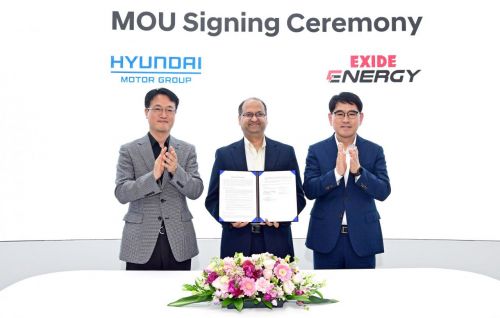 (Photo from left) Jeong Deokgyo, Executive Director of Electrification Parts Purchasing Division at Hyundai Motor Company and Kia, Mandar V Deo, CEO of Exide Energy, and Yang Heewon, Head of R&D Division at Hyundai Motor Company and Kia, are posing for a commemorative photo after signing a business agreement. [Photo by Hyundai Motor Company]
Exide Energy is a subsidiary established in 2022 by Exide, the leading company in the Indian lead-acid battery market with over 75 years of battery business experience in India, to enter the automotive battery business. It plans to begin pilot mass production of electric vehicle battery cells as early as the end of this year.
This agreement represents a global partnership for the successful launch of India-exclusive EVs, including ▲development and production of Hyundai Motor Company and Kia exclusive battery cells ▲expansion of partnerships across electrification such as EVs and HEVs ▲joint cooperation to secure cost competitiveness.
First, Exide Energy will develop and produce LFP (Lithium Iron Phosphate) battery cells, which are scheduled for initial mass production, and supply them to Hyundai Motor Company and Kia’s production bases in India. Exide Energy’s battery cells will be installed in future India-market exclusive EVs. This model is expected to be the first electric vehicle equipped with locally produced batteries.
Hyundai Motor Company and Kia will collaborate with Exide Energy throughout all stages from development to mass production to ensure the quality of vehicle batteries produced for the first time in India. They also plan to jointly respond to the Indian government’s electrification policies. India, known as one of the world’s top three automobile markets, recently began offering government incentives to companies starting electric vehicle production domestically. The Indian government announced plans to increase the share of electric vehicle sales to 30% of total vehicle sales by 2030.
Hyundai Motor Company and Kia expect that localizing batteries, which account for a significant portion of electric vehicle costs, will secure price competitiveness in the cost-sensitive Indian market and also diversify and stabilize the battery supply chain. In particular, they anticipate that the fact that electric vehicles are equipped with domestically produced batteries will act as a positive purchasing factor for Indian consumers.
Yang Heewon, Head of Hyundai Motor Company and Kia R&D Headquarters, said, "India is an important market where electrification is expected to expand in the future, and securing cost competitiveness through early battery localization is crucial. We are very honored that the dedicated EV scheduled for mass production in India will be the first electric vehicle to be equipped with batteries produced locally by an Indian company."
© The Asia Business Daily(www.asiae.co.kr). All rights reserved.
![User Who Sold Erroneously Deposited Bitcoins to Repay Debt and Fund Entertainment... What Did the Supreme Court Decide in 2021? [Legal Issue Check]](https://cwcontent.asiae.co.kr/asiaresize/183/2026020910431234020_1770601391.png)
















