Circulation with USD and Other Legal Currencies from the 8th
Value Plummets Despite Reintroduction in 2019
Zimbabwe is introducing a new currency to replace the Zimbabwe dollar (Z$), which has plummeted in value, in order to cope with soaring inflation.
On the 6th (local time), the local daily The Herald reported that the day before, John Mushayavanhu, Governor of the Reserve Bank of Zimbabwe, held a press conference to unveil the new currency called the "Zimbabwe Gold" (ZiG) dollar. ZiG will circulate alongside other legal tender currencies such as the US dollar and the South African rand starting from the 8th. The Zimbabwe dollar, whose value has sharply declined, will cease to be used.
Zimbabwe's new currency 'ZiG' [AFP=Yonhap News]
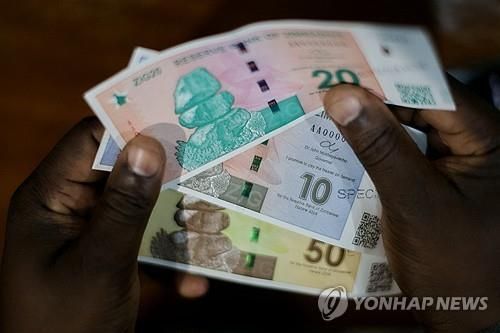
The exchange rate of the new currency, which is backed by foreign currency, gold, and precious metals held by the central bank, has been set at 13.56 ZiG per US dollar. Additionally, reflecting the new monetary policy, the interest rate was drastically lowered from 130% to 20%. Governor Mushayavanhu explained, "The multi-currency system will be maintained at least until 2030," and added, "The existing Zimbabwe dollar must be exchanged for ZiG currency within three weeks."
In 2009, Zimbabwe adopted foreign currencies such as the US dollar as legal tender after astronomical inflation exceeding 200 million percent rendered its own currency virtually worthless. At that time, Zimbabwe issued banknotes as high as 100 trillion Zimbabwe dollars before ultimately abandoning its national currency. Because of this, old Zimbabwean banknotes became popular among collectors worldwide and frequently appear on secondhand trading platforms in South Korea as well. In particular, the 100 trillion dollar note was nicknamed the "lucky bill," but in 2009, it was only worth enough to buy about three eggs in Zimbabwe.
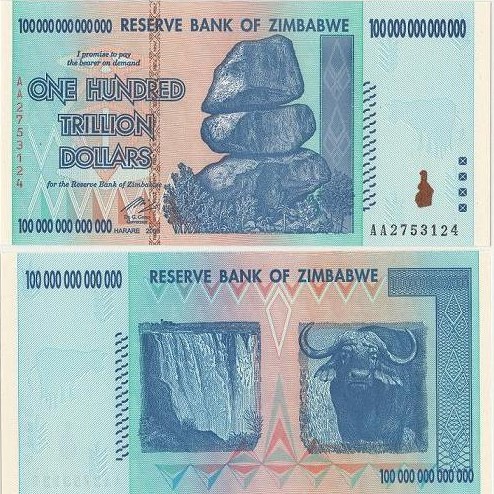 Zimbabwe 100 trillion dollars
Ten years later, in 2019, Zimbabwe reintroduced the Zimbabwe dollar and made various efforts to revive it, but these were insufficient to prevent the currency's depreciation. The Zimbabwe dollar has lost nearly 80% of its value in the official currency market this year, making it the second worst-performing currency in the world. Meanwhile, due to the sharp decline in currency value, Zimbabwe's inflation rate surged from 26.5% in December last year to 34.8% in January, 47.6% in February, and 55.3% in March.
Governor Mushayavanhu said, "Although nearly 85% of transactions are already conducted in US dollars, we will strive to ensure that the local currency does not disappear."
© The Asia Business Daily(www.asiae.co.kr). All rights reserved.
![Clutching a Stolen Dior Bag, Saying "I Hate Being Poor but Real"... The Grotesque Con of a "Human Knockoff" [Slate]](https://cwcontent.asiae.co.kr/asiaresize/183/2026021902243444107_1771435474.jpg)
















