One-Year Preliminary Design Project... Equipped with Advanced Technology
Total Project Budget Up to 6.2 Trillion KRW
The U.S. National Aeronautics and Space Administration (NASA) has officially begun developing a vehicle (LTV, lunar terrain vehicle) to carry out exploration missions on the lunar surface.
On the 5th (local time), NASA announced that it had selected Intuitive Machines, Luna Outpost, and Venturi Astrolab as candidate companies for LTV production. These companies will develop vehicles to be used by astronauts for mobility and exploration on the lunar surface during the Artemis Phase 5 mission in 2030.
The selected companies have formed consortia with specialized firms in various fields to develop special vehicles and tires capable of withstanding the lunar environment.
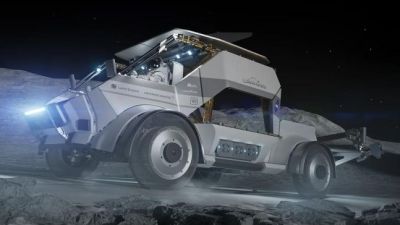 LTV development candidate company Intuitive Machines' lunar vehicle concept design
 [Image source: Provided by Intuitive Machines]
Intuitive Machines is collaborating with Boeing, Michelin, and Northrop Grumman, while Luna Outpost is working with Lockheed Martin, General Motors (GM), and Goodyear. Astrolab is known to have partnered with Axiom Space and Odyssey Space Research.
The selected companies will receive a one-year feasibility task order to develop preliminary design projects that meet NASA’s requirements. The vehicles to be developed must withstand the extreme conditions of the lunar south pole and be equipped with advanced technologies for power management, autonomous driving, communication, and navigation systems.
Afterward, NASA plans to select one company through a process of verifying the performance and safety of each design proposal and sign a follow-up contract. The companies will also be responsible for transporting the LTV to the Moon in addition to its development.
 Lunar Outpost's lunar rover concept design selected as a candidate for LTV development [Image source: Lunar Outpost]
The LTV will be remotely operated as needed to support NASA’s scientific activities when astronauts are not present on the Moon between Artemis missions. NASA stated, “During other periods, suppliers may use the LTV for commercial activities unrelated to NASA missions.”
Jacob Bleacher, chief scientist of NASA Headquarters’ Exploration Systems Development Mission Directorate, said, “We will use the LTV to travel to areas that are inaccessible on foot,” adding, “This will enhance exploration capabilities and enable new scientific discoveries.”
Meanwhile, NASA announced that the total budget for this project is expected to reach up to $4.6 billion (approximately 6.2261 trillion KRW).
© The Asia Business Daily(www.asiae.co.kr). All rights reserved.


















