Interview with Son Icheon, Chief Auctioneer at K-Auction
"Bang!" At the moment when the price of an artwork is decided with a clear sound, people's attention is usually directed not at the artwork but at the auctioneer. Naturally, the main character of an art auction is the artwork, but the show-stealer who raises the price and focuses people's interest is undoubtedly the auctioneer. There are fewer than ten art auctioneers in Korea, and they are like conductors leading an orchestra at the scene, but behind the auction, they must also play the roles of director and player who know all the data and information about the artworks and clients. We met Son Icheon, Director (Chief Auctioneer) of K Auction, who has been working as an art auctioneer for 16 years, to hear his special story.
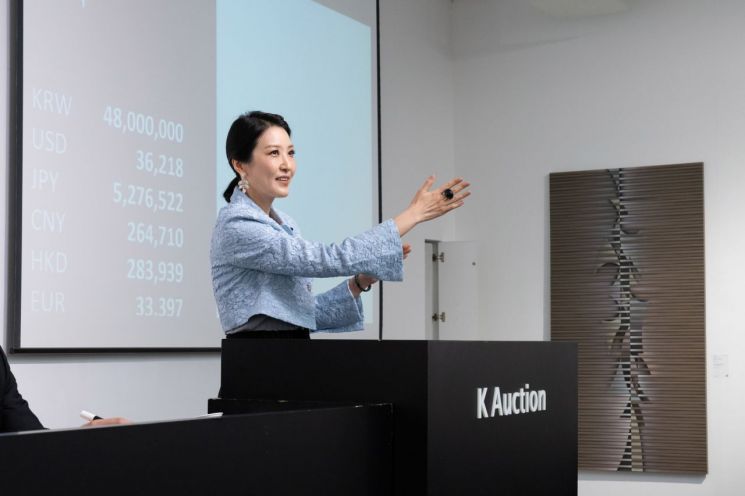
▲ I noticed that the sound of the auction gavel at the auction site is particularly crisp. Is it a personal collection?
- It is company property. It is a specially made auction gavel and auction board produced by the company 18 years ago. At that time, the chairman specially ordered it to be made from paulownia wood. We keep two gavels in case one is lost. In the past, during a Hong Kong auction, after the auction ended, the onsite items including the gavel were sent by sea instead of by plane, and they did not arrive until the next Seoul auction. At that time, we urgently purchased a ceremonial gavel and used it in the auction, and I could clearly feel the difference in sound. Since then, we have prepared two gavels in case of loss. In foreign countries, some auctioneers use personal gavels; there are short types like ours, but some use hammer-shaped ones, so there are various types.
▲ I am curious about how you became an art auctioneer.
- My mother majored in art, so I grew up in an environment where I was exposed to many art magazines and artworks from a young age. After graduating from graduate school, I worked at a marketing company, and while studying language in the U.S., I became interested in artworks and vaguely thought about working in the cultural and artistic field. When I returned to Korea, I found out that Hongik University Graduate School of Art had a department of art planning, and you could enter even if you did not major in art as an undergraduate. I studied theory and exhibition-related subjects for two years, and during that time, K Auction offered me a position, so I joined. At that time, I started as a PR officer.
▲ You are still working as both a PR officer and an art auctioneer.
- In my first year at the company, then Chairman Kim Sun-eung encouraged me to apply for the in-house auctioneer recruitment, which led me to enter as an auctioneer. I am grateful that I have been able to combine what I learned from studying journalism and broadcasting with what I learned from art to integrate PR and art auctions and continue to this day.
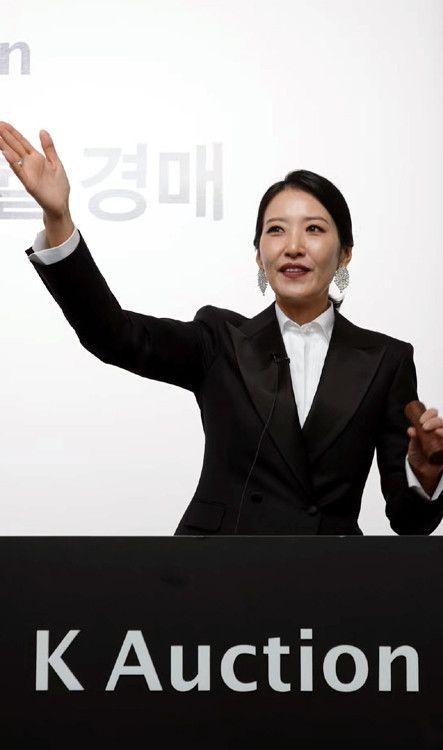
▲ Is there a particular reason why art auctioneers are trained within the company without a separate major?
- In France, there is a license system, but in Korea and most other countries, art auctioneers are trained within the company. The public only sees the auctioneer on the auction day and may think that auctioneers can work freelance like MCs, but to conduct the auction smoothly, the auctioneer shares many processes with the team members beforehand. This includes information about the artworks, clients, and employees. For example, I have information about clients cared for by each staff member, and if I know the tendencies of a particular employee, I can read their expressions and estimate whether I can raise the price further or conduct the auction well. Since auctions are team plays where all internal information is shared, auctioneers cannot be freelancers, and it is common for companies to select and train them internally.
▲ How many art auctioneers are currently active in Korea?
- At K Auction, there are currently three including myself, and I know that Seoul Auction also has three active auctioneers. I know there are a few other auction companies, but they mainly conduct online auctions, so if you consider one auctioneer per company, I think there are fewer than ten in total.
▲ You have been active as an auctioneer for 16 years. How many auctions and artworks have you handled so far?
- I recently had a chance to count, and I have conducted a total of 104 auctions. I haven't counted the artworks, but if you assume 100 pieces per auction, it would be about 10,000 pieces in total.
▲ You always mention the work 'Toewoo Teacher's Letter' as the most impressive artwork.
- It is probably more memorable because it set the highest price for Korean traditional art. It started at 2.6 billion KRW and was finally sold at 3.4 billion KRW, with fierce competition between onsite clients and two phone bidders. Another deeply impressive work was Kim Whanki's 'Silence 5-IV-73 #310,' which set the highest price in the art market at 6.55 billion KRW during the 2017 auction.
▲ Foreign star auctioneers are known to receive high performance bonuses based on results. How is it in Korea?
- Since we belong to a company, we are salaried employees like regular office workers. (laughs) Even if transactions increase or 100% of lots are sold, salaries do not increase nor are performance bonuses given.
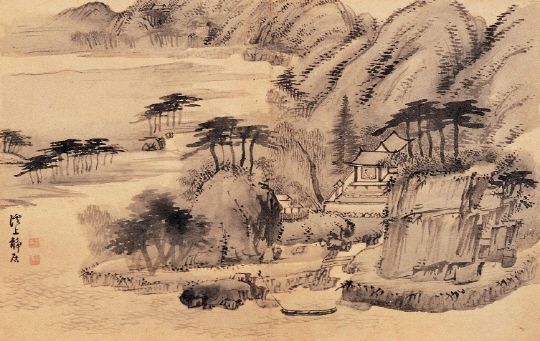 Director Son named 'Toeuinseonsaengjinjeok' as the most impressive work at the auction. The piece, sold for 3.4 billion won, made headlines by setting a new record for the highest price in Korean traditional art at the time. The winning bidder was a telephone bidder, later revealed to be the Samsung Foundation.
 [Photo by K Auction]
▲ Have you developed any habits or routines from working as an auctioneer?
- First and foremost, voice care. Since the voice is vital, colds are the enemy. Especially during seasonal changes, I pay extra attention to voice care. When I first participated in auctions, I focused only on not making mistakes with bids. Numbers like 140 million or 620 million that come up at auctions are not words we often say in daily life, and mistakes at the site can lead to major accidents, so I repeated them until they became familiar. Bidding is basic, but at the site, you also need flashy gestures, observe the sales staff's eyes and clients' reactions, and read whether to bid or give up, so I have become more perceptive. Since appearance that gives trust and favor to clients, accurate pronunciation, and tone are important during auctions, I always pay attention to health and diet management.
▲ What advice would you give to someone trying art auctions for the first time?
- I want to say, don't rush to buy artworks. You need to understand your taste over a long time and grasp the big trends in the market. Of course, if you are buying just as an enthusiast, you can buy what you like within your limits. However, as times change and the value of artworks as assets is considered, perspectives have changed. The art market is part of capitalism, and getting a feel for price fluctuations is similar to predicting stocks. If you approach it from an asset perspective, I would say artworks are not appropriate. If you approach it from an enthusiastic perspective, you can buy, but I advise not to buy hastily.
© The Asia Business Daily(www.asiae.co.kr). All rights reserved.



















