Despite Record High Sales Last Year,
Rising Costs and Voluntary Retirement Expenses
Result of Large-Scale Investment in Digital Transformation
Kyobo Book Centre, the largest bookstore chain in South Korea, has posted losses for two consecutive years. Although sales reached an all-time high last year, the company could not cope with the soaring cost increases during the COVID-19 period and the surge in large-scale investment expenses. Kyobo, which has stood tall as Korea’s representative bookstore for 44 years since its establishment in 1980, is now facing its greatest crisis ever. Kyobo Book Centre explained that the losses last year were at the expected level, attributing them to one-time costs from the company’s first-ever voluntary retirement program and large-scale investments for digital transformation.
According to Kyobo Book Centre’s audit report for last year, disclosed on the Financial Supervisory Service’s electronic disclosure system, the company recorded an operating loss of 36 billion KRW last year, continuing its losses for the second consecutive year. Kyobo Book Centre had posted an operating loss of 13.9 billion KRW in 2022, marking its first deficit in nine years since 2013. Last year, sales surpassed 900 billion KRW for the first time in history, reaching 901.4 billion KRW, an 8.3% increase from 832.4 billion KRW in 2022.
However, the company could not overcome the burden of rising costs and increased operating expenses. Cost of goods sold increased by about 45 billion KRW last year, and selling and administrative expenses rose by 46.7 billion KRW from 245.1 billion KRW in 2022 to 291.8 billion KRW last year. Specifically, retirement benefit expenses increased by 15.6 billion KRW from 5.5 billion KRW in 2022 to 21.1 billion KRW last year. Depreciation expenses also rose by 9.2 billion KRW compared to 2022.
Kyobo Book Centre explained that the large increase in retirement benefit expenses was due to a large-scale voluntary retirement program implemented last year following its merger with Hottracks. The company conducted its first-ever voluntary retirement program since its founding in 1980, targeting employees aged 40 and above with more than 10 years of service. The increase in depreciation expenses was attributed to large-scale investments for digital transformation, according to Kyobo Book Centre.
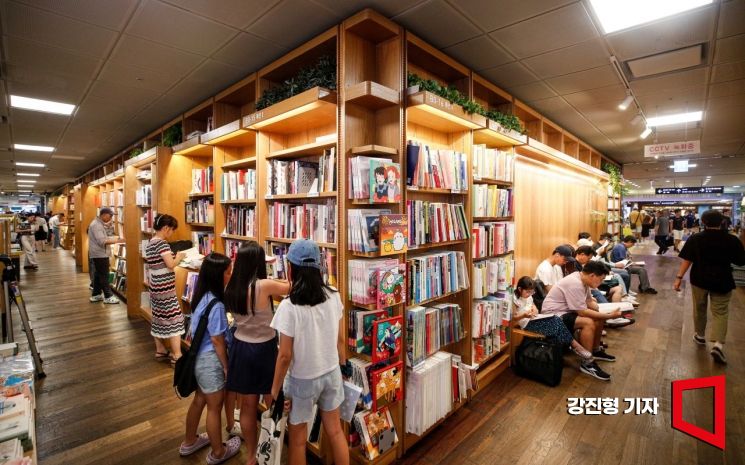 On the 7th, as the heatwave continues nationwide, citizens visiting Kyobo Bookstore Gwanghwamun Branch in Jongno-gu, Seoul, are escaping the heat by reading. Photo by Jinhyung Kang aymsdream@
Kyobo Book Centre relocated its data center from Namsudong, Jongno-gu to Songdo and began full-scale operations in November last year. It also significantly expanded its existing logistics center in Bugok-ri, Paju, and installed advanced automation equipment. Jin Young-kyun, Brand Management Team Manager at Kyobo Book Centre, said, "These are essential measures to strengthen technological infrastructure and security in line with the digital era," adding, "Last year’s operating loss resulted from investments to strengthen the company’s soundness and future growth." He also added, "The scale of the deficit was as expected, and we aim for better performance this year."
As the number of people reading e-books increases, the cultural focus of reading books in South Korea is rapidly shifting from offline to online. Kyobo Book Centre, which has been primarily operated as an offline bookstore, is undergoing a process of adapting to these changes. However, even considering these era-driven changes, the deterioration of Kyobo Book Centre’s performance inevitably leaves a bittersweet feeling for Koreans. This is because Kyobo Book Centre is recognized as a representative knowledge and cultural space in Korea, to the extent that the Seoul Metropolitan Government designated the Kyobo Book Centre Gwanghwamun branch as a Seoul Future Heritage site in 2022.
Kyobo Book Centre was established in 1980 by Shin Yong-ho, the founder of Kyobo Life Insurance, who aimed to increase the number of book readers and foster a reading culture. At the time, many opposed the establishment of the bookstore, saying it would not be profitable. However, Chairman Shin insisted that profits would be made through Kyobo Life Insurance, and social contributions would be made through the bookstore, pushing forward with the establishment despite potential losses. He was famously known for instructing staff never to give customers any pressure, even if they stood reading books for a long time or browsed without buying. Kyobo Book Centre is a 100% subsidiary of Kyobo Life Insurance. In 2021, Kyobo Life Insurance made a paid-in capital increase of 150 billion KRW in Kyobo Book Centre.
© The Asia Business Daily(www.asiae.co.kr). All rights reserved.

















