Cello Square Provides Customized Services Across All Logistics Areas
"Immediate Response and Proactive Management Are Crucial for Stable Logistics"
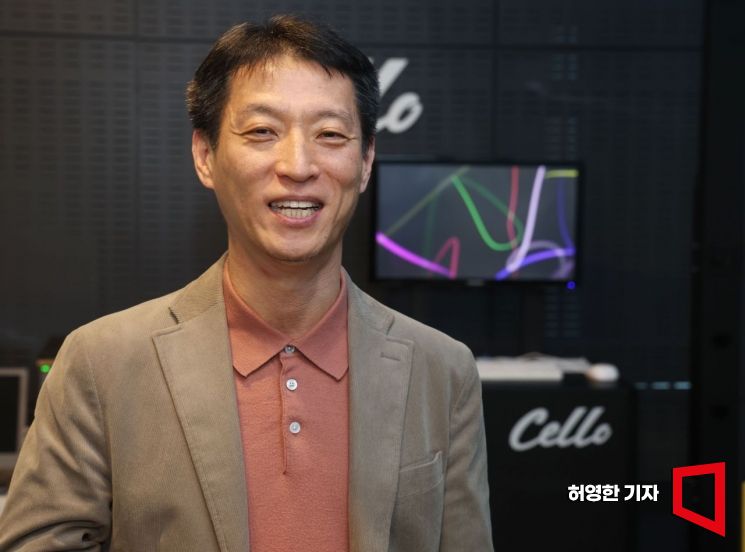 Choi Bong-gi, Head of Cello Square Business Team at Samsung SDS (Executive Director) Photo by Huh Young-han younghan@
"Logistics is fundamentally a business that must embrace risk. Therefore, immediate response and proactive risk management are crucial."
Following the Ukraine war and geopolitical risks in the Middle East, recent earthquakes in Taiwan have continued to pose global logistics risks. Logistics disruptions mean that corporate activities come to a halt. The demand from companies for securing stable supply chains remains steady. In response, Samsung SDS has been building the digital logistics platform Cello Square since 2015 by utilizing IT technology. It provides customized services across all areas of import and export logistics, from quotations to transportation reservations, transportation and customs clearance, tracking, communication, and settlement.
Choi Bong-gi, Head of the Cello Square Business Team at Samsung SDS (Executive Director), explained, "With global cargo volumes increasing due to e-commerce and other factors, it is becoming difficult to judge the variables that may arise in logistics. When an issue occurs, we identify alternatives and avoid risks through existing business experience and real-time tracking."
For real-time monitoring and response, which is the core of Cello Square, the role of the Global Control Center (GCC), similar to a military 'command and control room,' is essential. On the world map displayed on the GCC screen, the locations of Samsung SDS customers' cargo are shown moment by moment. These vessels are categorized as risks, variables, or ships. Risks are indicated when issues such as earthquakes, droughts, political events, or strikes that could affect logistics are likely to occur. Artificial Intelligence (AI) filters global English news articles to select content that may impact customers. Variables refer to actual disruptions such as delays, cargo damage, or theft. Ships are displayed when arrival times are delayed beyond the schedule, classified into three grades. The highest grade is assigned if the difference exceeds two weeks from the expected arrival time.
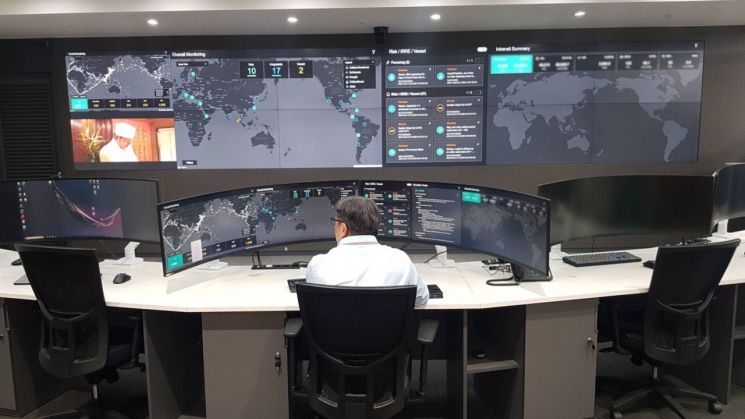 An employee at Samsung SDS Global Control Center (GCC) is checking the ship status.
 [Photo by Samsung SDS]
The Global Control Center also separately notifies ships that may be affected by specific incidents. When a magnitude 7 or higher earthquake occurred in eastern Taiwan on the 3rd, related alarms were confirmed. Ships operating near Taiwan, as well as in Southeast Asia and straits near Japan, appeared on the screen. Information analyzing ships scheduled to arrive in Taiwan during the ongoing earthquake aftermath was also provided. Additionally, real-time statuses of trucks operating in the US and Europe, and the amount of cargo stored at ports, were also monitored.
Executive Director Choi said, "There are areas in the logistics industry where highly advanced IT technologies have not yet been applied, so there are domains to be utilized in the future. The introduction of AI systems for cost reduction through efficient loading and routing will also become a key topic."
Cello Square initially targeted domestic companies but expanded its service areas to China, Vietnam, and other regions in 2022. Since last year, it has also started operations in India, the US, and Europe. The number of registered customers has surpassed 11,100. Samsung SDS plans to expand the service to 30 countries cumulatively. Executive Director Choi stated, "In the past, transportation was simply done by ships, but due to US-China relations and geopolitical issues, alternative means and routes are emerging. We are creating alternatives by combining past experience with new services to help reduce logistics costs and uncertainties for our customers."
© The Asia Business Daily(www.asiae.co.kr). All rights reserved.
![Clutching a Stolen Dior Bag, Saying "I Hate Being Poor but Real"... The Grotesque Con of a "Human Knockoff" [Slate]](https://cwcontent.asiae.co.kr/asiaresize/183/2026021902243444107_1771435474.jpg)












