With the April 10 general election just six days away, the possibility of last-minute unification of conservative candidates is being discussed, mainly in the Seoul metropolitan area. There is a forecast that attempts to unify candidates will occur in some regions where the vote difference between ruling and opposition candidates is not significant.
The most closely watched area is whether Lee Jun-seok, the Reform New Party candidate running in Hwaseong-si Eul, Gyeonggi Province, and Han Jeong-min, the People Power Party candidate, will unify. Currently, both sides publicly express a negative stance on unification, but the need is being raised mainly among conservative voters in the district. This is based on the judgment that if the support rates of Lee, who is in second place, and Han, who is in third place, are simply combined, they could compete within the margin of error against Gong Young-woon, the first-place candidate from the Democratic Party.
According to a survey commissioned by SBS to Ipsos (IPSOS) from March 31 to April 2, 503 men and women aged 18 or older residing in the Hwaseong-si Eul electoral district in Gyeonggi Province were asked, "If tomorrow were the general election voting day, who would you vote for?" The results showed Gong Young-woon of the Democratic Party at 47%, Han Jeong-min of the People Power Party at 18%, and Lee Jun-seok of the Reform New Party at 27%. The combined support rate of the two conservative candidates reaches 45%. The survey has a sampling error of ±4.4 percentage points at a 95% confidence level. The response rate was 14.1%, and the survey method was wireless telephone interviews (using virtual numbers provided by telecom companies), selecting respondents through wireless virtual number extraction after allocating by gender, age, and region. Detailed information can be found at the Central Election Survey Deliberation Commission.
Unification is also being discussed between Yoo Kyung-jun of the People Power Party and Lee Won-wook of the Reform New Party, both running in Hwaseong-si Jeong, Gyeonggi Province. On the 4th, Yoo said on BBS Radio regarding unification with Lee, "There are issues that need to be reviewed at the party level and agreements that must be made between candidates, so we have to see it through to the end, but I intend to have a conversation in the spirit of mutual respect," leaving room for possibility.
However, Lee expressed displeasure at even mentioning unification. On the same broadcast, he said, "It’s ridiculous. I never even imagined it," and raised his voice, saying, "Aren’t the major parties trying to eliminate our small party rather than thinking about how to help us? They should be ashamed."
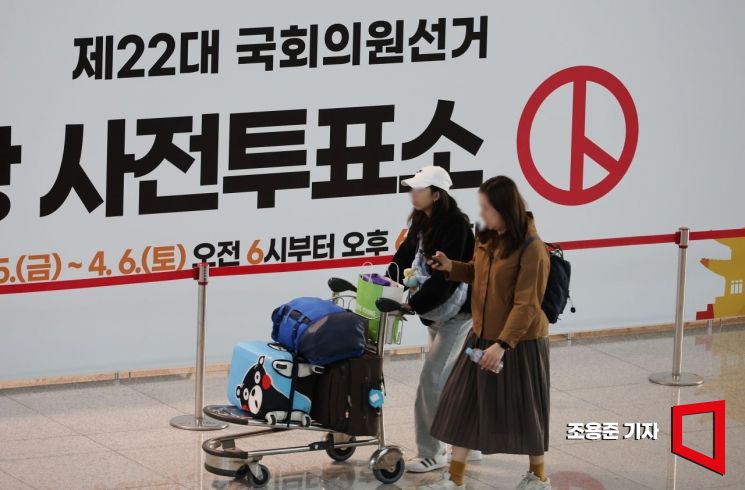 On the 4th, one day before the early voting for the 22nd National Assembly election, election commission staff are preparing to set up polling stations at Incheon Airport Terminal 1. Photo by Jo Yongjun jun21@
Legitimacy Undermined by Conservative Unification, Variable of Securing Proportional Seats
The reason the Reform New Party is more negative about unifying conservative candidates than the People Power Party in this general election is closely related to securing proportional representation seats in the National Assembly. Even if they succeed in unifying conservative candidates and win in the district, there is no guarantee that the party vote share will correspond. In particular, the Reform New Party calculates that if the party vote share declines due to candidate unification, it could negatively affect the expected proportional representation seats. A Reform New Party official said, "Before simply unifying candidates in specific districts, the party-level costs and benefits must be considered, so the possibility (of unification) is unlikely."
The synergy of unification cannot be guaranteed either. The arithmetic sum based on support rate surveys does not guarantee actual candidate and party vote shares. This was confirmed when the Reform New Party and New Future Party merged early after their founding, yet their support rates did not reach the combined results of the two parties. In particular, it is pointed out that unification does not align with the Reform New Party’s founding value of judging the Yoon Seok-yeol administration.
However, some in the political world are hoping for a dramatic last-minute unification of conservative candidates in some metropolitan areas. This is because Yang Hyang-ja, the Reform New Party candidate running in Yongin Gap, Gyeonggi Province, previously indicated a willingness to hold a unification primary with her district rival, Lee Won-mo of the People Power Party. Although the party drew a line by saying Yang’s remarks were merely political rhetoric, the conservative camp places weight on the need to unite even one vote to win the general election.
© The Asia Business Daily(www.asiae.co.kr). All rights reserved.

















