Minsheng Forum Economic Sector Follow-up Measures Review
"Allow Employment of Foreign Residents in Domestic Household and Childcare Fields"
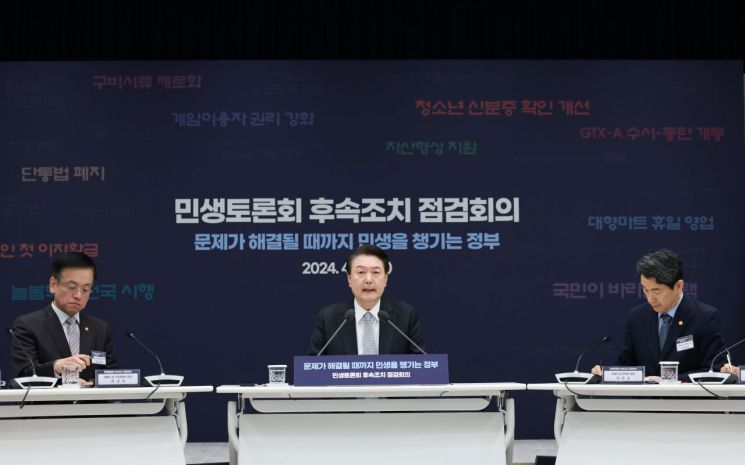 President Yoon Suk-yeol is speaking at the 2nd follow-up meeting on the economic sector after the public livelihood discussion held at the Yongsan Presidential Office building in Seoul on the 4th. [Image source=Yonhap News]
The income criteria for the Buttress Jeonse Loan, which helps ordinary citizens prepare funds for jeonse deposits, will be significantly relaxed. For newlyweds, the combined spousal income standard, previously 75 million KRW, will be raised to 100 million KRW. The combined spousal income standard for special loans for households with newborns will also be significantly increased from 130 million KRW to 200 million KRW. Additionally, measures will be put in place to allow foreign international students and marriage immigrant families residing in Korea to work in domestic housekeeping and childcare sectors.
On the morning of the 4th, President Yoon Suk-yeol held an "Economic Sector Follow-up Measures Review Meeting on the Livelihood Discussion" at the Freedom Hall of the Presidential Office, under the theme "A government that takes care of people's livelihoods until problems are resolved," and announced plans to strengthen housing support for youth. This meeting was organized to review the implementation of practical tasks and future plans in the economic sector, following the social sector meeting held on the 2nd.
Regarding the Buttress Jeonse Loan, President Yoon stated, "There are criticisms from young people that some government support programs act as a marriage penalty for newlyweds," and added, "This time, we will definitely change that." Accordingly, the income criteria for the Buttress Jeonse Loan for newlyweds will be raised from 75 million KRW to 100 million KRW; the combined spousal income standard for special loans for newborn households will be increased from 130 million KRW to 200 million KRW; and the combined spousal income standard for the Earned Income Tax Credit will be raised from 38 million KRW or less to 44 million KRW or less.
President Yoon explained, "The individual income criterion to qualify for the Buttress Jeonse Loan is 50 million KRW per year, but for newlyweds, the combined standard is 75 million KRW, which often causes couples to delay marriage registration to qualify for the loan," and added, "From now on, the income criterion for newlyweds will be raised to a combined total of 100 million KRW, with 50 million KRW per person."
To ease the burden on dual-income couples, active measures will be taken to allow foreign international students and marriage immigrant families residing in Korea to work in housekeeping and childcare fields. President Yoon emphasized, "Above all, it is important to reduce the childcare burden on dual-income couples," and urged, "The Ministry of Justice, Ministry of Employment and Labor, and other related agencies should actively establish measures so that foreigners residing in Korea can be trusted by parents to take care of their children."
President Yoon added, "Allowing the 163,000 foreign international students and 39,000 marriage immigrant families already residing in Korea to work in housekeeping and childcare sectors is an effective method," and noted, "Employment within households will not be subject to minimum wage restrictions, and a flexible market will be formed according to supply and demand."
Furthermore, President Yoon instructed the Ministry of Employment and Labor to establish a "Department for Supporting Unorganized Workers," emphasizing that the state must take an interest in and directly manage the rights and interests of unorganized workers who are not members of labor unions.
President Yoon stated, "We plan to complete the revision of subordinate laws and regulations that the government can handle by the first half of the year at the latest, and finish all by the end of this year," and added, "We will do our best to ensure that livelihood bills pending in the National Assembly are passed within the term of the 21st National Assembly, and bills discussed in the livelihood discussion will be prepared as quickly as possible and submitted immediately after the formation of the 22nd National Assembly to ensure swift passage."
© The Asia Business Daily(www.asiae.co.kr). All rights reserved.

















