Government and Local Governments Participate in 'Railroad Undergrounding Integrated Development Council Inauguration Ceremony'
Seoul City Announces Competitiveness Enhancement through 'Future-Oriented Hub Spaces' and 'Open Spaces'
Internal Discussions Begin on Basic Development Plans for Areas Surrounding Railroad Undergrounding
Feasibility Study for Six Urban Ground Railroad Lines Totaling 71.6km Underway
The government's 'Railroad Undergrounding Project,' which aims to underground aboveground railroads and utilize the upper levels, has entered full swing. A council composed of the government, local governments, public institutions, and research organizations has been launched to begin the process of selecting pilot project sites. In Seoul, where the most project sites are expected to be included, discussions on upper-level development plans have already started.
On the afternoon of the 4th, Seoul Mayor Oh Se-hoon will attend the 'Railroad Undergrounding Integrated Development Council Launch Ceremony' held in the Yongsan-gu area. The council was established to explore ways to underground aboveground railroads and innovatively recreate urban areas divided by railroads.
At the government level, work has begun on establishing the 'Comprehensive Plan for Integrated Railroad Undergrounding Development.' This is a de facto top-level plan that includes criteria for selecting target projects, directions for upper-level development, and funding procurement methods. In this process, the current status of domestic railroad sites and domestic and international cases of railroad undergrounding will be reviewed to prepare evaluation criteria for route selection.
The target routes include those proposed by local governments and some sections of the Gyeongbu Line, Gyeongin Line, and Gyeongwon Line, which the government is promoting. In particular, Seoul plays the largest role, as six national railroad sections (71.6 km), including the Gyeongbu and Gyeongin Lines, are being discussed as target sites. Proactive measures have also been taken. The railroad undergrounding project was selected as a way to increase land-use efficiency in existing urban areas, and last month, Seoul began exploring development possibilities for the entire aboveground national railroad sections and surrounding areas.
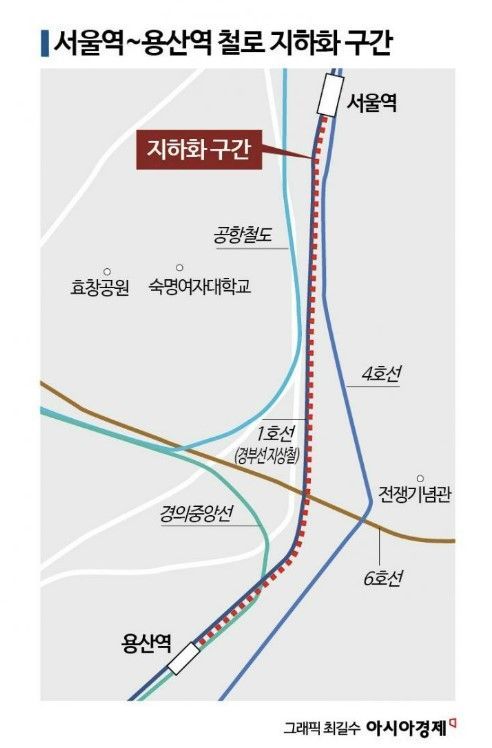
According to Seoul City, the target sites include six national railroad sections (71.6 km) such as the Gyeongbu, Gyeongin, Gyeongwon, Gyeongui, Jungang, and Gyeongchun Lines, and there is also a possibility of reviewing four urban rail lines (Lines 2, 3, 4, and 7) covering 29.6 km. Among these, the core sections are Seoul Station and Yongsan Station. Seoul is currently referencing domestic and international cases such as the 'Paris Rive Gauche Project,' which created an artificial ground connecting the 13th district slum and the Seine River to restore urban vitality through railroad undergrounding.
By the first half of the year, a spatial plan for the entire railroad section will be established, and a proposal for the projects to be prioritized will be submitted to the Ministry of Land, Infrastructure and Transport by September. Since the Ministry of Land, Infrastructure and Transport, which holds the key, has expressed a stance of 'partnering first with local governments that are well-prepared in advance,' it is understood that Seoul plans to quickly prepare not only feasibility analyses but also concrete directions for upper-level development and consult with the ministry.
Individual districts have also begun to move. In addition to Yongsan-gu, which owns the Seoul Station and Yongsan Station sections, Yeongdeungpo-gu (around the 3.4 km aboveground Gyeongbu Line section from Daebang Station to Sindorim Station) and Guro-gu (including the 5.6 km section from Guro Station to Onsu Station) are preparing discussions on upper-level development plans resulting from the railroad undergrounding project. A Seoul city official said, "Since this is a choice to solve various problems such as regional division, lack of available land in the city center, and noise, we will continue to respond step-by-step to the government project and consider ways to enhance feasibility."
© The Asia Business Daily(www.asiae.co.kr). All rights reserved.

















