The price of gold, a representative safe-haven asset, surpassed $2,300 per ounce for the first time in history. This surge reflects its heightened presence as a hedge amid concerns that inflation will not easily slow down. Jerome Powell, Chairman of the U.S. Federal Reserve (Fed), maintaining a broadly dovish stance on interest rate cuts also fueled demand for gold investments.
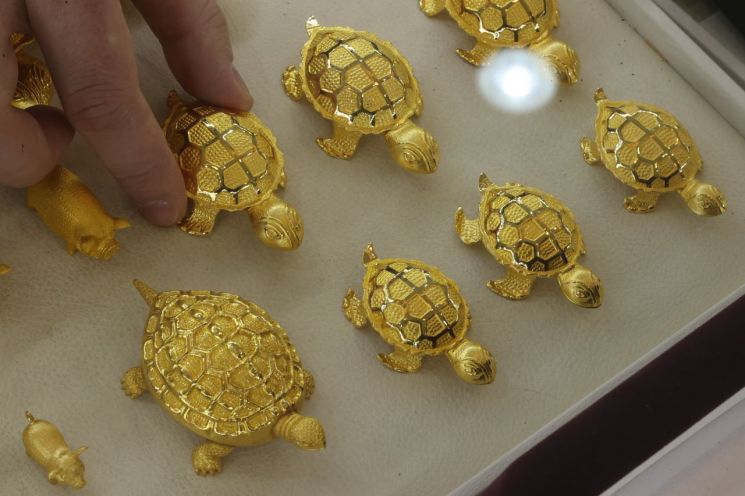
On the 3rd (local time) at the New York Mercantile Exchange, June delivery gold futures rose $33.2 (1.5%) from the previous session to trade at $2,315.0 per ounce. This is the first time gold has broken through the $2,300 per ounce level. During the session, gold futures even briefly exceeded $2,320.
Since the beginning of the year, gold prices have continued a double-digit rise due to expectations of interest rate cuts by the Fed and other central banks worldwide, geopolitical risks, and purchases by central banks mainly in China. Recently, the release of inflation data that stoked concerns about the ‘last mile’?the final stretch before reaching targets?has increased attention on gold as a traditional inflation hedge. David Einhorn, founder of Greenlight Capital, appeared on CNBC that day and said, "I think inflation is accelerating again," adding, "In response, we are expanding our gold positions."
Powell’s reaffirmation of the interest rate cut policy also manifested as a relief rally among gold investors that day. In a speech at Stanford University, Powell acknowledged concerns about a rebound in inflation and hinted at cautious monetary policy decisions, but said, "It does not fundamentally change the overall situation." His more dovish-than-expected remarks immediately led to a drop in Treasury yields and a weaker dollar, supporting the rise in gold prices.
Bart Melek, Global Head of Commodity Strategy at TD Securities, said, "This suggests the Fed will cut rates before reaching its inflation target," and evaluated it as "very positive for gold." Tai Wong, an independent metals trader based in New York, also conveyed the mood, saying, "Gold bulls are not worried about Powell’s usual ‘cautious approach,’ and more people have joined gold trading." This indicates a judgment that despite the cautious tone from Powell and other Fed officials, the path to rate cuts within the year will not change significantly.
Additionally, concerns over the excessive U.S. fiscal deficit, combined with inflation worries, have recently contributed to the rise in gold prices. Michael Widmer, Commodity Strategist at Bank of America (BoA), diagnosed, "Investors are increasingly paying attention to gold as a protection mechanism against concerns over the high U.S. debt level," adding, "This will be a focus ahead of the U.S. presidential election in November." Geopolitical risks that previously pushed gold prices higher, such as Russia’s invasion of Ukraine and the war between Israel and the Palestinian armed group Hamas, also continue.
Silver, platinum, and palladium also showed simultaneous upward trends. Silver prices jumped more than 4%, reaching the $27 per ounce level, the highest since June 2021. Platinum and palladium also rose by more than 1% each.
© The Asia Business Daily(www.asiae.co.kr). All rights reserved.
![User Who Sold Erroneously Deposited Bitcoins to Repay Debt and Fund Entertainment... What Did the Supreme Court Decide in 2021? [Legal Issue Check]](https://cwcontent.asiae.co.kr/asiaresize/183/2026020910431234020_1770601391.png)















